Bloomsday Brings Dublin's Past to Life
Each year on 16 June, the city of Dublin undergoes a remarkable transformation, evoking a bygone era. Residents and visitors alike don straw hats tied with ribbons and Edwardian-style clothing to commemorate Bloomsday, the date on which James Joyce set his seminal literary work, Ulysses.
Fans of Joyce acknowledge that Ulysses is a substantial work, spanning approximately 700 pages and containing over 265,000 words. Those who read it from beginning to end are rewarded with a vivid depiction of Joyce's Dublin, as the novel unfolds across various real locations throughout the city.
Among these locations are Sweny's Pharmacy on Lincoln Place, which now operates as a bookshop, and Davy Byrne's pub on Duke Street, which remains in business more than a century later.
For enthusiasts, Bloomsday offers a unique chance to immerse themselves in the novel. Participants dress up—some as characters from the book, others in period-inspired attire—and visit these sites to recreate and recite scenes from the text. The distinctive straw hats adorned with ribbons make Bloomsday celebrants easily recognizable from a distance.
'Changes the whole experience'
Michelle O'Toole crafted her own dress and brought her daughter, Amelie O'Toole Driuex, to experience her first Bloomsday celebration.
"My dress is actually made of an old curtain that I've had for years," she explained. "I cut it into pieces, and have sewn it all together. Even the lace detail is actually a net curtain. The hat I had and I attached some flowers to match my dress and I had this parasol anyway that I wore one year to the races."
Outside Davy Byrne's pub on Duke Street, straw hats were distributed to attendees. Many men wore three-piece suits and bowties, while women donned elaborate hats decorated with large, colorful flowers and long dresses in bright, bold colors.

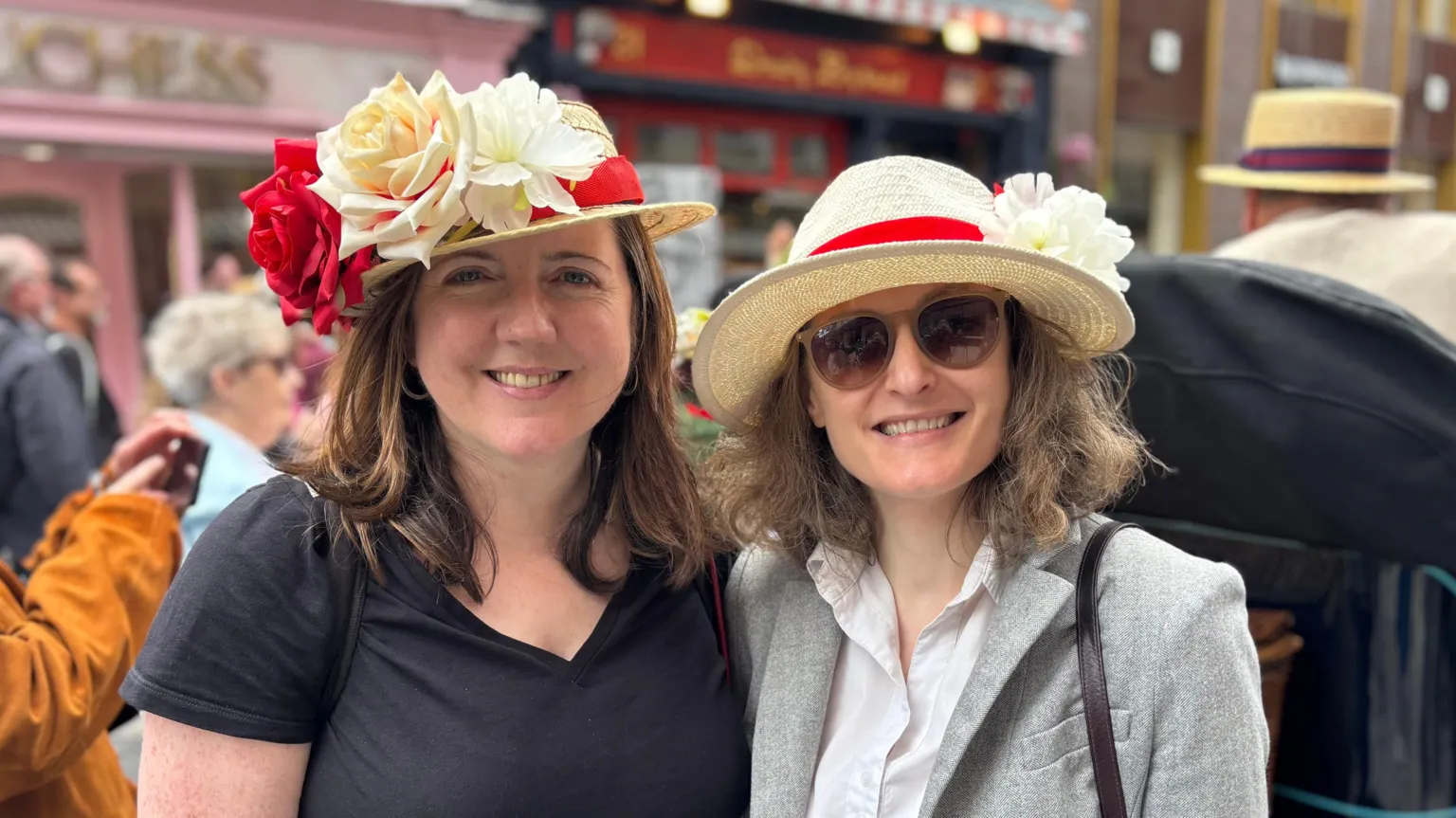
Jennifer Whelan and Claire Devlin shared that they had read the "big book" as part of a book club over nine months.
"It changes the whole experience of living in Dublin because now I walk around and I think, oh, 'Bloom did that there' and 'that's where he ate'," said Devlin. "It feels so real and if you dress up and get really involved in the festivities, it feels even more real - and also people are really nice to you if you're wearing the hat."
Whelan added, "We embellished the hats ourselves, using chicken wire to attach large white and red roses."
What is Bloomsday?
Bloomsday is an annual literary celebration held on 16 June to honor the life and work of author James Joyce. The event is named after Leopold Bloom, one of the main characters in Joyce's 1922 novel Ulysses.
The precise origins of Bloomsday are uncertain. Festival organizers reference a letter Joyce sent to a friend in 1924, two years after the novel's publication, in which he wrote, "there is a group of people who observe what they call Bloom's day." The novel itself takes place entirely on a single day—16 June 1904.
Andrew Basquille, a volunteer at the Joyce Tower and Museum in Sandycove, explained that Joyce had a personal reason for selecting this date.
"The reason that Joyce set it on that date is because that is the date that he had his first date with Nora Barnacle, who eventually became his wife. So all over the city, people have readings, songs associated with the book, reenactments of various episodes."
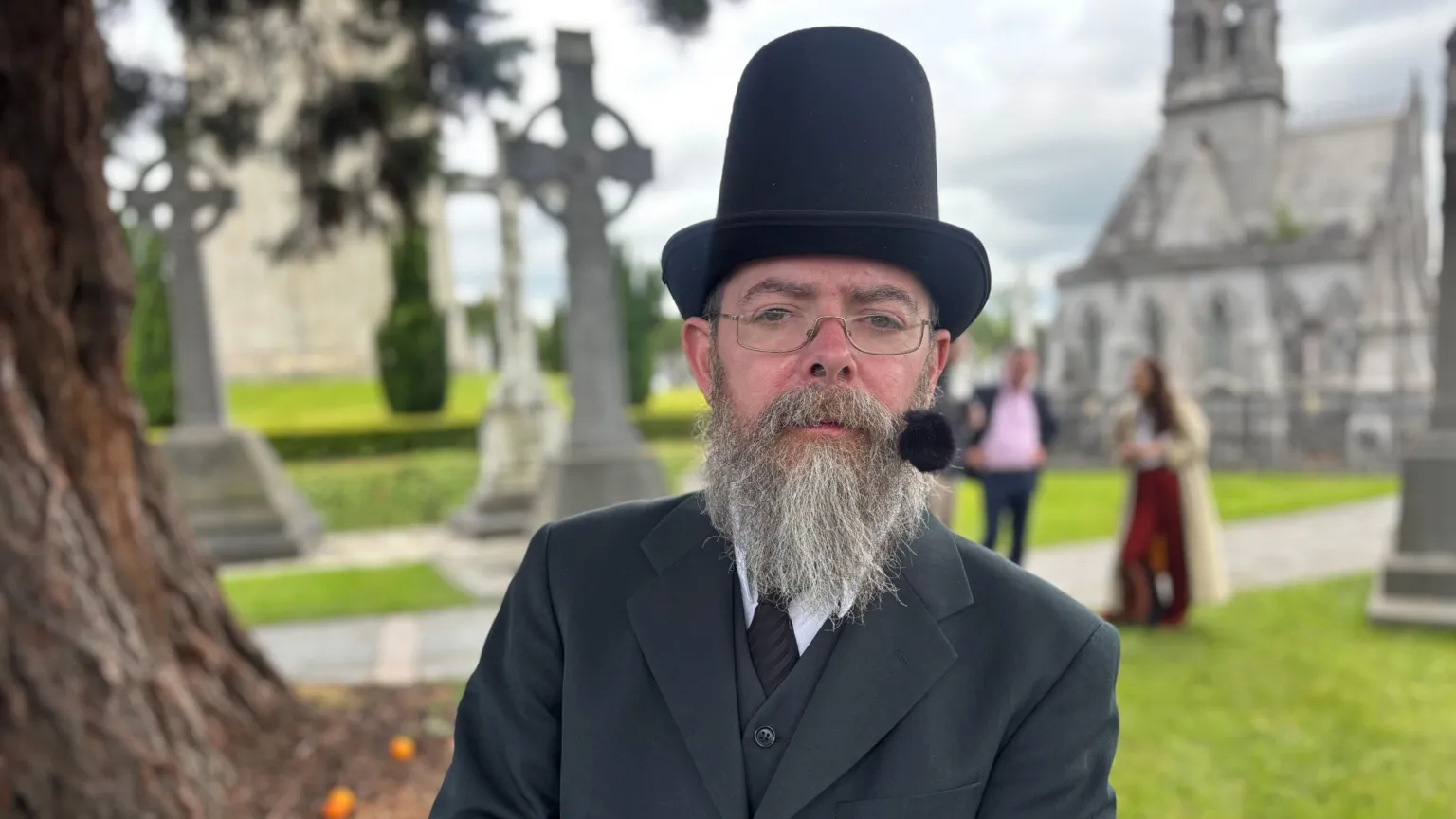
Basquille was present at Glasnevin Cemetery for a reenactment of the funeral of the fictional Paddy Dignam, an event attended by Leopold Bloom in Ulysses. Glasnevin Cemetery is the resting place of more than one million individuals, including Irish revolutionary leaders such as Michael Collins, Arthur Griffith, and Countess Constance Markievicz, all of whom played significant roles in the formation of the Irish State.
Blaise Reid, who participated in the reenactment, has been reading Ulysses for several decades.
"I was given Ulysses for my 21st birthday and I am now 54 and still working through it," he said. "It's an incredible read and it's very complicated in a lot of ways."