

Introduction to the Pavilion
Throughout the summer, the Serpentine Pavilion graces the green carpet of Kensington Gardens, serving as a platform for architectural experimentation akin to haute couture. Over the past 25 years, it has welcomed a variety of visionary architects, from those whose designs resembled a lumber yard explosion to Swiss creators who constructed charcoal-walled hortus conclusus that isolated visitors from the surrounding park landscape.
The Serpentine Pavilion follows a straightforward principle: the chosen architect must not have previously built in the UK, providing an opportunity to highlight emerging or lesser-known talent. The early years featured a constellation of predominantly white male architects creating elaborate self-parodies, but this phase has evolved into a more nuanced era showcasing younger architects from diverse backgrounds.
Lanza Atelier’s Contribution
This year, the pavilion is the work of Lanza Atelier, a Mexico City-based studio founded in 2015 by Isabel Abascal and Alessandro Arienzo. The duo is recognized for reinterpreting and subverting familiar materials and forms through their exploration of craft, technology, and spatial design traditions.
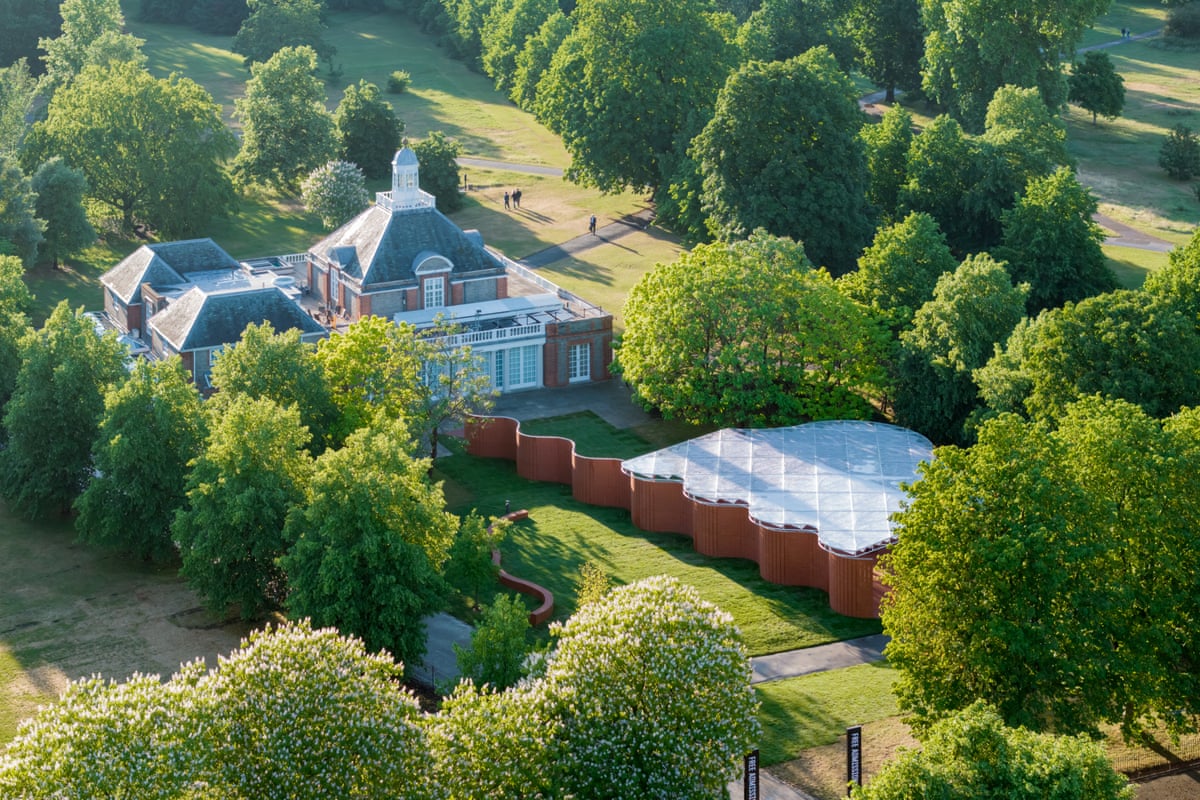
Abascal and Arienzo have embraced simplicity by producing one of the most literal Serpentine Pavilions in recent memory: a serpentine form realized as a wavy wall of rust-coloured brick. This design employs a crinkle-crankle wall, a term describing a distinctive undulating brick wall. Originating in rural Suffolk, these walls were introduced by Dutch engineers in the mid-17th century during marsh drainage projects in the Fens. The Dutch referred to them as slangenmuur (snake walls). Similar walls are also found in Mexico and have been discovered in ancient Egyptian archaeological sites.
Structural and Climatic Benefits
Mathematically, these walls can be described as sinusoidal, while from an engineering perspective, their curvilinear shape offers material efficiency and inherent stability. This form resists lateral forces, allowing construction with only a single layer of bricks without additional buttressing. When oriented on an east-west axis, as in this pavilion, the south-facing side captures sunlight, which historically aided fruit tree cultivation by extending the growing season. Abascal explains,
“They’re structures that temper climate, create shelter and enable growth.”
Reframing the Concept of Walls
In recent times, walls have often been associated with division, notably in reference to President Trump’s proposed US-Mexico border wall. Lanza Atelier’s pavilion offers a contrasting perspective, presenting a wall that attracts rather than divides. Abascal states,
“We’re doing a wall that attracts instead of divides and becomes a gathering place and creates a series of little rooms. A wall doesn’t necessarily need to be built for division.”
The architects embrace the concept of “gentle geometry,” which responds dynamically to those moving through the space. The serpentine shape was inspired by the natural curves of existing tree canopies on the site, as Arienzo notes,
“So that’s where the geometry comes from, understanding the common limits of the site.”
The undulating form also references the Serpentine pond that winds through the park, complemented by a serpentine-shaped bench that acts as a smaller counterpart to the pavilion.

Design and Materials
The pavilion is topped with a flat glass roof supported by a steel grid. Fixed louvres are inset into the roof to deflect the summer sun and provide cooling shade within the interior. The design is straightforward and logical, with the only hint of theatricality being a row of glittering lights along the top of the crinkle-crankle wall.
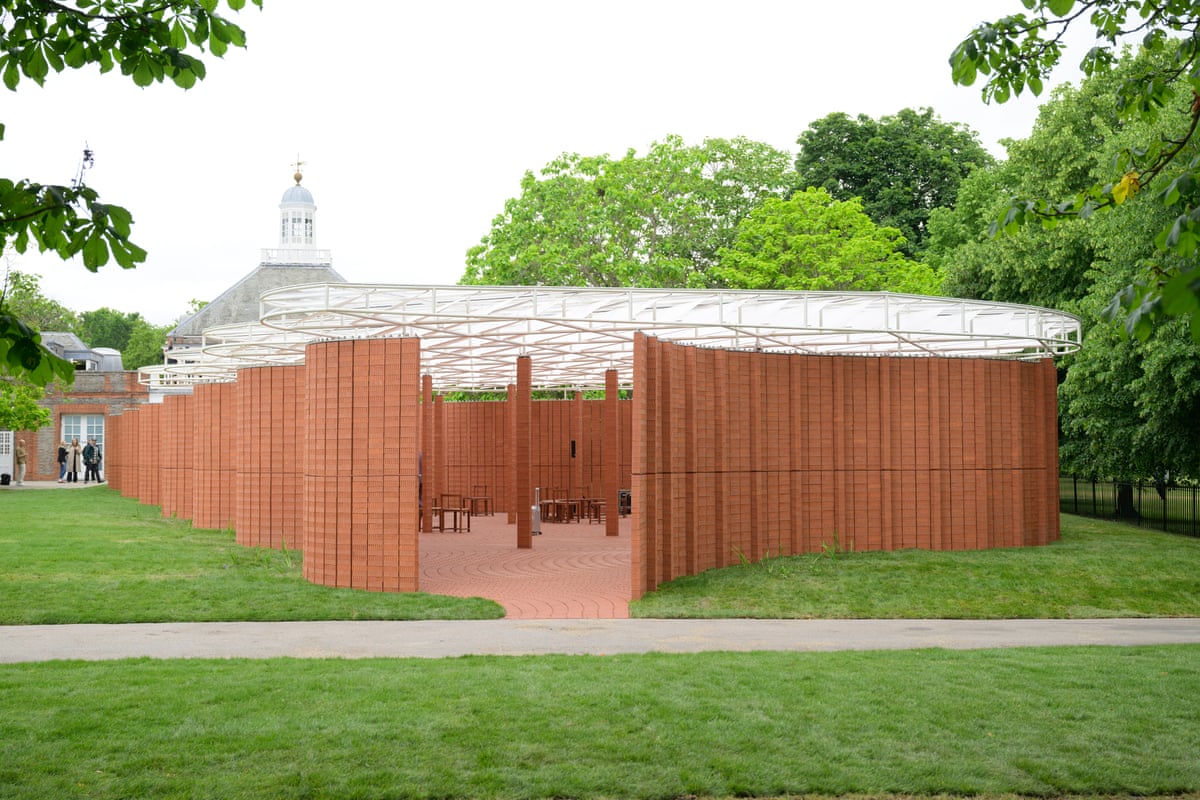
Historically, the Serpentine Pavilion has incorporated diverse materials such as cork, timber, slate, glass, concrete, and even inflatable structures. However, this is the first time brick has been used, a material traditionally considered too permanent and earthbound for a temporary installation.
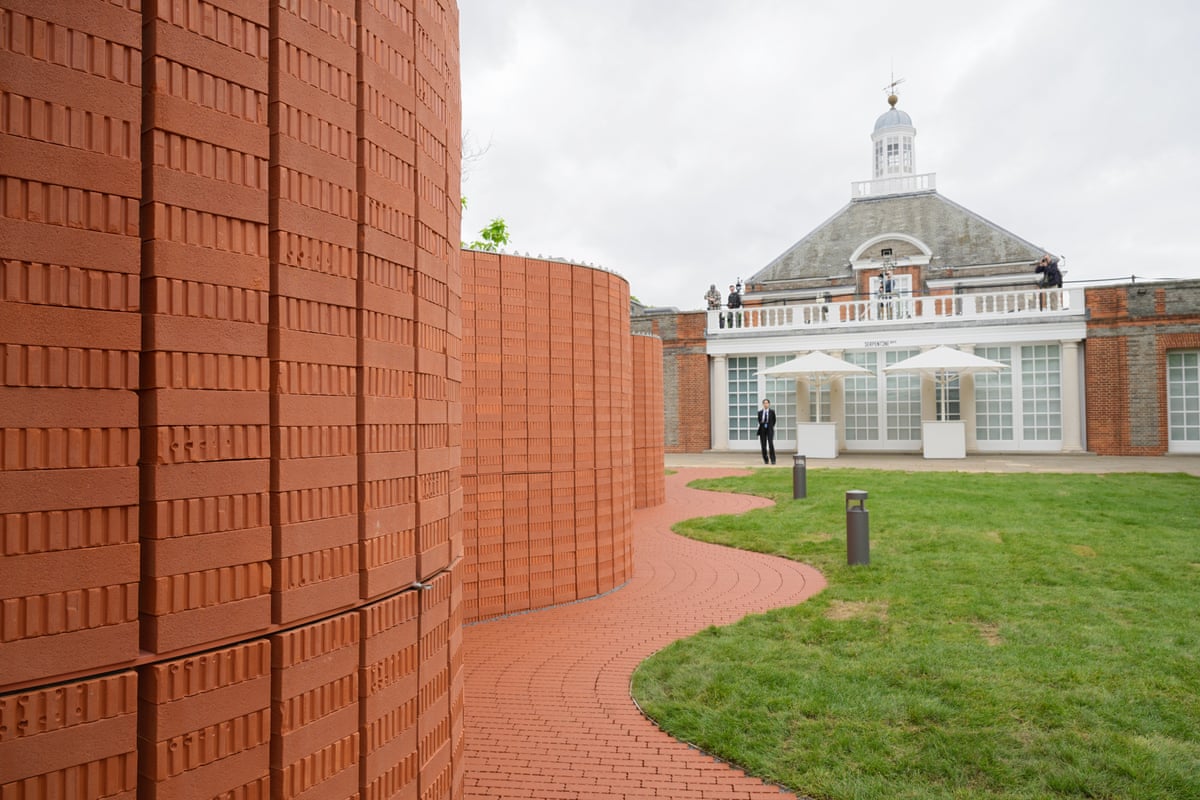
The bricks were manufactured in Surrey at a plant with a history of supplying London buildings. Although standard in size, their ordinariness is transformed by Lanza Atelier’s design. The bricks are set without mortar joints and threaded through reinforcing bars like beads on a chain, facilitating dismantling without damage or waste.
In an unconventional approach, the bricks are laid back to front, with ribbed sides facing outward, adding textural interest and creating a surface resembling woven textile. Normally, the ribs face inward to provide adhesion for mortar.
Contextual and Historical References
Lanza’s undulating brick walls evoke the weathered red brickwork of the nearby 1930s parkland pavilion, as well as the broader South Kensington environment, characterized by Victorian brick mansion blocks and iconic structures like the Royal Albert Hall.
Reflecting on the significance of brick, the pioneering American modernist Frank Lloyd Wright famously remarked,
“Do you know what a brick is? A brick is a small, ordinary, worthless thing that costs 11 cents, but give me a brick and it becomes worth its weight in gold.”
Arienzo concurs, stating,
“A brick is nothing very sophisticated. But once you see it laid down or built in a different way, it sparks curiosity and that makes people enjoy it more.”
As an archetypal building block used for millennia and fitting comfortably in the human hand, brick’s debut at the Serpentine Pavilion after 25 years feels both fitting and overdue.


