

Spain's Defensive Mastery at the 2026 World Cup
Unai Simon has maintained an impressive run of 519 consecutive World Cup minutes without conceding a goal, as Spain remain unbeaten in terms of goals allowed at the 2026 tournament.
An adage often linked to the legendary American football coach Paul 'Bear' Bryant states, "offence sells tickets, but defence wins championships." If this holds true, Spain are positioning themselves strongly to claim the World Cup title.
Under the guidance of Luis de la Fuente, Spain have advanced to the last 16 without conceding a single goal, standing as the only team yet to be scored against at the 2026 World Cup, especially notable after Mexico conceded three goals to England.
Spain are the first European team since Switzerland in 2006 to keep clean sheets in each of their first four World Cup matches. Additionally, having drawn 0-0 with Morocco in their final group game at the 2022 Qatar World Cup, they are on course to become the first team in history to achieve six consecutive World Cup clean sheets.
Their 3-0 win over Austria marked another milestone, as Spain became the first team since Germany in the 2014 final against Argentina to face no shots on target in a World Cup knockout match.
Oyarzabal's Double Secures Comfortable Win Over Austria
Spain's achievements continue to accumulate. Goalkeeper Unai Simon has now surpassed Walter Zenga's long-standing World Cup record of 517 minutes without conceding, as well as Iker Casillas' Spanish record of 476 minutes, which ended when Robin van Persie scored his memorable diving header in 2014.
Simon’s rise has been supported by the consistent confidence of coach Luis de la Fuente, who has maintained his trust in the 28-year-old despite competition from Premier League Golden Glove winner David Raya and Barcelona’s Joan Garcia. De la Fuente and Simon first collaborated when Spain won the European Under-19 Championship in 2015 and reunited with the senior team in 2023.
"I feel proud of him," De la Fuente said after the victory over Austria. "I feel like he is a member of my family. I'm very happy for him."
However, De la Fuente emphasized that these accomplishments reflect the collective defensive effort rather than individual brilliance.
"He played a very big role in the victory, but it's not just about individuals," the Spain manager stated. "It's about the whole group coming together for that defensive effort."
Spain are also approaching another historic record. Switzerland holds the longest streak of consecutive World Cup minutes without conceding at 559 minutes between 1994 and 2010. Should Spain keep Portugal scoreless until the 41st minute of their last-16 match, they will establish a new record.
Statistics indicate Spain have a strong chance of achieving this. No team has managed a shot on target against Spain in the first 75 minutes of any match at this World Cup. Across four games, opponents have combined for only one shot on target in the first half-hour and a total of 10 shots before halftime, averaging 2.5 per first half. If this trend continues against Portugal, Spain could set another World Cup benchmark.
Spain’s defensive strength is further highlighted by the limited opportunities they allow opponents. They lead the tournament in fewest shots faced (19), fewest shots on target faced (3), fewest touches conceded inside their penalty area (30), and lowest expected goals against (xGA) at 0.85. Excluding set-pieces, opponents have generated only 0.62 expected goals from open play, the best underlying defensive statistic among remaining teams.
Opponents are also forced to take low-value shots, with nearly 58% of attempts coming from outside the penalty area, and only 60 passes completed into Spain’s box. This indicates a defence that not only blocks shots but prevents dangerous attacks from developing.

Spain’s control extends far up the pitch. Opponents average just 2.9 passes and 7.7 seconds per possession before Spain regain the ball, among the best figures in the tournament. Spain have allowed only two build-up attacks over four matches and have yet to face a shot following a high turnover, demonstrating their ability to extinguish attacks early.
Defending Through Ball Possession
Spain’s defensive control begins with possession. They lead the World Cup with an average of 68.2% ball possession, forcing opponents to start their possessions further from goal and make less progress upfield than against nearly any other team.
Central to this is Manchester City midfielder Rodri, who has attempted and completed more passes than any player at this World Cup, serving as the metronome ahead of the back four. In possession, Rodri often drops between Aymeric Laporte and 19-year-old Pau Cubarsi to form a back three, reminiscent of Sergio Busquets’ role for Spain over the past decade.
Laporte and Cubarsi have been equally influential. Only two players in the tournament average more interceptions per 90 minutes than Laporte (2.26). The former Manchester City defender boasts a 93% pass completion rate and has provided an assist. Cubarsi, regarded as one of Europe’s top young defenders, has misplaced only 11 of 372 passes, achieving a tournament-leading 97% completion rate among players with at least 300 passes attempted.
These statistics reflect the evolution of the centre-back role. Former Netherlands coach Louis van Gaal noted, "In modern football the two centre-backs have really become the playmakers. The No 10, behind the strikers, can't be called a playmaker any more because the space in which he operates is too restricted."
Pep Guardiola shares this philosophy, emphasizing that defenders need the "best ball-handling skills" to navigate pressure and initiate attacks—an approach central to Spain’s style.
Pau Cubarsi, Aymeric Laporte and Marc Cucurella have formed the backbone of a flawless Spain defence at the 2026 World Cup
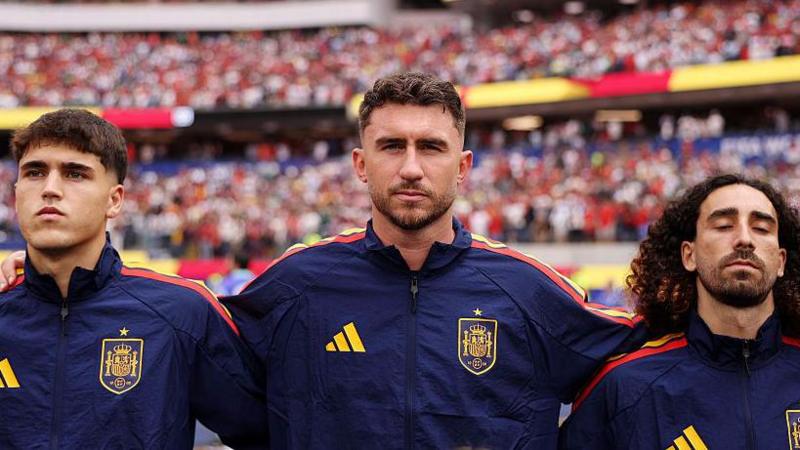
This defensive strength extends across the full backline. Marc Cucurella has combined dependable left-back defending with attacking prowess, becoming the first Spanish player to register two assists in a World Cup match since Javier de Pedro against Paraguay in 2002.
On the right flank, Marcos Llorente and Pedro Porro have shared duties without disrupting Spain’s balance. Llorente, who started against Cape Verde and Uruguay, has recorded an assist and averages 2.5 successful tackles per 90 minutes, second only to Rodri (2.52) among Spanish players.
Porro has scored once, leads Spain with eight chances created and six completed open-play crosses, and averages the most ball recoveries per 90 minutes (seven) among Spain’s outfield players.
Historical Context and Upcoming Challenges
Spain’s greatest World Cup success came in 2010, built on resilience and possession football, conceding only two goals throughout the tournament. Italy in 2006 and France in 1998 also won the World Cup after allowing just two goals, the joint-fewest by any champions.
De la Fuente’s team still faces four matches to emulate those champions, beginning with a challenging last-16 encounter against Portugal. Statistically, however, they are already delivering one of the most dominant World Cup campaigns recorded. If this trajectory continues, history suggests that defence may once again be the foundation for championship success.
- How to watch the World Cup on the BBC and ITV
- Everything you need to know about the World Cup


