

Funding Cut Sparks Outrage Over Lead Pipe Replacement
There is significant outrage among politicians and activists following the US Congress's decision to reduce funding by $125 million for replacing toxic lead drinking water pipes, a critical issue particularly affecting children.
The reduction disproportionately impacts states with the highest concentrations of lead pipes, including Michigan, Illinois, Texas, and New York. This cut was incorporated into a broader government funding bill and is linked to ongoing disputes over funding for Immigration and Customs Enforcement (ICE).
Lead pipe replacement funding had previously received bipartisan approval in 2021. However, Republican leadership on the interior, environment, and related agencies committee, which oversees appropriations, redirected these funds toward wildfire prevention despite objections from many members of Congress.
Numerous US states have called for increased federal funding as millions of Americans continue to consume water contaminated with dangerous levels of lead. Michigan Congresswoman Rashida Tlaib emphasized the urgency of the financial resources in a statement to , noting that her district around Detroit has among the highest levels of lead service lines.
“Our work to rapidly replace every lead service line in America is reaching a critical moment, and this is an insult to every one of our communities struggling for access to clean water,”
said Tlaib, who chairs the Get the Lead Out caucus in Congress.
Republican leadership on the interior committee did not respond to requests for comment.
Lead is recognized as one of the most toxic substances globally. The Environmental Protection Agency (EPA) has stated that no level of lead exposure is safe. The agency has linked lead exposure to lowered IQ scores in children, developmental delays, and increased blood pressure in adults.
According to EPA estimates, removing lead pipes could prevent up to 900,000 infants from experiencing low birth weight, save approximately 200,000 IQ points in children, and avoid up to 1,500 premature deaths annually from heart disease.
This funding cut represents the latest development in what public health advocates describe as a troubling struggle over replacing the nation’s lead water lines. Advocates argue that the issue should enjoy broad bipartisan support and be adequately funded without contention.
President Joe Biden’s EPA has proposed regulations in 2024 mandating the replacement of all lead lines within ten years. However, Republicans have consistently opposed lead line replacement efforts in recent years, partly due to pressure from water utilities that resist the changes.

Replacing lead lines is a complex task due to the sheer number remaining. The EPA estimated in 2024 that up to 9 million lead lines require replacement, although the Trump administration’s EPA controversially revised this figure down to 4 million after altering the methodology.
The $125 million cut is part of the $15 billion allocated for lead service line replacement under the 2021 Infrastructure Investment and Jobs Act, also known as the bipartisan infrastructure law, which was supported by President Biden.
This law mandates the federal government to provide $3 billion annually to states over five years to replace lead service lines, which are the pipes delivering water to homes and businesses. The Trump EPA released the 2025 funding late, with the final $3 billion tranche scheduled for distribution this year.
Erik Olson, senior adviser to the Natural Resources Defense Council Action Fund, commented on the cut:
“You can replace a lot of lead pipes for $125m,”
He called the cut “pennywise and poundfoolish” because multiple studies have shown that the upfront investment in replacing pipes costs significantly less than addressing the health impacts later.
An earlier draft of the bill had proposed a $250 million cut, but House Democrats, led by Rashida Tlaib and Michigan Congresswoman Debbie Dingell—who coordinated a letter to Senate leaders signed by 43 other members of Congress—managed to reduce the cut by half.
The issue is particularly severe in Chicago, where crews have replaced less than 4% of the city’s approximately 400,000 lead service lines. Replacing the remaining lines would require about $3 billion.
Democratic Illinois Senator Tammy Duckworth criticized the Trump administration’s decision, calling it “obscene” to cut funding for clean drinking water projects while increasing funding for ICE, which has conducted aggressive operations in Chicago.
While the $125 million cut represents a small portion of the forthcoming $3 billion tranche, Olson noted that the GOP has made additional cuts to water infrastructure, and the Trump administration proposed a 90% reduction in safe drinking water funding. The conflict over funding continues.
“We are worried about the signal this sends – that lead pipes aren’t a high priority, and once you start clawing back money, it doesn’t bode well for future funding,”
Olson said.
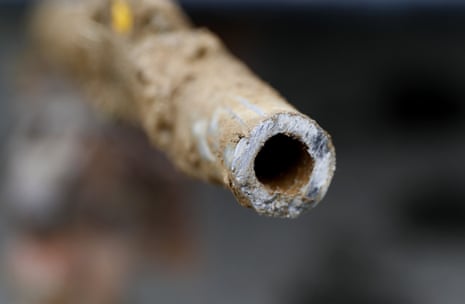
A lead pipe is shown after being replaced by a copper water supply line to a home in Flint, Michigan, on 20 July 2018. Photograph: Paul Sancya/AP


