President Trump's Lengthiest State of the Union Address
President Donald Trump delivered his annual State of the Union address, providing an extensive update on the status of the nation. This address became the longest in history for this event type, featuring a mix of triumphant and occasionally confrontational remarks. Trump praised the efforts of his Republican colleagues and outlined his agenda moving forward.
The State of the Union is traditionally presented to members of the United States Congress, the president's cabinet, Supreme Court justices, the president's family, and other invited guests.
This year's speech occurred amid significant challenges, including escalating tensions with Iran, the Supreme Court's rejection of Trump's global tariffs, and ongoing concerns about affordability in the United States. These issues are critical as they could influence the president's ability to maintain full control of Congress in the upcoming midterm elections.
The following are five major takeaways from Trump's address, delivered to a deeply divided Congress and millions of viewers nationwide.
1. Partial Supreme Court Attendance and Tense Interactions
For the first time publicly since the Supreme Court overturned his global tariffs, President Trump faced members of the Court during the address. Traditionally, the full bench attends the State of the Union, but only four of the nine justices were present: Chief Justice John Roberts, and Justices Amy Coney Barrett, Elena Kagan, and Brett Kavanaugh.
Upon entering, Trump greeted various lawmakers and then the justices seated in the front row. He shook Chief Justice Roberts' hand, a customary gesture, but their exchange was marked by a stoic expression, possibly reflecting lingering tensions from the president's previous criticism of the six justices, including Roberts, who ruled against his tariffs.
During his speech, Trump directly addressed the Court's ruling and his tariff policies, expressing disappointment but with less severity than before. The camera focused on Justice Amy Coney Barrett, nominated by Trump during his first term and also part of the ruling against the tariffs. Barrett maintained a neutral expression as Trump described the decision as "disappointing" and "unfortunate," looking toward the justices seated nearby.
Trump announced plans to pursue alternative legal avenues to enforce his tariff policy, including a new 15% tariff he declared would replace those invalidated by the Supreme Court.
This new tariff was implemented through a proclamation signed under Section 122, a rarely used law that authorizes tariffs up to 15% for 150 days, after which Congressional approval is required.
Trump stated,
"Congressional action will not be necessary,"further asserting that these tariffs would substitute for income tax, a statement that has raised concerns regarding adherence to legal procedures.
2. Democratic Protests and Lawmaker Ejections
Protests from the opposing party have become a recurring feature of Trump's annual addresses. This year, numerous Democrats, including some leaders, abstained from attending the speech, opting instead to participate in rallies in Washington opposing the president and his policies.

The absence of many Democrats was evident inside the chamber, with several empty seats visible on one side of the aisle from various camera angles.
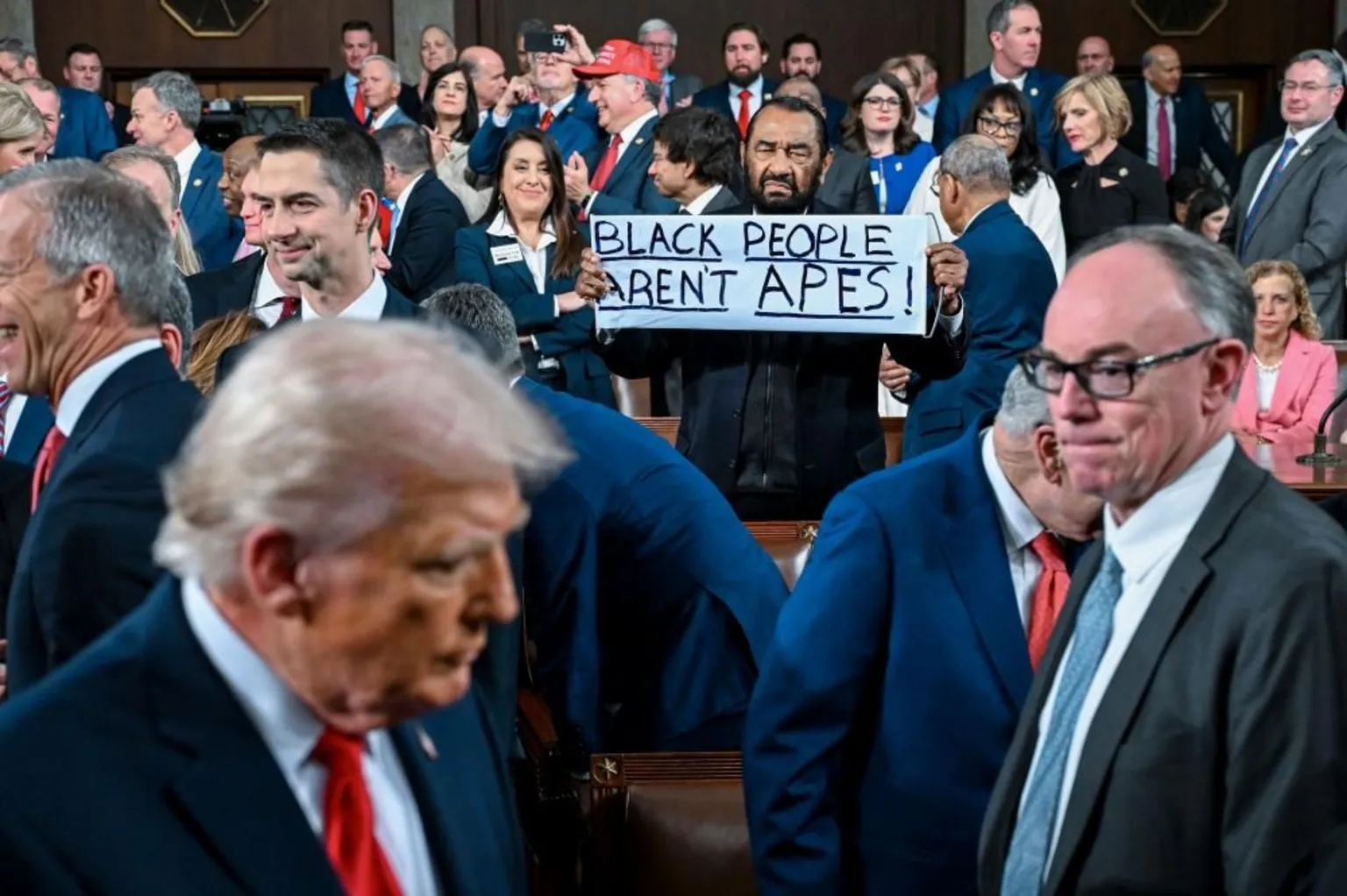
Some Democrats present engaged in vocal protests. Congressman Al Green of Texas was removed from the chamber for the second consecutive year. As Trump entered, Green held a white sign with black lettering stating,
"black people aren't apes!"
The sign appeared to reference a controversial and subsequently deleted video posted by Trump on social media, which depicted former President Barack Obama and former First Lady Michelle Obama as apes.
Due to the sign and Green's shouting, officials escorted him out of the chamber. Green had also been removed last year after shouting during the address.
Congresswoman Ilhan Omar, a Democrat from Minnesota, was also heard repeatedly shouting at the president as he spoke about immigration and alleged fraud within Minnesota's Somali-American communities. She shouted,
"That's a lie, you're a liar,"while Trump spoke over her.
3. A Patriotic Display Featuring the U.S. Men's Hockey Team
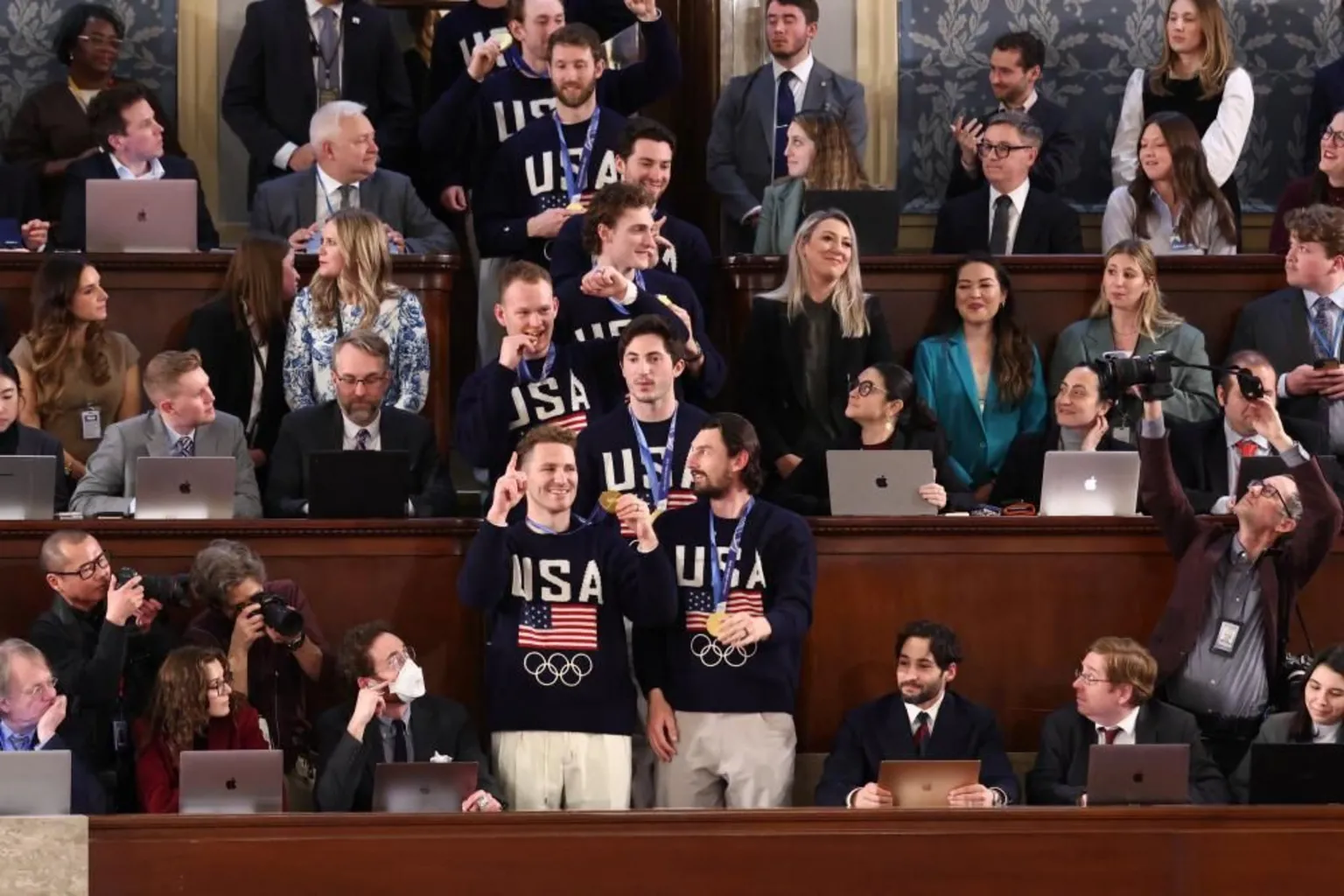
In a dramatic entrance, the U.S. men's hockey team descended into the House chamber from an overhang above where members of the press were seated, eliciting applause and chants of "U-S-A" from the audience.
The team's appearance followed their gold-medal overtime victory against Canada at the Winter Olympics on Sunday, an event that had been teased earlier in the week.
President Trump commended the team's achievement as they stood in the chamber wearing their gold medals. He announced that Connor Hellebuyck, the team's goalie, would be awarded the Presidential Medal of Freedom, the nation's highest civilian honor.
Patriotism was a recurring theme throughout Trump's speech, including references to planned celebrations for the country's 250th anniversary later this summer. However, he also used patriotic themes to highlight divisions within the country.
At one point, Trump asked the audience, largely composed of Congress members, to stand if they agreed with the statement:
"The first duty of the American government is to protect American citizens, not illegal aliens."
Cameras showed Republicans rising to their feet and cheering, while many Democrats remained seated and motionless.
Trump repeatedly noted the lack of Democratic support as he enumerated his administration's accomplishments and policy successes, stating,
"These people are crazy. I'm telling you. They're crazy,"referring to Democrats.