Substack Profits from Far-Right and Nazi Content
The global publishing platform Substack is generating revenue from newsletters that promote Nazi ideology, white supremacy, and antisemitism, according to a investigation.
Substack, which reports having approximately 50 million users worldwide, enables individuals to self-publish articles and charge for premium content. The platform takes about 10% of the revenue generated by these newsletters. Approximately 5 million people pay for access to newsletters on Substack.
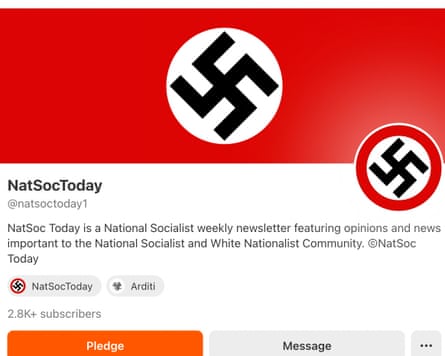
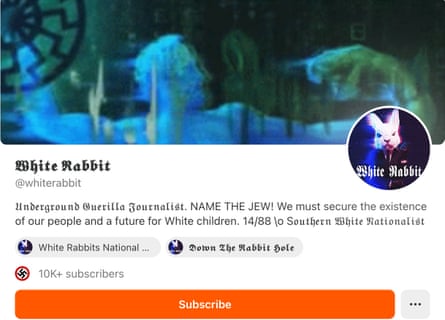
Among these are newsletters openly promoting racist ideology. One such newsletter, NatSocToday, has 2,800 rs and charges $80 (around £60) annually, although most posts are freely accessible.
NatSocToday is believed to be operated by a far-right activist based in the United States. Its profile picture features a swastika, a symbol adopted by the Nazi party in the 1920s to represent white supremacy. The full name of the Nazi party was the National Socialist German Workers’ Party.
One recent post from NatSocToday suggested that the Jewish race was responsible for the Second World War and described Adolf Hitler as “one of the greatest men of all time.” Within two hours of subscribing to NatSocToday for this investigation, the Substack algorithm recommended 21 other profiles with similar content to ’s account.
Many of these accounts regularly share and like each other’s posts and have thousands of followers.
Erika Drexler, a self-described “NS [national socialist] activist” with 241 rs, shared posts praising Hitler as her hero and the “most overqualified leader ever.” This account is also believed to be US-based and charges $150 annually for subscriptions.
Ava Wolfe, who has 3,000 rs and identifies as an “archivist of articles and videos about history in particular WW2,” appears to be UK-based. Her profile features swastikas and other Nazi imagery. An annual subscription to her Substack costs £38.
Much of Wolfe’s content engages in Holocaust denial. Despite approximately 6 million Jews dying in the Holocaust, she falsely claimed earlier this month that doctors found “no one was deliberately murdered by Germans” and that “death was from disease and starvation only.”
It remains unclear whether Drexler and Wolfe use their real identities or pseudonyms to post this material.
Another account, Third Reich Literature Archive, with 2,100 rs, shared postcards purportedly from a Nazi propaganda rally in Nuremberg in 1938, the year before the Second World War began. This account also charges $80 annually for premium subscriptions.
account was shown posts promoting conspiracy theories about Jewish power and influence and suggesting antisemitism was a myth.

The algorithm also promoted other extremist content, including newsletters related to the “great replacement” conspiracy theory, which alleges a plot to replace white Europeans with people from other races.
There has been a sharp increase in antisemitism and Islamophobia since the Israel-Gaza war began in October 2023. In October last year, two men were killed when a synagogue in Heaton Park, Manchester, was attacked on the Jewish holiday of Yom Kippur. In December, fifteen people were shot dead during Hanukkah celebrations at Sydney’s Bondi Beach.
Concerns Over Online Harm and Real-World Violence
Danny Stone, chief executive of the Policy Trust, stated that harmful online content often inspires real-life attacks.
“People can be, and are, inspired by online harm to cause harm in real world,” he said. “The terrorist who attacked Heaton Park synagogue didn’t wake up one morning and decide to kill Jews; he will have been radicalised.
“Algorithmic prompts and the amplification of harmful materials is extremely serious. The Online Safety Act was supposed to address the illegal content but very little is being done about so-called legal but harmful content.”
Stone also expressed concern about online disinformation regarding the Holocaust.
“There has been a drop in attendance and take-up of Holocaust memorial events,” he said. “We know that knowledge already was frighteningly low.
“When you have Holocaust denial, inversion or comparisons, you are seeing, across the board, a diminishing of the memory of the Holocaust. As we are further away, with fewer survivors, the facts can get lost.
“We have to win the battle for that narrative. This online content does extreme damage because if we fail to learn the lessons of that past, we’re doomed to repeat it.”
A spokesperson for the Holocaust Educational Trust commented:
“Material like this that spreads conspiracy theories and Holocaust denial and which praises Hitler and the Nazis is not new but clearly its reach is increasing. The idea that Substack profits from this hateful material and allows for it to be boosted via their algorithm is a disgrace.
“We are acutely aware of the passage of time which moves us further away from the events of the Holocaust, and eyewitnesses to this history are becoming fewer in number. At the same time, antisemitism is increasing – this extremism needs to be exposed, challenged and stamped out.”
Calls for Accountability
Joani Reid, Labour chair of the all-party parliamentary group against antisemitism, said she planned to write to Substack and Ofcom to address ’s findings.
She stated that antisemitism is “spreading with impunity” and worsening.
“We need to hold these tech companies to account because there are real-life consequences to this,” she said. “Jewish people have been complaining about this for years – saying this violence online is going to end in violence offline and that is exactly what has happened. We need to start taking this stuff far more seriously.”
Substack was contacted for comment but did not respond.
Substack’s Position and History
Launched in 2017, Substack has previously faced criticism for hosting newsletters promoting extremist views. In 2023, co-founder Hamish McKenzie addressed the platform’s decision to host Nazi content in a post on the site.
“I just want to make it clear that we don’t like Nazis either – we wish no one held those views,” he wrote. “But some people do hold those and other extreme views. Given that, we don’t think that censorship (including through demonetising publications) makes the problem go away – in fact, it makes it worse.
“We believe that supporting individual rights and civil liberties while subjecting ideas to open discourse is the best way to strip bad ideas of their power. We are committed to upholding and protecting freedom of expression, even when it hurts.”
McKenzie also noted that the site’s content guidelines include narrowly defined prohibitions, such as a clause forbidding incitements to violence.
How to Contact Securely
encourages first-hand accounts from knowledgeable sources. To share information confidentially, app offers a secure messaging tool with end-to-end encryption, concealed within routine app activity to protect user privacy.
If you do not have app, it can be downloaded for iOS or Android. After installation, select ‘Secure Messaging’ from the menu.
’s guide at the.com/tips outlines several secure contact methods and discusses their advantages and disadvantages.