

Introduction
When social workers requested a hair sample from a mother for a drug test, she believed it would confirm her sobriety. However, this test marked the beginning of a legal struggle to regain custody of her daughter.
Emily (a pseudonym) was a former ketamine user whose substance abuse led to her baby daughter being taken into care at the end of 2022.
Over the following six months, Emily committed to overcoming her addiction. With support from a drug charity, she attended courses and underwent urine tests approximately twice weekly to demonstrate her abstinence.
Despite these efforts, the hair strand test results were unexpected and distressing.
The test indicated high levels of ketamine and suggested active drug use during the six months leading up to June 2023.
Consequently, the court denied Emily’s petition to reunite with her daughter.
Use of Hair Strand Tests in Family Courts
Hair strand tests are commonly employed in Family Court cases involving parents suspected of or with a history of drug or alcohol abuse. These tests assist judges in making critical decisions about the safety of children living with their parents.
While the scientific basis of hair strand testing is reliable, concerns have grown regarding the interpretation and presentation of test results.
Factors such as hair type, hair treatments or dyes, individual hair growth rates, and environmental conditions can influence results. Critics argue that test reports often fail to adequately account for these variables.
Historically, reporting cases like Emily’s was nearly impossible due to Family Court privacy rules. Recently, however, the Family Court has increased transparency, allowing journalists access. The BBC secured a High Court order to share Emily’s story.
Emily’s Experience and Test Results
"It absolutely blew me away," Emily said regarding the hair strand test, "because I hadn't touched [ketamine] at all."
Emily believed any ketamine traces originated from 2022, when she was still using.
The test report stated the results demonstrated "active use of ketamine" since her daughter had been taken into care. However, it also ambiguously noted it could neither "confirm nor refute" that she had ceased using the drug.
Determined, Emily volunteered for six additional hair tests during her fight to regain custody.
How Hair Strand Tests Work
Hair strand tests for drugs and alcohol have become integral to Family Court proceedings and are conducted by government-approved commercial laboratories.
The tests operate on the principle that drugs entering the bloodstream leave traces in hair. As hair grows, it retains these traces, providing a timeline of drug intake.
To perform the test, hair samples are cut into 1cm segments, roughly corresponding to one month’s growth. The segment closest to the scalp represents the most recent month, followed by earlier months in subsequent segments.
The segments are broken down or mixed with solvents and analyzed via chromatography.
Results are compared against a 'cut-off' level used by laboratories to differentiate active drug use from passive exposure. However, some legal professionals consider this measure overly simplistic.
Concerns Regarding Hair Type and Test Interpretation
Although not a significant factor in Emily’s case, hair type can greatly affect test outcomes. Experienced family barrister Sarah Branson highlights this issue.
Branson recounted representing a young father whose hair strand test was positive for crack cocaine, inconsistent with his lifestyle and history.
He was caring for an older daughter without social service concerns and had no history of drug use.
However, his hair was black and dreadlocked. Branson found academic research indicating that black hair, particularly Asian, Afro-Caribbean, or African hair, contains more melanin, which can absorb more drug traces.
It was possible the father absorbed cocaine traces from his environment rather than through use.
One academic study found black hair to be 15 times more absorbent than ginger hair, meaning two individuals with identical drug exposure could have very different test results.
Other variables influencing results include hair growth rate, hair treatments, and environmental factors.
Despite these complexities, Family Court pressures often result in test results being presented without independent expert interpretation.
In 2024, the Court of Appeal overturned a Family Court decision to remove three children from their family based on hair strand tests. Lord Justice Cobb, now president of the Family Division, stated the science was "sound" but evolving, and data should be treated with "proper caution."

Return to Court and Further Testing
In February 2024, Emily admitted to a "stupid mistake" of taking ketamine once.
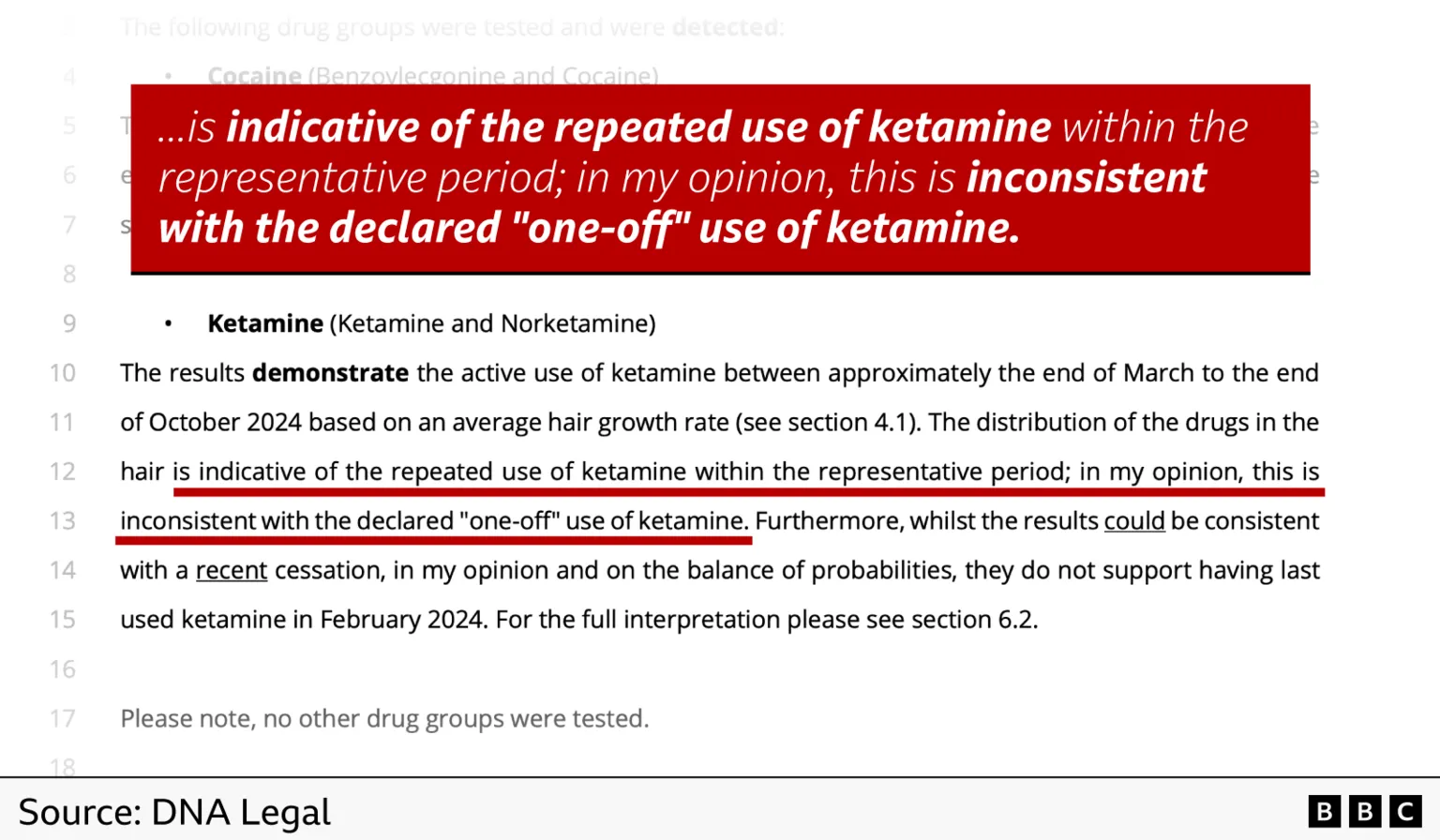
During a Family Court fact-finding hearing in December 2024, hair strand tests suggested more recent and repeated use.
A report covering March to October 2024 indicated evidence of "repeated use," challenging Emily’s claim of abstinence.
For this hearing, Emily was represented by a new barrister, Jonathan Adler, who conducted his own research into hair strand testing. The court appointed a respected specialist as an expert witness.
During cross-examination, Adler cited research proposing alternative explanations for Emily’s results, such as ketamine at the hair ends being moved toward the scalp by hair straighteners.
The expert conceded this point and acknowledged Emily could have been truthful.
Additional factors supported Emily’s case, including clear urine tests and positive parenting assessments from social workers. Consequently, the local authority decided Emily’s daughter could return home.
DNA Legal, the laboratory that performed the December 2024 test, declined to comment, stating it was not authorized to discuss the matter.
Risks and Calls for Regulation
Jonathan Adler believes a miscarriage of justice was averted in Emily’s case.
Sarah Branson has represented parents in two cases where babies were placed for adoption based on positive crack cocaine test results, which the parents denied. She believes she can now demonstrate those test results were flawed.
Social workers face challenges in disputing positive drug tests, as incorrectly dismissing them could have severe consequences.
In 2023, Shannon Marsden and Stephen Boden were sentenced to life imprisonment for the murder of their baby, Finley. Finley had been returned to their care after they convinced social workers they had ceased drug use, but hair strand tests revealed ongoing cannabis use.
There are increasing calls for forensic evidence in Family Courts to be regulated similarly to Criminal Courts.
"[It] would seem sensible to protect against risks of poor practice or risks to justice," said Prof Gillian Tully, former forensic science regulator for England and Wales. "A huge part of doing forensic science well is making sure that the interpretation is right."
In December 2024, the Family Court’s most senior judge referred the issue of hair strand tests to the advisory Family Justice Council for urgent review; however, guidance has not yet been issued.
The Ministry of Justice acknowledged awareness of concerns regarding hair strand testing and is awaiting the Family Justice Council’s guidance.


