Early Adoption Meets Rising Costs
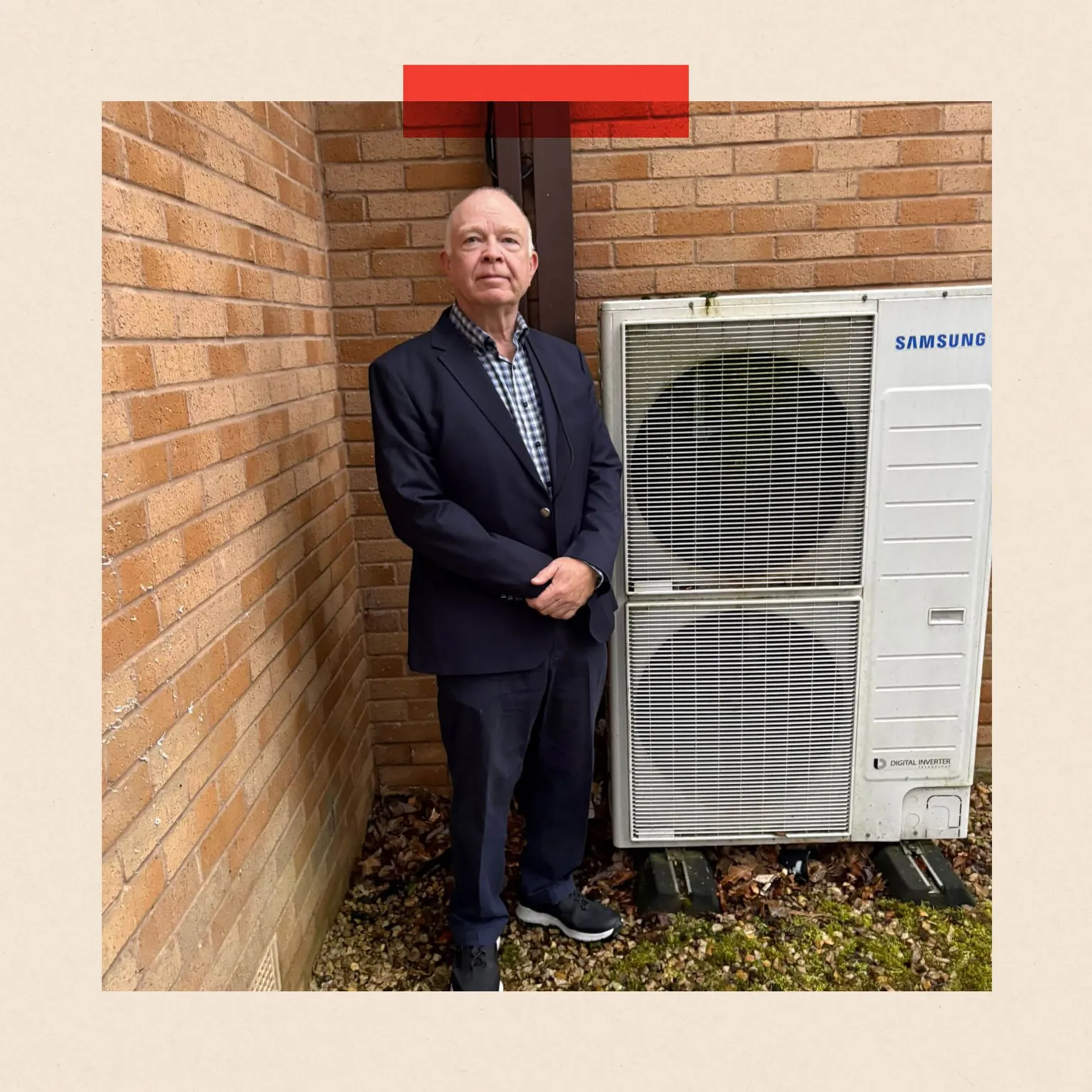
"I'm an early adopter of new technology,"says Gavin Tait, a 69-year-old from Glasgow, with a hint of pride.
When he received a lump sum on retirement about a decade ago, he invested in renewable energy technologies: solar panels on his roof, a home battery, and a heat pump.
"It seemed like a no-brainer,"he recalls.
"I could save money and help the environment - why wouldn't I?"
Initially, his well-insulated home stayed warm and his energy bills decreased. However, over the past couple of winters, he noticed a change.
"I noticed my electricity bills were going through the roof,"he says.
This winter, he and his wife switched off the heat pump and reverted to their gas boiler, which they had kept as a backup.
Gavin, who shared his experience with BBC Your Voice, explains the issue: while gas boilers deliver nearly one unit of heat per unit of energy, heat pumps can deliver three to four units of heat per unit of electricity. However, as heat pumps run on electricity, he is now paying approximately 27p per kilowatt-hour for electricity compared to less than 6p for gas, making the running costs more than four times higher.
"It's simple,"he says.
"Economically, it just doesn't stack up."
His experience is not isolated. A survey of 1,000 heat pump owners conducted last summer by Censuswide for Ecotricity found that two-thirds reported their homes were more expensive to heat than before.
For critics of government policy, stories like Gavin's highlight a deeper issue.
Heating and transport account for over 40% of the UK's emissions, but progress in replacing gas boilers and petrol cars is lagging behind targets. Critics argue that ministers have focused excessively on cleaning up electricity generation, which accounts for about 10% of emissions. This focus has increased electricity prices, making it more costly for people to switch to heat pumps or electric vehicles.
The issue has gained urgency as conflict in the Middle East has pushed up oil and gas prices, raising concerns that high energy costs may persist.
The government maintains that investing in renewables will ultimately enhance energy security by reducing reliance on imported gas, lowering emissions, and crucially, reducing bills.
Are they correct? Or does prioritising cleaner electricity while lagging in heating and transport represent misaligned targets?
The Hidden Cost of Clean Power
While renewable electricity generation can be inexpensive, the infrastructure required to deliver it is not. Sir Dieter Helm, professor of economic policy at Oxford University, explains that focusing solely on generation costs overlooks the broader system costs.
Electricity must be available continuously, not only when the wind blows or sun shines, necessitating backup generation, additional capacity, and an expanded network.
Sir Dieter illustrates: the UK's peak electricity demand is around 45 gigawatts (GW), previously met by roughly 60GW of coal, gas, and nuclear capacity.
With the shift to renewables, much more capacity is required — including wind, solar, and backup sources. He estimates the UK is moving toward approximately 120GW capacity. The grid must also expand to transmit electricity from offshore wind farms to demand centers.
Though exact figures vary, the trend is clear: renewables are making the system larger, more complex, and more expensive. Some costs are already reflected in bills, such as higher network charges due to new pylons and power lines.
Additional "balancing costs" include payments to wind farms to curtail output when supply exceeds demand. Until recently, a subsidy scheme contributed about 10% of the average household bill.
Another factor is that the UK’s richest renewable resource is offshore wind, which is relatively expensive.
Solar power has seen dramatic cost reductions due to mass production, but Britain's often overcast skies, especially in winter when demand peaks, limit its effectiveness.
Offshore wind is more reliable but involves large, site-specific engineering projects that cannot be mass-produced, so costs have not declined as sharply. Rising prices for materials like steel and rare earths, along with higher interest rates, have further increased costs.
The Price of Progress
On paper, the UK has made significant progress in reducing emissions — down around 50% since 1990. However, this may not reflect a comparable reduction in the UK's overall global carbon footprint.
Many goods once produced domestically are now manufactured overseas and imported, often from countries with higher carbon footprints.
China, for example, still relies on coal for over half its energy, suggesting emissions have shifted abroad rather than decreased globally.
Professor Kevin Anderson of Manchester University notes that the 50% reduction figure excludes international aviation, shipping, and imports and exports.
"If you include those, which of course the climate includes, then the reduction's about 20% since 1990,"he says. The government states it follows United Nations guidelines on emissions reporting.
Higher system costs affect not only household bills but also the wider economy. UK households face some of the highest electricity bills in Europe, with an even more acute impact on businesses.
While renewable costs contribute, the main driver is gas. The UK energy mix often includes significant renewable generation, but gas is frequently needed. The market operates by accepting the cheapest bids to supply power in half-hour blocks, but all successful bidders receive the price of the most expensive source required — usually gas.
Thus, even when renewables generate much electricity at low marginal cost, gas-fired plants set the price, influencing what all consumers pay.
This system is common across Europe, but the UK's heavy reliance on gas means electricity bills rise sharply with gas price increases, as seen recently.
High energy costs have coincided with closures in energy-intensive industries. Sharon Todd, chief executive of the Society of Chemical Industry, describes the impact as a
"national act of self-harm,"warning UK industry is
"standing on the edge of a cliff"and calling for an urgent independent review of the net zero approach.

The Politics of Price
Against this backdrop, the politics of climate change have shifted.

When Prime Minister Theresa May set the 2050 net zero target in 2019, it passed without formal opposition. Since then, consensus has fractured.
The Conservative Party now argues the target is
"impossible,"with leader Kemi Badenoch openly sceptical. Reform UK proposes abandoning what it calls
"net stupid zero"altogether. Even the Green Party criticises aspects of government policy, with leader Zack Polanski stating the current approach does not deliver for ordinary people.
The Liberal Democrats advocate that net zero must support households and reduce energy bills. The SNP affirms commitment to a fair and just transition to net zero, while Plaid Cymru recently moved away from its earlier goal of reaching net zero in Wales by 2035.
Polling suggests public support for decarbonisation remains strong. More in Common found four in five Britons believe tackling climate change is important, including nearly 80% of 2024 Conservative voters.
Cost is the primary concern. Office for National Statistics data shows around 90% of adults cite the cost of living as an important issue, with energy bills among the most frequent financial pressures.
This context fuels the argument for focusing on lowering energy prices alongside decarbonisation. Economists and politicians making this case say it would help maintain public support and accelerate emissions reductions.
The argument is straightforward: cheaper electricity encourages more households and businesses to adopt electric technologies like cars and heat pumps, reducing emissions faster.
Former UK Prime Minister Sir Tony Blair’s Tony Blair Institute for Global Change called last year for shifting focus from the government’s
"Clean Power 2030"agenda to
"Cheap Power 2030."
The "clean power" approach posits that a cleaner grid makes all electric-powered devices cleaner by default. Advocates of "cheap power" contend that cutting emissions in energy-using sectors is the bigger opportunity.
Reducing emissions depends on persuading people to switch to electric technologies. As Gavin Tait’s experience shows, cost is a decisive factor.
If electricity is expensive, households and businesses lack incentive to switch. If cheaper, the transition is easier and faster.

The Difficult Choices Ahead
Tone Langengen, senior policy adviser on climate and energy at the Tony Blair Institute and author of its recent report, argues the focus should shift from targets to reducing energy costs.
She states that every energy policy decision should be evaluated based on its impact on prices.
"The sooner we move from a debate focused on targets to one focused on how you structurally change the economy and decarbonise in a way that works both economically and politically,"she says,
"the faster we will move on climate action."
However, implementing this idea is complex. Every option involves trade-offs among prices, emissions, and public spending.
Sir Dieter, the Conservatives, and the Tony Blair Institute suggest slowing renewable expansion and maintaining a larger role for gas in the short term as part of the solution. While fewer renewables could reduce system costs, it risks slowing emissions reductions.
Energy Secretary Ed Miliband emphasizes the broader benefits of renewables.
"The lesson of yet another global energy shock is that the UK needs to get off the fossil fuel rollercoaster and onto clean homegrown power that we control,"he says.
"Driving for clean energy is a national security and economic security imperative - that is why this Government is investing record amounts in new renewables, nuclear, and upgrading homes through our Warm Homes Plan."

Other proposals involve similar tensions. Reforming the electricity market could reduce provider revenues and bills. Shifting some policy costs from electricity bills to general taxation could lower prices but increase public spending pressure.
When pressed on how to reduce electricity prices practically, Langengen acknowledges there is
"no magic wand."She notes this reflects the credibility of the argument but also the difficulty of the choices.
For some economists, this difficulty leads to an uncomfortable truth about political leadership.
Sir Dieter states that tackling climate change will cost money.
Fossil fuels are cheap partly because their prices do not reflect environmental and health damages. Cutting emissions means incorporating these hidden costs into energy prices, with consequences.
"My costs go up, my bills go up and my standard of living goes down,"Sir Dieter says.
"There is, he argues, no easy way around that. The evidence suggests it is going to be more expensive."
This presents a dilemma for governments. The current push for clean power bets that countries like the UK can decarbonise the grid without imposing unacceptable costs and thus lead globally.
The Office of Budget Responsibility states that
"the costs of failing to get climate change under control would be much larger than those of bringing emissions down to zero."However, achieving this requires global emissions reductions.
There is also an argument that transitioning off gas reduces vulnerability to price shocks. Yet if the UK transition raises costs and erodes public support, it may serve as a warning rather than a model.
Despite challenges, the urgency of emissions cuts is clear. The World Meteorological Organization warns the Earth is more out of balance than ever, absorbing more heat than it can release. UN Secretary General António Guterres states,
"every key climate indicator is flashing red."
If Sir Dieter is correct, governments must be honest: the transition will cost more. The challenge is persuading the public it is worthwhile.