

Summertime, and the cooking is easy – or at least it should be. This is the season to spend less time in the kitchen and more round the table. Here’s how
This year, 22 February happened twice for me. The first time, I was flying from Auckland to San Francisco, crossing the international date line somewhere over the Pacific. I’ve never fully understood what actually happens at the date line. There’s an explanation – something about a group of men in Washington deciding where one day would end and another begin, drawing a line down the middle of the ocean. Knowing that doesn’t make it feel less strange. You fall asleep, and when you wake up it’s still yesterday.
Groundhog Day, except the groundhog was me, in my plane seat, eating something that had been described on the menu as a “warm pasta dish”.
I had been midway through my Crowd Pleaser tour – four weeks of travelling, cooking, talking about food across Asia, Australia, New Zealand and now North America. I had left late summer in New Zealand – cherries at the market and a sunset that hung around until gone nine – and stepped off the plane into a San Francisco February that should have felt like winter. Instead it was warm and sunny. I had a case of seasonal jet lag, on top of the regular kind.
We tend to think of eating seasonally as something signposted – lamb at Easter, strawberries in summer, the first pumpkin soup in October. The holidays and occasions do a lot of this work for us, nudging us towards what’s ready, whether we’ve noticed it or not. But we all know that the real thing is mainly physical: the set of signals your body has been quietly receiving all along – the cold that makes you want something warm, the heat that makes watermelon, eaten over the sink, taste perfect. Cross enough time zones and hemispheres and those signals get scrambled. You’re hungry, but you don’t know what for.
So on my second 22 February, I took the train to Oakland to visit my friend Samin Nosrat – the best possible prescription for a scrambled appetite. There was banana bread when I got there – from her latest book, Good Things – sparkling with sugar and cinnamon, whole bananas caramelised on top. We had coffee in the garden, walked the neighbourhood, and went in and out of small shops. I ignored Samin’s warning and bought ceramics I knew I would have to carry with me for another two weeks.
For dinner, Samin bought chips and rotisserie chicken from a specialised restaurant. She also got some leaves from the market, opened her fridge and brought out a few bottles and jars with dressing she had made: a vinaigrette, a lemon and miso dressing, tahini and herb-based, something yoghurty and creamy. We dressed the leaves, pulled the chicken into pieces and sat down to eat.
Samin writes in Good Things about attention – about how time, and its fast companion attention, are the most precious things we can give or receive. And that cooking for someone is only a small part of a larger exchange: one of presence and of showing up.
I admit it took me a moment to settle into this way of thinking. My instinct, arriving at a friend’s house for dinner, is always towards more – towards offering to help, doing something, justifying my presence with effort. There is a particular kind of cook, and I am one of them, for whom restraint doesn’t come naturally. We express love through labour. So a shop-bought chicken can feel like a small defeat.
But this is precisely what summer asks you to unlearn. Winter gives you cover – something in the oven, the kitchen full of steam, and the effort itself is the point. The darkness justifies the production. Summer is less forgiving. By June, tomatoes, courgettes, cherries and nectarines are at their peak, and the best thing you can do is get out of their way. A tomato salad, lightly dressed, left to sit in its own juices until the plate is streaked orange-red and crying out for bread. A good peach, on its own, or grilled with some brown sugar and a splash of rum.
The cooking is in the decisions you make early, so that by the time people arrive you are actually at the table with them. A bunch of condiments left over from earlier meals, or made specially when you have a moment to spare – a dressing, an oil, a quick pickle, or even a citrussy sugar sprinkle like the one I use in my mango mess – are all you need, really, for a particular kind of summer meal.
Eating what is ripe and cold and juicy in August is not an act of virtue, but of attention. And the reason summer cooking should be simple is not that simple is easy, but that simplicity is the only approach that leaves you present enough to actually taste it – and to be with the people you’re feeding.
My summer cooking plan: to accept a little help – shop-bought birds or meringues, a perfectly ripe mango – and spend more time at the table. The second 22 February was much better than the first.
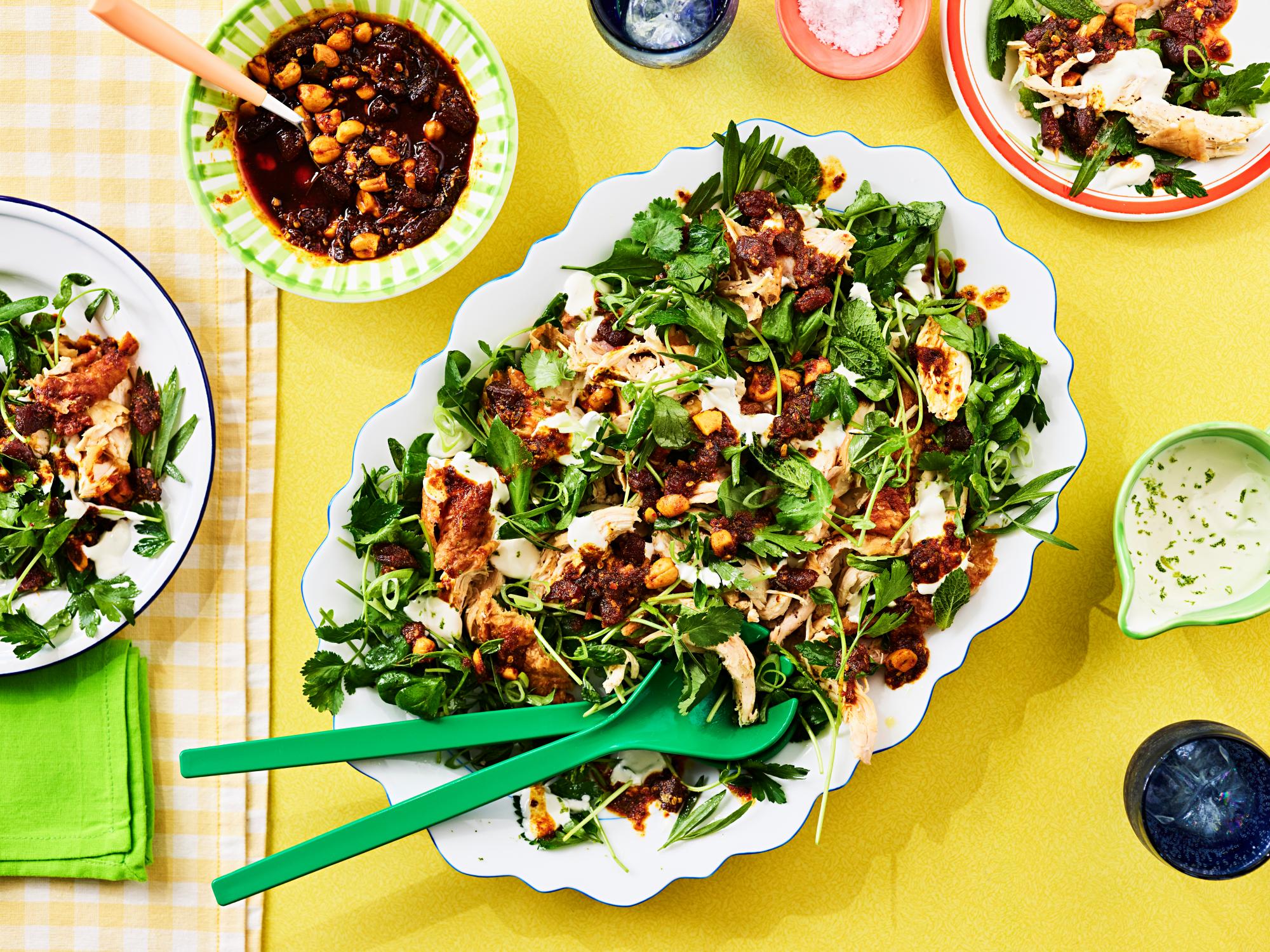
Vadouvan coronation chicken salad with lime yoghurt
Coronation chicken sometimes gets a bad press, but this version – lime yoghurt, sticky apricots and cashews – makes a strong case for it. It centres on a shop‑bought rotisserie bird, and everything else comes together pretty quickly. The kind of thing you put in the middle of the table for everyone to help themselves. Vadouvan is a mild curry mix with a French influence originating in Pondicherry. There’s a sweetness to it, from onion and garlic, but also a strong savoury note from cumin and fenugreek. It’s worth seeking out, but you can use a mild madras curry powder as a substitute.
Prep 20 min
Cook 10 min
Assembly 10 min
Serves 4-6
150g Greek yoghurt
120g mayonnaise
1 lime 1 tsp grated zest and 1½ tbsp juice
Fine sea salt and black pepper
1 shop-bought rotisserie chicken (1kg), roughly picked in 3cm pieces (650g)
3 tbsp good quality rapeseed oil
50g picked mixed herbs, such as mint, coriander, basil, tarragon or parsley
50g pea shoots
3 spring onions (45g), thinly sliced at an angle
For the vadouvan chilli oil
175ml good quality rapeseed oil
50g cashews, chopped into roughly ½ cm pieces
100g dried apricots, chopped into ½ cm pieces
50g vadouvan spice blend (or use mild madras curry powder, see intro)
¼ tsp sugar
15g Aleppo chilli flakes (or 2 tsp regular chilli flakes)
1 tbsp cider vinegar
For the vadouvan oil, place the rapeseed oil in a small saucepan on medium heat. Once hot, add the cashews and apricots, and cook for eight to 10 minutes, until the cashews are golden and the apricots are sticky. Remove from the heat, allow to cool for two minutes, then stir in the vadouvan spices, sugar, chilli and vinegar. Set aside to cool.
In a small bowl, whisk together the yoghurt, mayonnaise, lime zest, half a tablespoon of juice and quarter of a teaspoon of salt, and set aside.
In a large bowl, mix the chicken with one‑and‑a-half tablespoons of oil, a quarter of a teaspoon of salt and some black pepper. Add the herbs, pea shoots and spring onions, along with one-and-a-half tablespoons of oil, one tablespoon of lime juice and one-eighth of a teaspoon of salt.
Arrange the chicken and herb mixture in one layer on a platter. Spoon over half of the yoghurt, followed by half of the vadouvan oil. Serve the remaining in bowls on the side.
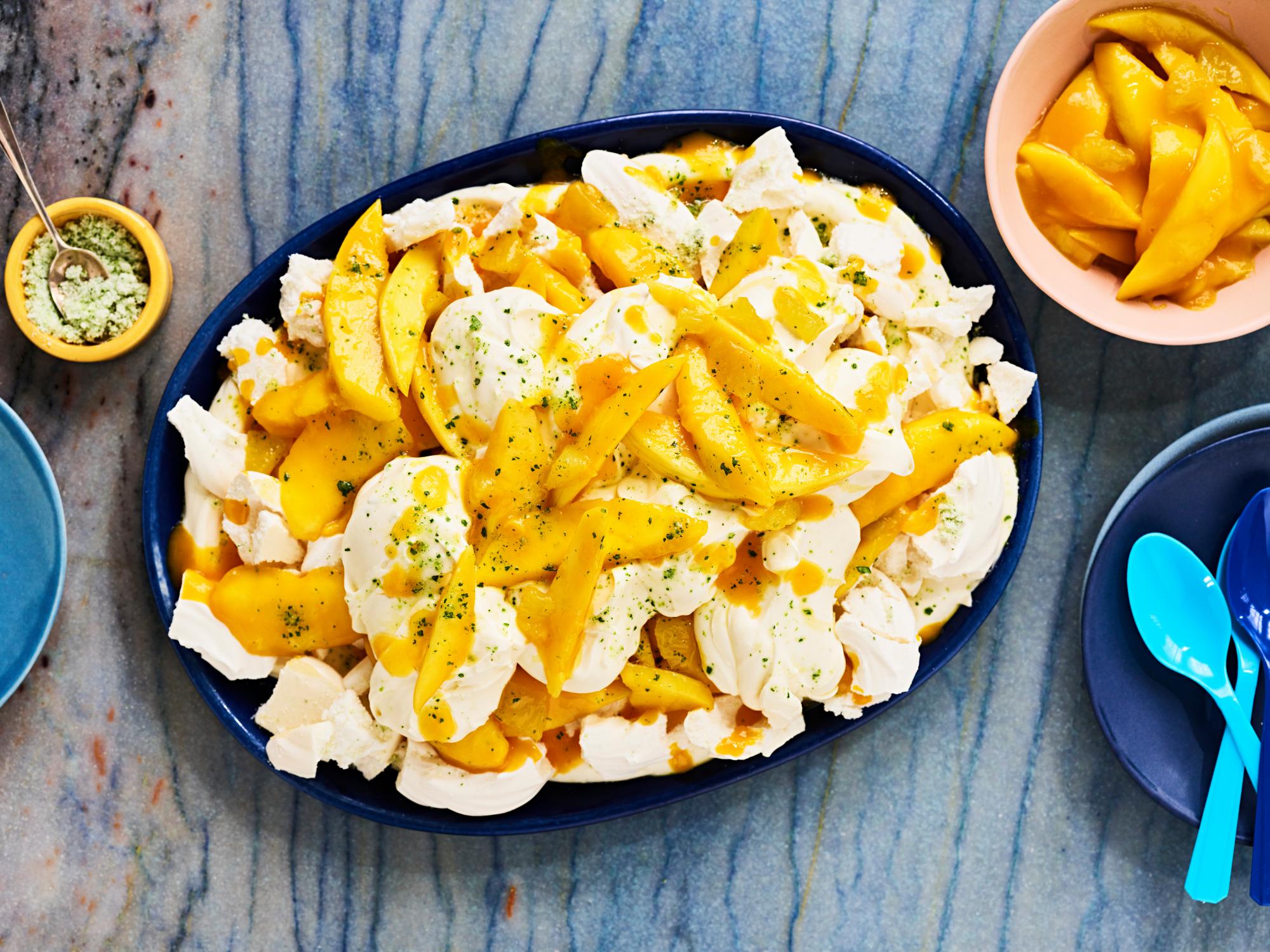
Mango mess with yoghurt cream and lime leaf sugar
An Eton mess, more or less, but with mango and a lime leaf sugar that’s worth making in bigger batches and keeping around. Alphonso puree gives the mango mixture its depth – fresh alone won’t get you there – and any extra is good swirled into yoghurt or spooned over a fruit salad. Everything can be done in advance – the cream, the mangoes and the zesty sugar – and brought together at the last minute, or up to an hour before if you want the meringues to soften a little into the cream.
Prep 30 min
Assembly 10 min
Serves 6
6 meringues, shop bought are fine (70g)
For the yoghurt cream
600ml double cream
100g Greek yoghurt
1½ tsp vanilla bean paste
1 lime 1 tsp grated zest and 1 tbsp juice
60g palm or brown sugar
For the lime leaf sugar
10g lime leaf, stem removed
40g caster sugar
2 limes grate 2 tsp zest, and keep the limes for the mangoes
⅛ tsp flaked sea salt
For the mangoes
3 mangoes, peeled and sliced into ½ cm slices (400g)
150ml sweetened alphonso mango puree
15g palm or brown sugar
2 (grated) limes, peeled, segmented and flesh cut into 1cm pieces
To make the yoghurt cream, whisk the cream with the yoghurt, vanilla, lime zest and juice and sugar until soft peaks form. Refrigerate until needed.
Place all the ingredients for the lime leaf sugar in a food processor and blitz until the leaves are finely chopped and the sugar turns green. Transfer to a small bowl.
In a bowl, combine the mangoes with the puree, sugar and lime pieces, and refrigerate until needed.
To assemble, spoon half the cream on to a platter, arrange the meringues on top, then haphazardly spoon over some of the mango mixture. Scatter over some of the lime leaf sugar and dollop over the remaining cream. Spoon over some more of the mango mixture and finish with another scattering of lime leaf sugar.
Serve with the remaining mango mixture and lime sugar in bowls on the side.


