

Package Holidays to Dubai and Egypt Become More Affordable
Family package holidays to destinations such as Dubai and Egypt are less expensive this summer compared to last year, as tour operators reduce prices to attract travelers.
The ongoing conflict in Iran has discouraged many UK holidaymakers from traveling to countries near the conflict zone or through Middle Eastern airspace, leading them to choose European destinations instead.
Data from TravelSupermarket, compiled for the BBC, shows that prices for an average all-inclusive seven-night family stay in the United Arab Emirates (UAE) have decreased by 25% this August compared to the previous year. Similarly, holidays to Egypt are 8% cheaper.
Conversely, package holiday prices to Spain, Portugal, and Greece have increased by 3-5% over the same period.

Case Study: The Harris Family's Change of Plans
Tim and Natalie Harris from Swansea had initially booked a holiday to Dubai with their two teenage daughters this summer. However, following the outbreak of the Iran war, they canceled their trip and forfeited their deposit.
"We did manage to find a package for £6,400 for all-inclusive in Mexico which we've booked," says Tim.
Last month, the Foreign Office lifted its travel advisory against Dubai after the US and Iran reached an agreement to cease hostilities, but it cautioned British citizens that "the situation remains unpredictable" in the region.
Price Reductions in Other Destinations
Tour operators have also lowered prices for other destinations: holidays to Morocco are down by 6.5%, Tunisia by 2.5%, and Turkey by 1.6% compared to last summer.
Travel Agent Insights on Customer Concerns
Mollie Hitchen, assistant manager of Marple Travel Hyde, reports that customers have been more cautious this year about traveling near the Middle East or potentially being stranded due to fuel shortages.
"People will ask questions, but we just reassure people that there is absolutely no problems with those destinations," she says.
Fluctuating Holiday Prices and Consumer Experiences

Flora Badger, who is taking three teenage girls on their first holiday abroad this summer, contacted BBC Your Voice to express frustration over fluctuating holiday prices.
She initially considered booking in April to avoid the high summer costs but delayed due to concerns about the Middle East situation and fears of being stranded abroad.

Ultimately, she booked a trip to the Spanish island of Lanzarote in September.
"Price was a huge, huge issue," she says. "It's very frustrating how much it increases in the school holidays.
"At the end of the day they need a treat, we've been saving up for it, they've been looking forward to it, so we're planning on going."
European Holiday Prices Continue to Rise
Although the rapid increase in European holiday prices has slowed, TravelSupermarket data indicates that costs are still rising.
The average all-inclusive seven-night family stay in Spain this August is up 4% to £155 per person. Portugal has seen a 3% increase, and Greece prices have risen by 5%.
Depending on the day of the week, a family of four could pay up to £160 more for a seven-night holiday to Spain this year compared to last, with totals reaching as much as £4,340.
The data is based on online searches made on TravelSupermarket between 18 April and 17 June for all-inclusive, seven-night family holidays in August 2025 and 2026.
While this data provides a general trend, actual costs vary depending on the specific destination and booking timing.
Car Hire Costs Decrease Across Popular Destinations
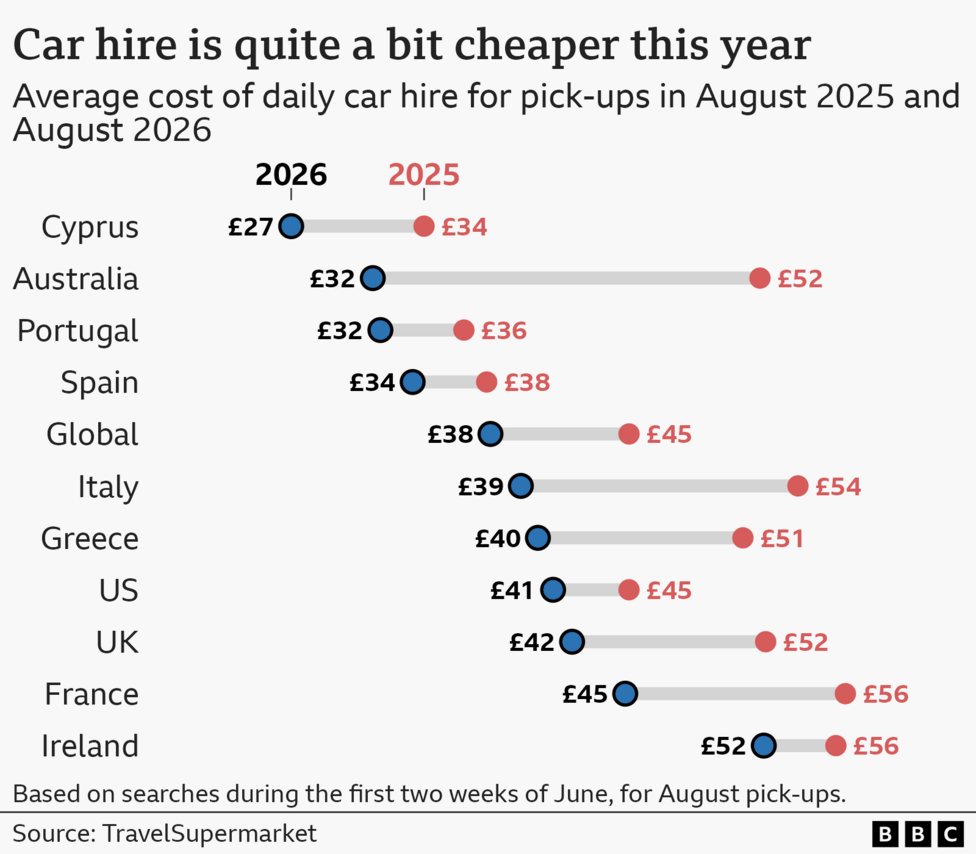
One benefit Flora has been able to utilize is the reduction in car hire costs across many popular destinations compared to last year.
The post-pandemic slowdown in new car production has resulted in increased stock availability, leading to intense competition among car hire operators for fewer bookings during the spring.
"It was cheaper to go for a hire car than to do transfer costs from the airport for four people," says Flora.
Destination Switching and Booking Trends
Richard Slater, managing director of Henbury Travel Limited in Macclesfield, notes that bookings have increased since the US and Iran signed a ceasefire agreement last month.
"Over the last week, we've done about a month's worth of bookings. That's a mix of last-minute bookings to the Mediterranean, and we're also seeing significant cruise bookings," he says.
He adds that travelers are managing rising prices by shortening the duration of their holidays.
"Two weeks used to be the mainstay when we started 40 years ago, and now, you could count on two hands the number of two-week beach holidays we sell. It's more like eight, nine and 10 nights, and then they might take a city break for two or three nights as well."
Slater also highlights that destination switching has become a strategy for holidaymakers seeking better value, with Montenegro, Malta, and Madeira gaining popularity.


