

Decades of Waiting for a Title
Scotland have not secured a title since their 1999 Five Nations victory. The opportunity to claim a championship has finally arrived after decades marked by frustration, fleeting hopes, and a pervasive sense of fatalism. While isolated victories have occurred, Scotland has lacked consistency, witnessing Ireland and Wales celebrate championships and Grand Slams while they remained on the sidelines, locked out and overlooked.
Coaches such as Matt Williams, Frank Hadden, Andy Robinson, Scott Johnson, and Vern Cotter have all experienced fluctuating fortunes with the team. Cotter advanced Scotland's progress, but it is Gregor Townsend, now in his ninth Six Nations campaign, who has guided them to their most consequential championship match since the 1999 title-winning squad.
The prize at stake is silverware in the form of a Triple Crown, and potentially a championship, though the latter remains uncertain with France still favored despite Scotland's recent victory over them.
In contemporary rugby, the Triple Crown may not carry the same weight for nations accustomed to winning it, but for Scotland, it represents rugby's promised land — a long-sought paradise.
The Stakes in Dublin
The upcoming match in Dublin encompasses multiple historic milestones: ending an 11-game losing streak against Ireland, achieving a fourth championship win for the first time, securing a second-place finish also for the first time, and capturing the first Triple Crown since 1990 — only the third since 1938. Ireland alone has claimed eight Triple Crowns during the Six Nations era.
Reflecting on the journey, the match in Rome now feels like a distant memory despite being just 35 days prior. The defeat there was marked by a weak mentality, a dominated scrum, a broken lineout, and a dispirited attitude culminating in 29 unsuccessful phases in heavy rain, prompting calls for Townsend's dismissal.
Turning Points and Momentum
Following Rome, Scotland faced England and found themselves 17-0 down within 14 minutes. However, Finn Russell's creativity, Huw Jones' opportunism, Matt Fagerson's charge down, and Kyle Steyn's relentless performance led to a bonus-point victory and regained momentum.
Next came a challenging match in Wales, where Scotland overcame a 20-5 deficit in a high-intensity environment — a comeback that would have been unlikely in previous years, signaling a new resilience.

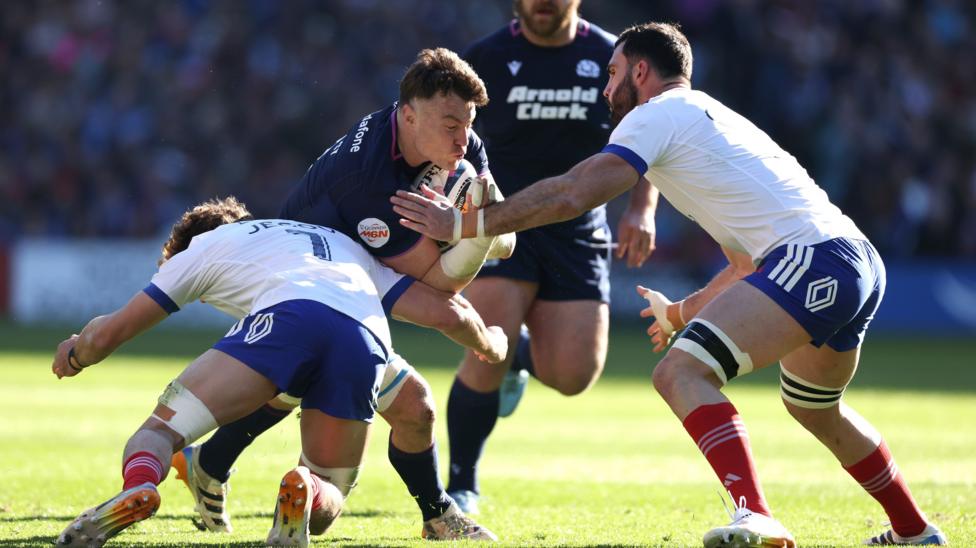
Then, Scotland faced France, a leading force in European and world rugby. Despite France initially leading 14-7 and gaining momentum, Scotland responded with an extraordinary display, scoring 40 unanswered points. This performance showcased not only their brilliance but also their power and relentless pursuit even when victory seemed assured. It was arguably Scotland's most remarkable performance and win in recent memory.
Scotland's Challenge in Dublin
The final hurdle to glory awaits in Dublin, the home of their most formidable adversary, Ireland. The narrative resembles a cinematic script: Scotland aiming to overcome their long-standing nemesis, akin to a rugby-themed Rocky story.
The key to success hinges on physicality. Historically, Ireland has dominated this aspect, while Scotland has lacked sufficient physical presence. Despite rugby's complexities, Scotland's captain Sione Tuipulotu emphasized a fundamental truth:
"I think that's the game, to be honest," he said regarding the necessity of winning physical confrontations. "In Test rugby you go through all these things of game planning and all the intricacies around the lineout, scrum or even kick strategy, but I feel like Test rugby is pretty simple, you win the collisions, you win the game.
"The collisions are the breakdown, the collisions are the target, the collisions are the defence. If you can win those three - I haven't seen many people lose when they win those three.
"The breakdown is going to be a big part of it. Definitely [Ireland] have picked some guys that are pretty notorious as breakdown pests. That's the part of the game that we need to control in order to get our game out there. That's no secret."
Throughout the week, Scotland has maintained a measured public demeanor. Townsend was notably reserved on Thursday, a prudent approach given the magnitude of the match. Overstating the occasion could prove counterproductive.
Tuipulotu, however, came close to expressing the emotional weight of the moment, particularly when discussing his father, Fohe, who attended the recent Murrayfield match where Sione captained Scotland for the first time.
"My dad doesn't speak much," Tuipulotu shared. "He's been coming to all my rugby games since I was a kid but he doesn't have much to say after any game.
"He has probably a bit more to say if we lose or if I've played bad than if we win. Usually if we win there's not much said, so it was probably a good thing that there wasn't much said after last week and hopefully he doesn't say anything after Saturday either."
While Fohe may not be an expressive man, his pride is evident through his support. Tuipulotu reflected on the dynamic:
"Like I said, it's hard to gauge. Tongan dads are all pretty similar, they don't show their emotion much. It's hard to gauge his mood around things, but I know he wants this one just as much as I do and he'll be there to support.
"[His pride] is probably something that I'm still figuring out. But that's my dad and I've just grown up like that, I suppose.
"Playing rugby, since I've been a kid, has always been a little bit like chasing that approval from my dad. That hasn't changed for me my whole career so I'm happy he's in the crowd because I get to chase it again."
Tuipulotu's tactical insight and leadership set a clear tone. If the rest of the team aligns with his mindset, Scotland could produce a historic performance at the Aviva Stadium.
They have accomplished much to reach this point, yet the most challenging moment lies ahead.
Chasing a title and confronting past disappointments, this is the moment Scotland has long awaited.


