

Ireland reignite title bid with record away win over England
Prior to the commencement of the Six Nations, England head coach Steve Borthwick identified the upcoming match against France in Paris on 14 March as a potential title decider.
"We want to be in a position in that game to get what we all want to achieve. We want English fans flooding across the channel to get there and watch that game," he stated.
The objective was to replicate the 2016 Grand Slam victory in Paris and secure England's first title since 2020.
However, two successive heavy defeats have left England in fourth place in the standings, effectively eliminating them from the title race, with only one win against Wales recorded so far.
England's 12-game winning streak was halted by a 31-20 loss to Scotland at Murrayfield last week, followed by a 42-21 defeat by Ireland at Twickenham on Saturday, marking one of the poorest performances under Borthwick's leadership.
The nature of these defeats has raised questions regarding Borthwick's tactical approach and the team's mentality.
Consequently, England now must secure points in away matches against Italy and France to aim for a mid-table finish.
The Allianz Stadium match was particularly disappointing, with England conceding five tries, highlighting defensive vulnerabilities.
"Two weeks ago after 12 wins on the bounce people were saying we were the best team in the world, and now we are all sorts of things. Neither of these are true," Borthwick told .
"We are on a journey of development that has a lot of growth in it. That England team from today will be a lot better in two weeks' time."
First-half errors gifted Ireland scoring chances - Borthwick
'Borthwick needs to adapt his tactics'
'Emotional' Dawson criticises England's mentality
Ireland scored 22 points within the first 30 minutes, marking the fourth-most first-half points England have conceded at home.
This followed England falling behind 17-0 within 15 minutes against Scotland at Murrayfield.
"Fast starts are not about being physical and smashing them, that is a given, you are running out for your country," former England scrum-half Matt Dawson told BBC Rugby Union Weekly.
"It's the tactics. It's about how you are going to play, where you will play and how they will play.
"It's individual preparation and the understanding of how to play professional sport, not just rugby. Have you got that mentality to adapt from minute one?
"England, when it goes badly in the first 10 minutes, they are yet to find a methodology or a way out of it."
Former England fly-half Paul Grayson commented on the performance:
"From nowhere England pulled out a performance that lacked accuracy, energy and emotion.
"The Twickenham crowd were making a heck of a racket at the start but 30 minutes in there were ironic cheers for making touch with a kick."
Borthwick has previously experienced similar challenges as England coach. In 2023, England conceded 53 points at home to France but later nearly reached the World Cup final that year.
'Another chastening campaign'
The last two weeks have seen a significant downturn in England's form.
Following a strong performance against Wales at Twickenham, expectations were that England could contend for the title on the final day.
However, the current Six Nations campaign has been disappointing, with England failing to contend for the title in six consecutive Championships.
Saturday's defeat was among the worst in recent memory, and the reaction from England supporters was notably critical of the team's current standing.
England now faces a period of reflection and must prepare rigorously for upcoming matches against Italy and France.
'No-one knows what the answer is right now'
Genge apologises to England fans after Ireland thrashing
After seven impactful appearances off the bench, 21-year-old back rower Henry Pollock earned his first Test start.
His inclusion aimed to inject energy and prevent a repeat of Scotland's early dominance in the previous match.
"What do you do? Two weeks in a row conceding so many points in the first 15 minutes," prop forward Ellis Genge told .
"Everyone has to take a look at themselves. No-one knows what the answer is right now or we would have sorted it out.
"It opened up scar tissue from last week - we have to be better at managing that period and stop turning the ball over.
"It's brutal, professional sport because if you get 5% wrong it's gone. We probably believed the hype from the first week too much. We can't let the noise in now.
"We have let everyone down. Apologies for that but I promise we will make it better. We are going to go away and work as hard as we can to go away and rectify things."
England frequently entered Ireland's 22-metre area but lacked precision, committing 14 handling errors during the game.
Additionally, George Ford missed a penalty kick that could have positioned England to score.

"As players, senior players and the leadership team we have to take responsibility for not starting the game right," said Maro Itoje.
"It was just our inaccuracy. We turned the ball over too much, and when we did get into positions to hurt Ireland we were not accurate and then gave ourselves a mountain to climb."
An England blip, or long-term cause for concern?
'Ireland show they're far from done with record-breaking win'
Ruthless Ireland hit record away win over England
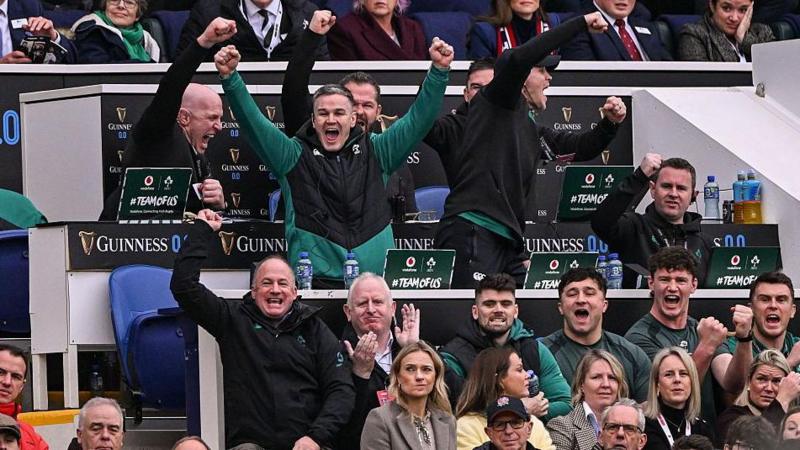
'Special day' - Farrell revels in record Irish win
'England were utterly dreadful in defence'
Ireland capitalized on England's weak one-on-one tackling, making 12 line breaks during the match.
Stuart McCloskey's clean break leading to Ireland's second try occurred after replacement scrum-half Jack van Poortvliet, who had recently entered the game replacing the injured Alex Mitchell, misread the play, allowing Ollie Lawrence to fend off.
Fraser Dingwall was beaten on the outside by Robert Baloucoune, who feigned Tommy Freeman and then escaped Lawrence to score the third try.
Ireland captain Caelan Doris broke through Ellis Genge to sprint clear and assist in setting up Dan Sheehan's bonus-point try early in the second half.
"In the first 30 minutes of a Test match collisions should be massive, but England were not even making contact and were getting rinsed down the middle of the field two or three times," added Paul Grayson.
"England were utterly dreadful in defence."
Both Baloucoune and Sheehan's tries resulted from yellow cards issued due to scrambling defence by Freddie Steward and Henry Pollock, further compounding England's difficulties.
England lose aerial battle
England's kick-heavy strategy had been instrumental in their 12-game winning streak, but against Scotland they failed to dominate the aerial contest.
Tommy Freeman's repositioning from outside centre to right wing aimed to improve aerial competitiveness.
The 24-year-old had a mixed performance in the air against Ireland but remained competitive when required.
With Ireland losing James Lowe early due to injury, deploying Freeman against Leinster's Hugo O'Brien early in the game was expected to create opportunities.
However, O'Brien managed to regather a kick that eventually led to Baloucoune's try.
Ireland won the aerial battle decisively, also exploiting the height advantage of the 6ft 4in Baloucoune over England's Henry Arundell, who is four inches shorter.
Arundell, 23, was expected to respond strongly following his red card against Scotland but failed to assert himself in this match.
Immanuel Feyi-Waboso's injury, which ended his championship participation, has become a significant setback for England.
What was once a key strength for England is now emerging as a vulnerability.
Henry Pollock received a yellow card early in the second half, further impacting England's performance.
Most points conceded by England at home
England's previous record for most points conceded at home was 42 against South Africa in 2008.
England's kick-heavy strategy was key in their 12-game winning run, but against Scotland they failed to win the aerial battle.
Leinster's O'Brien managed to regather a kick that eventually led to Baloucoune's try.
England's defensive struggles and tactical issues have been highlighted by this campaign's results.


