

Early Life and Racing Career
Alex Zanardi, who passed away at the age of 59, was a distinguished Formula One driver and two-time CART champion, as well as a paralympic athlete who earned four gold medals in hand-cycling. He was widely admired for his resilience and ability to reinvent his life following a catastrophic racing accident in 2001 that resulted in the loss of both his legs.
Zanardi was born in Castel Maggiore near Bologna in 1966. He was the younger child of Dino Zanardi, a plumber, and Anna, a shirtmaker. His older sister, Cristina, tragically died in a car accident at age 15. Despite concerns from his grieving parents about his adventurous nature, Zanardi’s father bought him a go-kart just before his 14th birthday. Zanardi described his first experience driving it as "by far the best day of my life." Over the next seven years, he won three Italian go-kart titles and the European championship.
At nearly 22, Zanardi advanced to car racing, joining the Italian Formula 3 series in 1988. There he met Daniela Manni, who managed the Erre 3 racing team; they married in 1996. After several podium finishes in Formula 3, Zanardi moved to Formula 3000 in 1991 with the Il Barone Rampante team, securing two wins and four second places.
His talent attracted Formula One attention, and late in 1991 he drove three races for Jordan, finishing ninth twice but scoring no points. During this period, he became involved in a complex legal dispute between Jordan's boss Eddie Jordan and Benetton’s Flavio Briatore over Michael Schumacher’s contract.
In 1992, Zanardi joined Minardi but faced difficulties, including two "Did Not Qualify" results and a retirement. The following year, he raced for Lotus, scoring a single point in Brazil before a serious crash in Belgium ended his season. The 1994 season yielded no points and marked Lotus’s final year in Formula One.
Concluding his F1 career was over, Zanardi moved to the United States to race in CART with Chip Ganassi Racing, beginning his most successful racing period. In 1996, he won three races, finished third overall, and was named rookie of the year. He won the CART championship in 1997 and 1998, famously inventing the "donut" victory celebration, where the car spins in a cloud of tire smoke. His charismatic personality made him a fan favorite.
Despite his success, Zanardi returned to Formula One in 1999 with Williams, a decision he later regretted. The season was disappointing, with no points and 10 retirements in 16 races. He returned to CART for the 2001 season.

2001 Racing Accident and Recovery
In September 2001, during a CART race at Lausitzring in northeast Germany—the first time the American series raced in Europe—Zanardi was leading when he made a late pit stop. Exiting the pits, he lost control, spun across the track, and was struck broadside by Alex Tagliani. The collision severed Zanardi’s car in two.
“Part of the car stayed with me, and the other part left, with parts of me in it,” Zanardi recalled in his 2004 autobiography My Story.
Zanardi nearly bled to death, losing all but one litre of his blood. His left leg was amputated at the thigh and his right at the knee. Emergency doctors Terry Trammell and Steve Olvey acted decisively, airlifting him to an intensive care unit in Berlin. His heart stopped three times en route.
Remarkably, six weeks later Zanardi was discharged from hospital and began a rigorous rehabilitation program, learning to walk with prosthetic legs he designed himself. In 2003, he returned to Lausitzring in a specially modified car and symbolically completed the 13 laps he had been unable to finish in 2001.
He described the crash as “an opportunity to start all over again.”
Return to Racing and Paralympic Success
Zanardi resumed racing with BMW in the European and World Touring Car Championships from 2003 to 2009, winning three races. In 2014, he competed in the Blancpain Sprint Series, and in January 2019, he participated in the 24 Hours of Daytona.
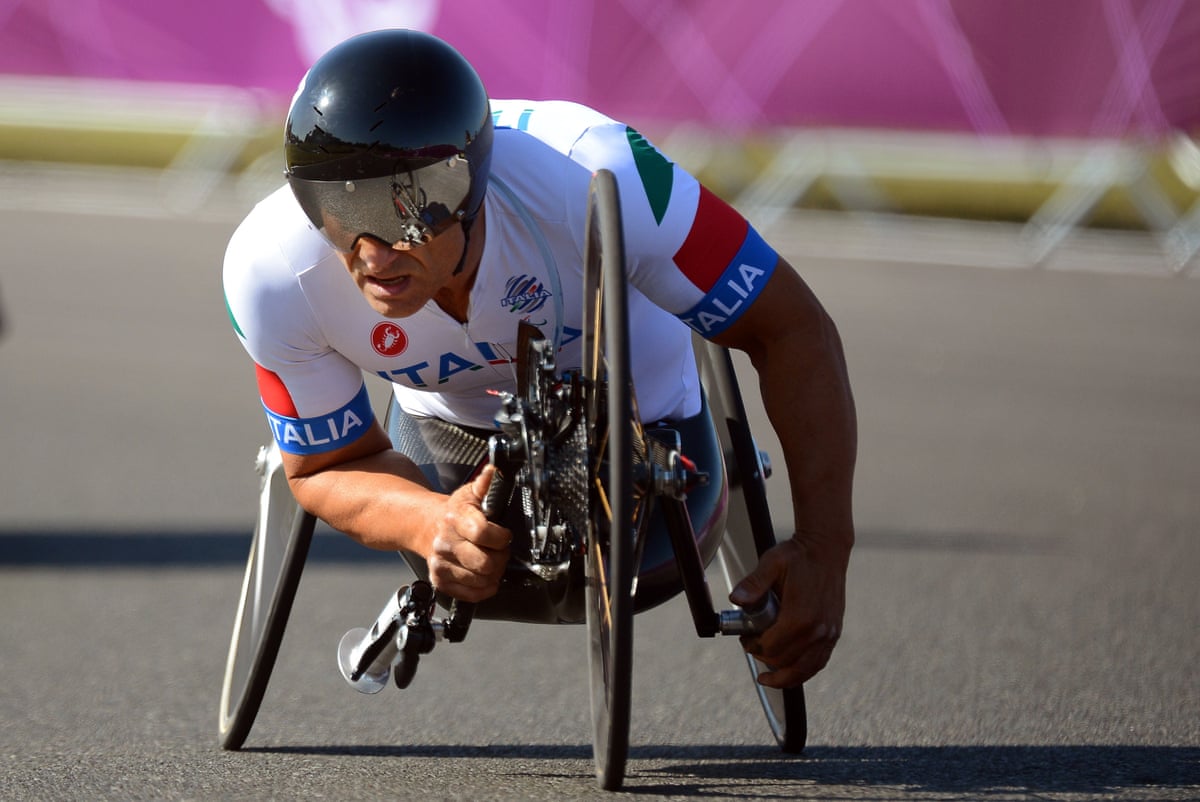
His involvement with hand-cycling began when his sponsor, Barilla pasta, invited him to the New York marathon to give a speech. Zanardi chose instead to compete using a handcycle. After only three weeks of training, he finished fourth, marking the start of a new chapter. He went on to win marathons in Venice, Rome, and New York, and earned two gold and one silver medal at both the 2012 London and 2016 Rio Paralympic Games.
Later Life and Legacy
Zanardi’s remarkable comeback earned him global recognition as an inspirational figure. He became a sought-after motivational speaker, emphasizing the positive outlook he maintained despite his injuries.
“I have such a happy life, and it’s related to all the great things I’ve done in this new condition of mine,” he told F1’s Beyond The Grid podcast in 2020.
Tragically, just days after this interview, Zanardi was involved in a serious accident with a truck during the Obiettivo Tricolore road race for paralympic athletes in Italy. He sustained severe head injuries and was placed in a medically induced coma at a hospital in Siena. In 2021, he was able to return home to continue rehabilitation.
Alex Zanardi is survived by his wife Daniela and their son Niccolò.


