

England vs Scotland: The Oldest International Football Rivalry
England stand two matches away from ending 60 years of World Cup disappointment. Their next challenge is a highly anticipated semi-final against Argentina. However, for those north of the border, the real pain lies in supporting Scotland.
This year, Scotland's men's team qualified for the World Cup in the United States for the first time since 1998, though their campaign was brief. As the Tartan Army fondly recalls their June matches in Boston and Miami, a debate has emerged: should Scots support their close neighbors England, or adopt an 'anyone but England' stance?
The Scottish Town That Supported Norway 86 Years Ago
Scotland versus England is the original international football rivalry, dating back to 1872. Both nations claim to have invented the sport, with early dominance by Scotland, who popularized the passing style of play.
By 1966, England had become World Cup champions, while Scotland has never progressed beyond the first round. Despite qualifying for their first World Cup since 1998, Scotland's men's team once again failed to break this pattern.
As England advance, potentially to the final, some Scottish football fans face difficult choices regarding their loyalties.
'How Could We Live With an England Win?'
Hamish Husband says the Tartan Army became "more popular than Taylor Swift in the US"
Tartan Army organiser Hamish Husband, who was partly raised in England and supports Carlisle United, admits he does not watch England games.
"I feel too guilty about wanting them to lose," he tells BBC Scotland News.
Regarding a potential second World Cup title for England, Hamish rhetorically asks:
"How could we live with it?"
He clarifies that his feelings are not directed at the players, manager, or fans, but rather at England as a 'big brother' figure.
"England is our big brother, and sometimes you don't want your big brother to do well, do you?" Husband says.
His primary concern is the media reaction to an English World Cup victory.
"The Dutch don't watch German national games with German commentators, but we watch England games with English commentators talking about 'our nation', 'our country'.
Perhaps it is unsurprising that a country whose national anthem recalls sending an invading English army homeward "tae think again" does not fully support the "Auld Enemy".
However, this is only part of the story; Scottish sentiments are more nuanced.
According to a YouGov poll conducted before the World Cup, nearly one in three Scots (31%) wished for England to perform poorly, while only 3% of English respondents hoped Scotland would do badly. Approximately 10% of Scots and a similar proportion of English people expressed willingness to support their neighbors.
This aligns with census data from 2022 indicating that nearly 10% of Scotland's population (506,207 people) were born in England.
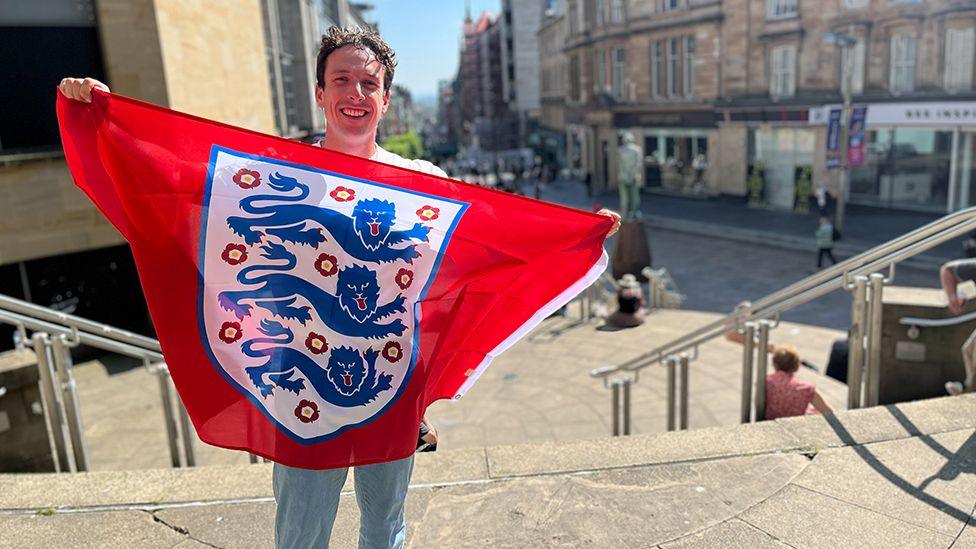
Robbie McSkimming, a Scotland fan, is supporting England in the semi-final
Robbie McSkimming, born and raised in Dunfermline, Fife, is a dedicated Scotland supporter who has cheered on his team against England at Hampden Park. However, due to family ties across the border, the 30-year-old has long supported the Three Lions in later stages of international tournaments.
"Growing up there wasn't too much to cheer about for Scotland anyway," he tells BBC Scotland News in Glasgow.
"So when I was young and getting into football, having the choice to watch an England team that had all the players that I was watching on Match of the Day was quite enticing."
Robbie describes the 'anyone but England' mentality as "a bit of fun in football," but says it is natural for him to support any team with which he feels a connection, whether England, Wales, or Northern Ireland.
A Bit of Fun or 'Churlish'?
Hamish emphasizes that any rivalry banter should be limited to light-hearted teasing.
He also describes Scots dressing up in sombreros, Viking helmets, or Argentina jerseys as "a bit churlish."
Despite this, Argentina jerseys have been a common sight in Scotland and even in Boston this summer, reflecting England's intense rivalry with the South Americans.
The last time England faced Argentina in a World Cup knockout match was in 1998, when a factory in Ayrshire capitalized on the fixture by producing the now-famous blue and white jerseys.
During visits to three Glasgow sports shops on a recent Tuesday, BBC reporters found Argentina kits widely available, while England shirts were absent from the shelves.
In 2002, SNP economy spokesman Andrew Wilson sought to redefine the relationship by urging the Tartan Army to support England, suggesting it would symbolize Scottish self-confidence.

Before the 2006 World Cup, a young Andy Murray joked in a press conference that he would support "anyone but England," which resulted in hate mail and a subsequent clarification that he was not anti-English.
This year, even King Charles commented wryly that it might be "too much to hope" that the Tartan Army would "cheer with full voice" for England after Scotland's elimination.
MP Called 'Pathetic'
While Scottish broadcaster Andrew Neil declared his support for the Three Lions following Scotland's exit, comments by SNP MP Lara Bird suggest the King's expectations may have been optimistic.
Bird, who is half English, told Politics Live that Scots had become "really passionate" supporters of Mexico and Norway ahead of their matches against England, and she herself was likely to cheer for Norway.
She framed this as light-hearted fun, but some disagreed.
Several commentators labeled her stance "pathetic," while others expressed confusion.
MP Karl Turner posted on social media:
"If Scotland were playing anybody else in the world apart from England I'd be supporting them."
For many north of the border, the more relevant question is why they would be expected to support the "Auld Enemy" at all.
For these fans, England's elimination would simply be the most entertaining outcome.
A popular social media response includes a clip from a 2020 Kevin Bridges stand-up routine, where the comedian impersonates a confused English person:
"Let me get this straight ... you actively support the other teams because they're playing England?"
Switching to his Glaswegian accent, Bridges replies:
"That's pretty much it, mate."
New Zealand's Rivalry with Australia
While Scotland and England's rivalry is the oldest in football, similar dynamics exist elsewhere.
New Zealanders have often witnessed their larger neighbor Australia outperform them at major tournaments.
Jared McMillan, from New Zealand, cheers on Australia's World Cup opponents
Jared McMillan, a Kiwi who grew up in Gisborne and spent nearly a decade working in Melbourne, describes New Zealand as the "little brother" who resents Australia's success.
He notes that New Zealand's football community is close-knit, having played alongside future internationals at university in Wellington.
Now based in New York, Jared recalls that watching Australian games in Melbourne could be "insufferable."
"When everyone's happy and thinking they're the best, you're thinking I don't know about that - you're going to play a proper team soon, and you'll be found out.
"That might be similar, I guess, to how Scots feel about England."

'Best Fans in the World'
Hamish Husband spent a joyful week in the United States last month, where he says the Tartan Army became "more popular than Taylor Swift."

Reflecting on Scotland's group stage exit, he remarks:
"I wish our football team was better.
"England could have the best football team - possibly world champions - but we've got the best fans in the world."
Though a modest consolation, for Scotland supporters, taking what they can get is part of the experience.


