

Arteta’s Journey and Current Challenge
Mikel Arteta left his position as Pep Guardiola's assistant at Manchester City in 2019 to become Arsenal's head coach. He is pursuing his Premier League ambitions while his former mentor Guardiola is steadily closing the gap in the title race.
Arsenal currently hold a six-point advantage, a notable margin at this stage of the season. However, with momentum seemingly shifting towards Manchester City, every tactical and strategic decision by Arteta will carry increased significance for the Gunners.
Before the Champions League quarter-final against Sporting, Arteta motivated his team and supporters with the phrase
"no fear, pure fire". As he demands intensity and passion from the club, there is also anticipation for innovative tactical approaches from Arteta in the closing weeks of the campaign.
Small but effective adjustments, both on and off the field, could prove decisive in the title race. This analysis examines Arsenal’s recent performances and what they imply for the season’s conclusion.
Fans can listen to live commentary on BBC Radio 5 Live and , and follow live text updates on the app and website.
Communication Between Arteta and Guardiola
While it is unclear who initiated contact, Arteta and Guardiola have maintained communication, according to journalist Balague.
Recent Performance and Tactical Challenges
Arsenal have recently experienced setbacks by their standards, including Premier League losses to Manchester City and Bournemouth, as well as an FA Cup defeat to Championship side Southampton.
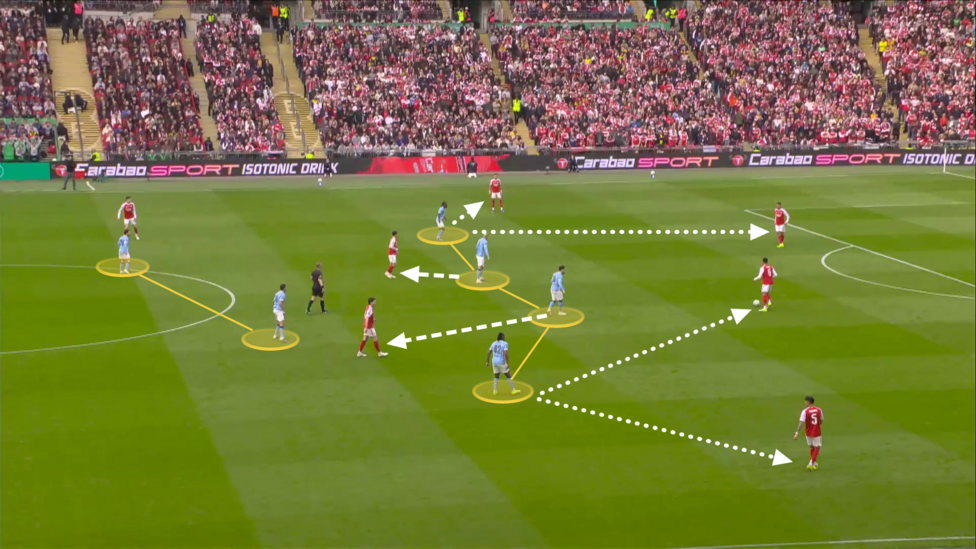
In the Carabao Cup final, Guardiola’s Manchester City effectively neutralized Arsenal’s build-up play. City deployed a 4-2-4 defensive block, with Erling Haaland and Rayan Cherki positioned centrally to obstruct passes into midfield, while Antoine Semenyo and Jeremy Doku pressed Arsenal’s centre-backs and blocked passing lanes to the full-backs.
Arsenal encountered difficulties for several reasons. City’s 4-2-4 formation allowed Arsenal’s central defenders to retain possession but limited proactive engagement compared to Bournemouth’s approach. The key for City was to restrict Arsenal’s access to their midfield duo and discourage passes to the full-backs, ultimately forcing Arsenal to play long balls where City’s defensive structure was prepared to intercept.
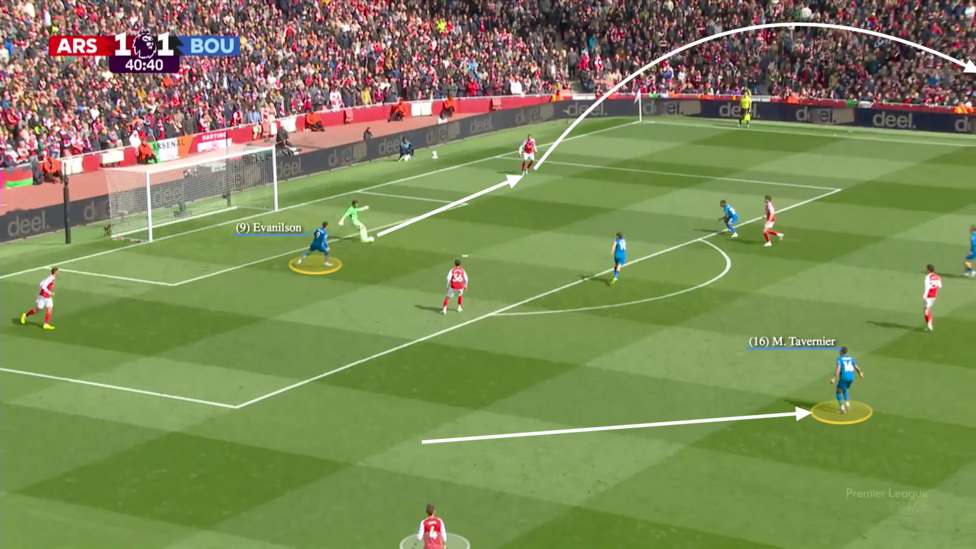
Bournemouth applied pressure more aggressively and with a different structure. Rather than a flat front four, their left-sided midfielder James Tavernier moved inside to support central midfielders, particularly when Kai Havertz dropped deep to form a midfield three with Martin Zubimendi and Declan Rice.
This left Ben White unmarked at right-back, but striker Evanilson’s curved runs effectively blocked passes to that flank, complicating Arsenal’s attempts to access the full-back.
Although City and Bournemouth’s pressing styles differed, both shared effective principles, such as channeling Arsenal’s play down the left side. Gabriel was tasked with dictating play from deep areas, a role his counterpart William Saliba fulfilled more effectively.
When play was directed down Arsenal’s left, Andoni Iraola’s Bournemouth team engaged in man-to-man marking. In these situations, Arsenal’s players and coaching staff often signaled to Gabriel to attempt long passes to striker Viktor Gyokeres.
Since the start of the year, Arsenal have focused on exploiting spaces that open when opponents press man-to-man, utilizing players like Noni Madueke, Gyokeres, Gabriel Martinelli, and Havertz, who possess the skills to capitalize on transitions.
However, against Bournemouth, Gyokeres struggled to win individual duels despite his physical presence, limiting Arsenal’s ability to dominate possession and advance. His strengths lie in running channels and ball-carrying to facilitate forward movement.
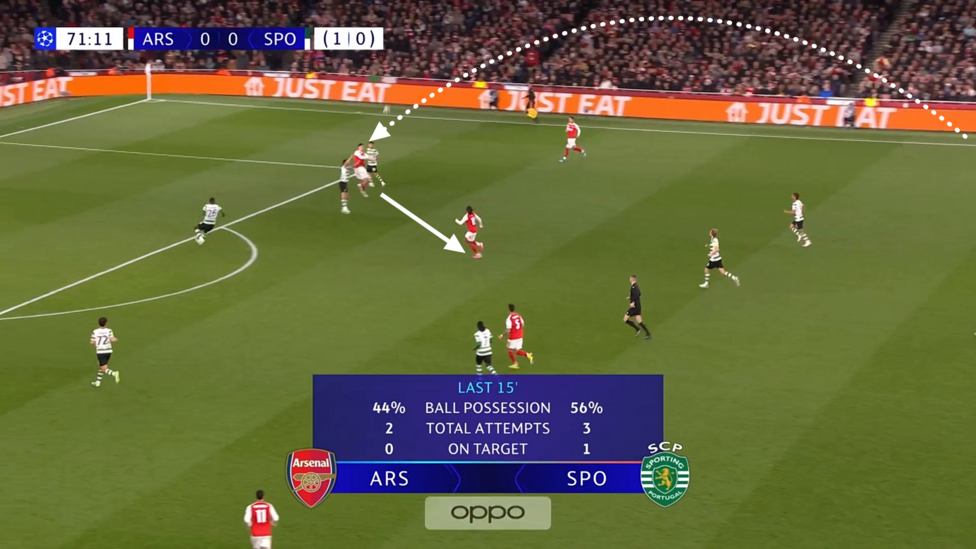
Against Sporting, Havertz was deployed as a striker and contributed to ball retention. Eberechi Eze operated behind him, and the pair combined effectively, with long passes directed to Havertz before the ball was played into space for Eze.
This emphasis on central play was a positive tactical shift, benefiting both Eze and Arsenal’s overall approach.
If Arsenal aim to improve ball progression, Arteta may increasingly rely on this duo.

Build-Up Play and Press Resistance
In recent matches, Arsenal have attempted to play out from pressure using short passes, often targeting the right flank as opponents force play down their left.
There were instances where Arsenal’s build-up successfully bypassed pressure, but these were sometimes undermined by individual mistakes.
Against City, goalkeeper David Raya’s involvement in deep build-up allowed Arsenal to shift the ball across the pitch, outnumbering City’s front four.
Havertz frequently dropped from his number 10 role into midfield, drawing tight marking from Bernardo Silva. This movement freed Ben White, who combined with Havertz to help Arsenal circumvent City’s press.
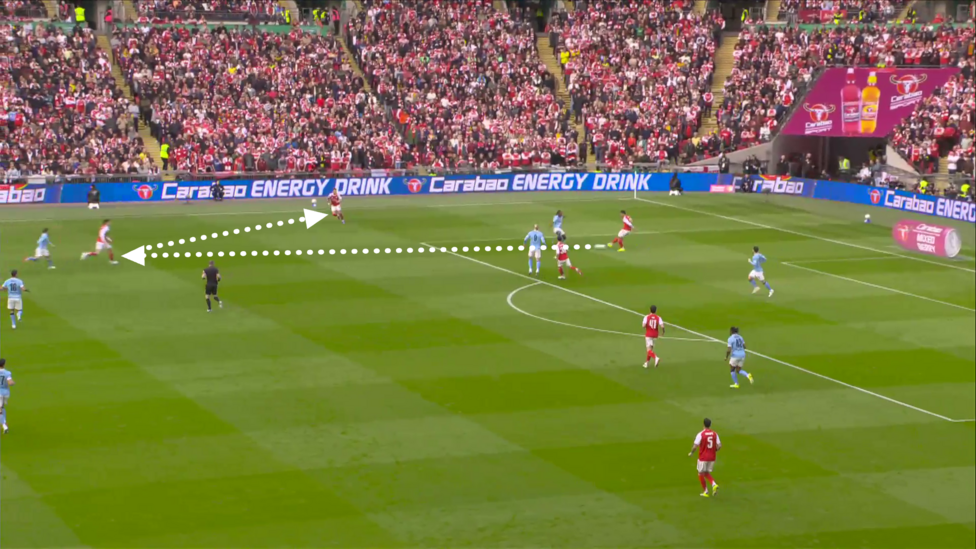
Liverpool employed a similar tactic by positioning Curtis Jones from midfield into defense, widening Ibrahima Konate and Virgil van Dijk, rather than involving their goalkeeper as a third defender.
Jones penetrated City’s front four to connect with Liverpool’s midfielders, creating a numerical advantage in midfield. Florian Wirtz moved infield from the left wing to join Ryan Gravenberch and Dominik Szoboszlai, forming a three-versus-two midfield scenario.
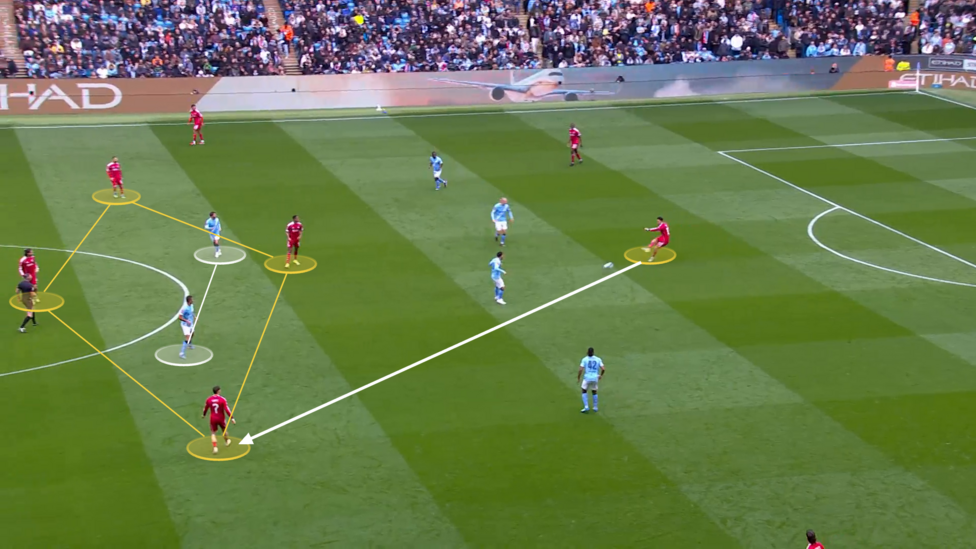
Another approach Arsenal have utilized involves central midfielders dropping deep to receive passes from centre-backs. This sudden movement can create unmarked moments as opponents adjust to the attacking team’s actions.
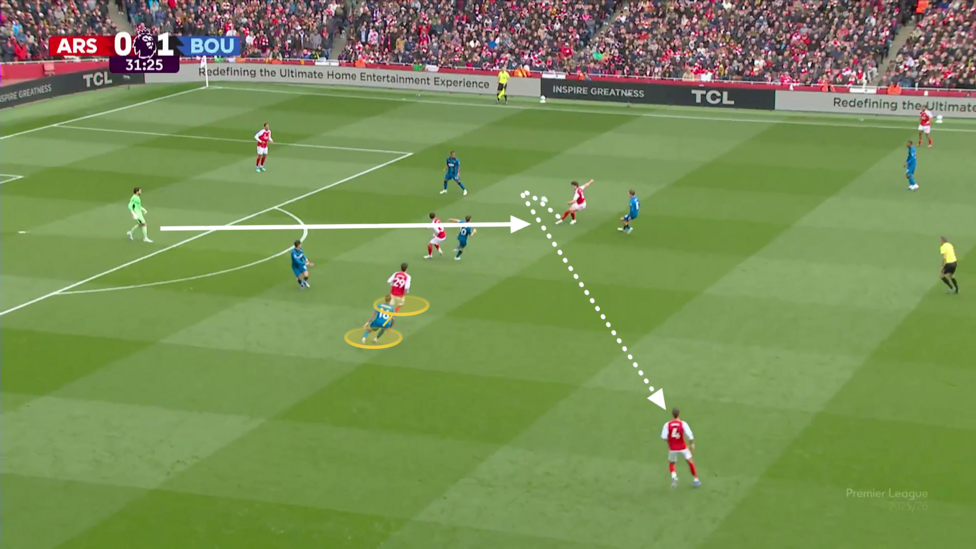
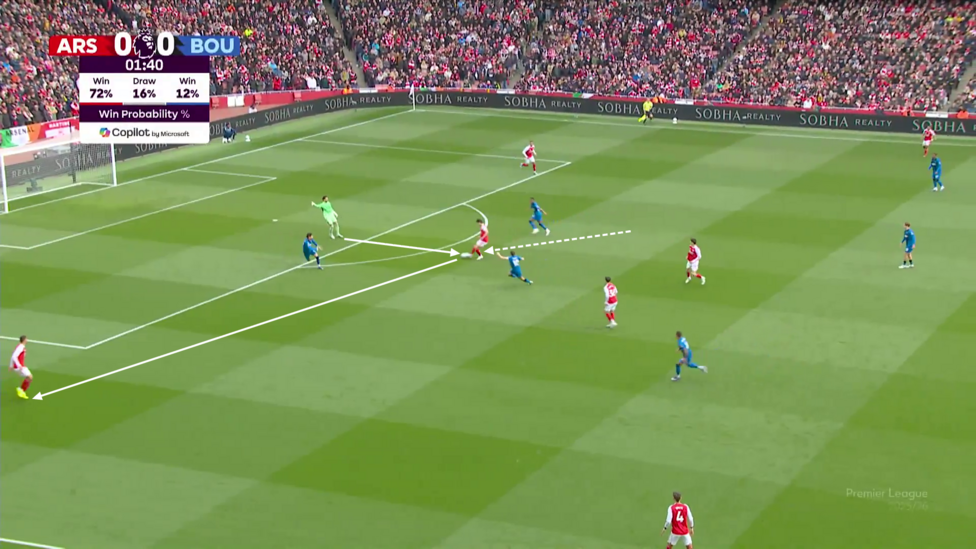
For example, against Bournemouth, Havertz attracted Tavernier inward, freeing White. Raya then found Rice, who moved sharply into space before delivering a pass intended for White.
Although the pass was overhit—a recurring issue—these patterns proved effective multiple times and merit continued use.
Defensive Considerations Against Manchester City
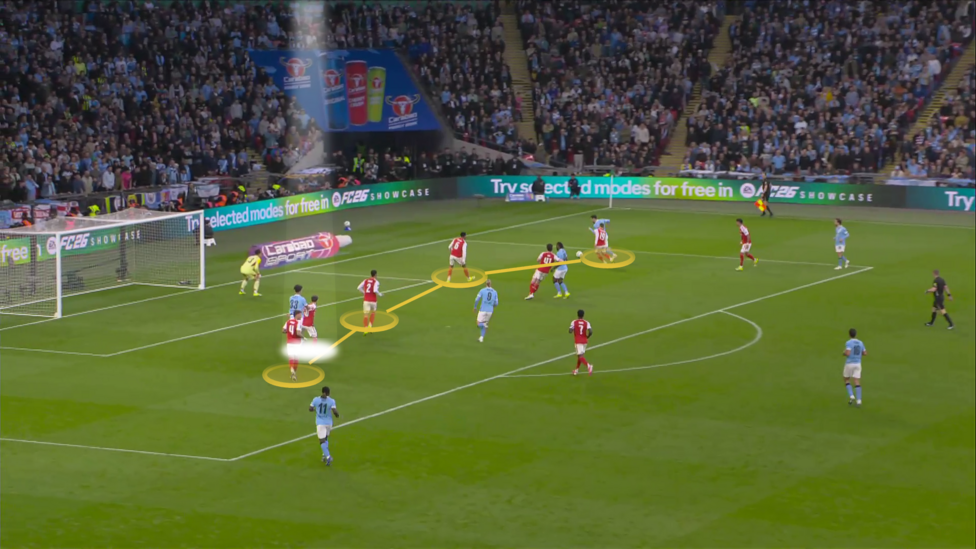
Defensively, Arsenal must remain vigilant against Nico O'Reilly, whose versatility has been instrumental in City’s resurgence since late last season. O'Reilly scored twice against Arsenal and once against Chelsea recently.
O'Reilly’s unconventional positioning—operating between traditional roles such as left-back, winger, or attacker—creates defensive challenges.
Arsenal alternated between having Bukayo Saka and Zubimendi mark O'Reilly, with both players losing him for goals. Chelsea’s Andrey Santos also attempted to man-mark O'Reilly but was eventually outmatched physically as O'Reilly scored to give City the lead.
Current Form and Mental Challenges
Arsenal have shown glimpses of solutions to the tactical questions posed in recent weeks but have struggled with consistency due to sloppy passing.
The injury to Bukayo Saka has reduced Arsenal’s capacity to control games and maintain pressure in the final third.
Combined with a seemingly more cautious approach from some players, it is arguable that the physical and psychological demands of the title race are impacting the team.
As Arteta continues to inspire his players and supporters, he appears to prioritize the mental aspect of the competition to match a Manchester City side gaining momentum.
Balancing this with necessary tactical adjustments on a game-by-game basis presents a significant challenge in the season’s final weeks. Nevertheless, Arteta and his squad may be closer to securing a historic campaign than some fans realize.


