

Late VAR Penalty Decision Boosts Celtic
Two recent matches featured stoppage-time video assistant referee (VAR) interventions that could prove decisive in their respective title races.
On Sunday in the Premier League, West Ham had a late equaliser against Arsenal disallowed due to a foul by Pablo on goalkeeper David Raya. This decision secured a 1-0 victory for Arsenal, maintaining their control over the title race while increasing West Ham's relegation concerns.
Then, on Wednesday night in the Scottish Premiership, VAR awarded a penalty for handball against Motherwell's Sam Nicholson with only eight seconds left in added time. Kelechi Iheanacho converted the spot-kick, securing a 3-2 win for Celtic with the final kick of the game.
Both decisions favored the larger clubs competing for the title, who often face less public support. However, the processes and standards for these VAR decisions differed notably.
Many Fans Feel VAR Was Promoted as the Ultimate Solution
Celtic's match-winning penalty came after a VAR review that found handball by Motherwell's Sam Nicholson.
"The controversy and discontent around West Ham not being given the goal is because it's Arsenal," Danny Murphy commented on Match of the Day (MOTD).
Murphy suggested many neutral fans may be reluctant to see Arsenal win the title, partly due to their playing style, perceived reliance on set-pieces, and accusations of physicality during corners.
"They can't be held accountable for decisions in the past," Murphy added. "Just because it's Arsenal we shouldn't get it distorted."
In Scotland, those not supporting Celtic or Hibernian likely prefer Hearts to win the title, breaking the longstanding Celtic-Rangers dominance. Since Sir Alex Ferguson's Aberdeen won in 1984-85, no team outside the Old Firm has been crowned Scottish champion.
Thanks to the VAR decision, Celtic now only need a win by any margin against Hearts in Saturday's title decider at Parkhead, rather than a three-goal victory.
Both VAR calls sparked significant controversy among pundits, fans, and media alike.
Headlines included:
- "Penalty for this? Celtic and Hearts face title decider as McInnes slams 'disgusting' call"
- "Five 'fouls' in one move - breaking down Premier League corner chaos"
- "Biggest VAR call ever? Four chaotic minutes that may define the season"
This raises questions about whether football has improved with VAR and whether reactions would differ without it.
Many supporters believed VAR would end disputes over decisions, but it has arguably intensified debates, with criticism directed at both on-field referees and video officials.
However, it is important to acknowledge that before VAR, decisions were also frequently contested, prompting the introduction of video review.
For example, the image of Pablo holding onto goalkeeper Raya was widely shared on social media and cited by Arsenal manager Mikel Arteta as evidence of an error. Yet, most pundits and refereeing experts agreed disallowing West Ham's goal was correct. Opposition largely came from fan sentiment.
Conversely, in Scotland, there is near-universal agreement that VAR should not have awarded the penalty to Celtic. Hearts' manager Derek McInnes described the decision as "disgusting."
Why VAR Official Andrew Dallas Had Only One Camera Angle
There is a certain irony, given that Arsenal have been the kings of the dark arts on set-pieces this season, that they beat West Ham thanks to VAR ruling out Pablo's effort for a foul on Gunners keeper David Raya.
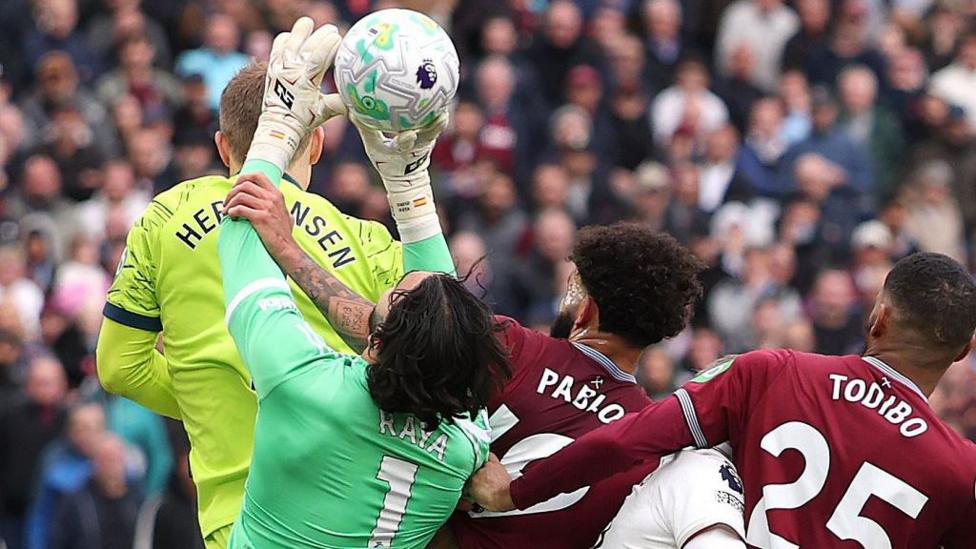
The VAR official for the Arsenal match, Darren England, spent two minutes and 41 seconds reviewing multiple angles of footage, examining potential fouls and penalties. Referee Chris Kavanagh then spent one minute and 15 seconds at the pitchside monitor, viewing 17 replays. The total review lasted four minutes and 11 seconds.
By contrast, the Celtic game’s VAR review was shorter and simpler, involving only one incident. The match was stopped for one minute and 25 seconds while VAR Andrew Dallas conducted a penalty check. Referee John Beaton spent just 20 seconds at the monitor, watching two replays. Dallas manipulated the frames to demonstrate clear contact between the ball and Nicholson's hand.
The entire process from potential handball to penalty award took two minutes and four seconds, roughly half the duration of the London Stadium decision.
VAR in Scottish football faces resource limitations. English grounds have a minimum of 28 cameras available to VAR officials, often more. Scottish matches typically have six cameras, increasing to 12 for televised fixtures.
That the VAR could present only one camera angle to the referee underscores these constraints. Beaton saw only what viewers at home saw on television.
Referees must trust that VAR intervenes only when a clear error has occurred. This explains why referees rarely uphold their original decisions after VAR review; the video assistant is the ultimate arbiter.
Therefore, regardless of whether the ball actually touched Nicholson's hand, it was a bold decision by VAR to claim definitive evidence.
"VAR was introduced to, in Fifa's terminology, not to look for pebbles but look for boulders," former Scottish Premiership referee Bobby Madden told BBC Radio 5 Live. "Last night isn't a pebble, it is not even a grain of sand. It goes against the whole ethos of why VAR was introduced."
The controversy was such that fans circulated fabricated images on social media, purporting to provide definitive proof.
VAR Requires Evidence That Is 'Absolutely Categorical'
The VAR felt there was no conclusive proof to rule out a goal by Manchester United's Benjamin Sesko against Liverpool in the Premier League.
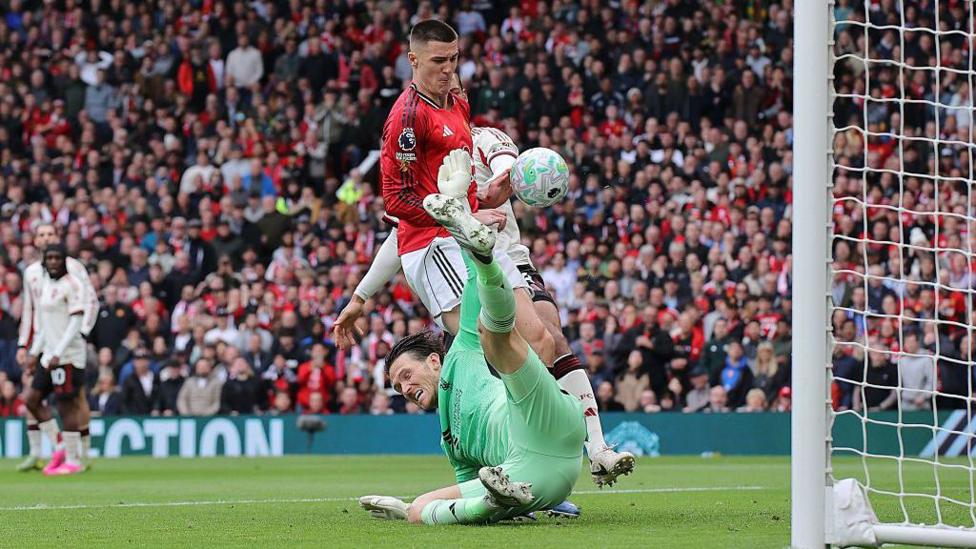
On Tuesday, Premier League referees' chief Howard Webb discussed a handball decision that was not given. When Benjamin Sesko scored Manchester United's second goal against Liverpool earlier this month, there was a possibility the ball touched his fingers before entering the net. According to handball laws, this should have led to disallowing the goal.
However, VAR Stuart Attwell, despite multiple camera angles, could not be "absolutely categorical" about the handball.
Given the limited camera angles and lighting at Fir Park, it is difficult to understand how Andrew Dallas could be certain in the Celtic-Motherwell incident.
While the decision at the London Stadium may be seen as just, the Scottish case appears less clear.
Did the ball touch Nicholson's hand or his head? Only the player knows, and that alone should not suffice for VAR intervention.
VAR has not eliminated arguments about football decisions, and given the sport's partisan nature, this was unlikely to happen.
What Does This Say About How VAR Is Working?
VAR remains divisive regardless of decision correctness and continues to frustrate fans.
Celtic fan writer Martin Callaghan commented:
"Maybe the biggest debate about the late penalty that Celtic got at Fir Park last night is just how sure (or not!) referee John Beaton could have been that a handball did indeed occur when he was called to the VAR monitor in the dying minutes of the game.
"So although I'd say that he did get it right, are he and his colleagues truly working with the suitable technology, resources and tools to consistently nail what could be decisions with multi million pound consequences?
"The product here in Scotland has been described in places as 'VAR Lite' and I'd say that's as accurate a way as any to describe what our officials are working with - and also what our supporters are having to endure.
"It's quite clear (pardon the pun) that there's simply not enough cameras to ensure that with any contentious decisions such as this one the referee is given enough data to make a truly informed decision – and that can't be right.
"So while the decision went Celtic's way last night – and some sort of myth has since been peddled that it was ever thus – the reality is that everyone is suffering with our below par product.
"Players, fans, clubs, coaches – and perhaps most of all, those in the middle who are ultimately tasked with making the big calls."
Hearts fan writer Greg Playfair stated:
"We could talk about the VARdict on Celtic's late penalty for another 40 years, under the current VAR set-up in Scotland.
"To borrow a VAR phrase, it's clear and obvious that the system is flawed - and it has nothing to do with the technology itself. My issue is with how the officials continue to misuse it. We're now in a position where human error could cost Hearts a potential £30-40m in Champions League revenue.
"It feels as though head of refereeing Willie Collum and his team have made things unnecessarily convoluted for officials in Scotland, particularly with interpretations of laws such as handball that seem to create controversies here which simply do happen elsewhere in European football.
"The other issue I take offence to is this: we have matches worth millions of pounds being officiated by part-time referees. Is some of the erratic decision-making down to the fact these officials are spending 40 or 50 hours a week in their main jobs and then arriving at grounds already fatigued?
"There needs to be a radical review and overhaul of refereeing in Scotland as soon as possible. But I've got a nagging feeling there will be one last controversy yet in the title decider between Celtic and Hearts, as the current set up is not fit for purpose."
Arsenal fan writer Chris Howard remarked:
"As a match-going fan, I experience the agony of a VAR 'wait' call on a regular basis, and I am not a fan. But Pandora's box has been opened, so we all need to reframe our relationship with it.
"I think we also have to go back to what we all want from VAR. We hear 'consistency' and 'getting the right decision' as the key reasons. The first part can be debated, but I do feel that when the decisions aren't extremely subjective ('that's never a pen'), VAR does often get things right.
"The noise around West Ham's disallowed goal was not about the decision in isolation, it was partisan fans, commentators and ex-players having their say, trying to create noise and get themselves profiled.
"We do, however, need to look at who is in charge of VAR and I do think a review of the people behind the screens is something that needs to be done, which I think will have to happen sooner rather than later."
West Ham fan writer Holly Turbutt observed:
"The VAR decision in the West Ham-Arsenal game has caused a huge debate among fans as to how useful this technology actually is in the Premier League.
"We know it was introduced to stop those clear and obvious errors that we were seeing happening quite a lot with referees, but the problem is that it still comes down to human error and human decision-making, and you can't look at everything across the board.
"That's where the frustration is coming.
"We're seeing inconsistencies as fans. We're seeing four-minute checks when fans don't know whether to celebrate or not. We're seeing so many situations that don't get looked at - or a situation that is given as a foul through VAR in one game, but not in another.
"And you've also got the situation when, if a referee goes to the screen, 99% of the time it feels like they are going to change their mind.
"All of this means VAR does not really feel like the useful resource we hoped it might be when it was introduced.
"Ultimately, VAR shines a spotlight on one moment but then it still comes down to a human decision in that moment, which is prone to human error and bound to cause debate among fans because it's such a pressured environment.
"The question is: has it actually changed anything?"
- Follow your club with
- Robertson to referee decider amid Hearts concerns
- Penalty pandemonium sets up Hearts & Celtic showdown for the ages


