

Parents urge council not to shut Scotland's smallest secondary
Enrollment at Dalry Secondary School has declined steadily, with projections indicating only eight pupils will attend by August.
The parent council of Scotland's smallest secondary school has appealed to Dumfries and Galloway Council (DGC) to reconsider plans to close the institution as the council prepares to decide its future.
DGC is being advised to initiate the statutory process that could lead to the permanent closure of the Dalry site.
Although the school has a capacity for 248 pupils, forecasts suggest only eight students will be enrolled from August this year.
DGC's education committee is recommended to approve the commencement of a multi-phase statutory process that may result in the school's closure.
Get in touch
What stories would you like to cover from the south of Scotland?
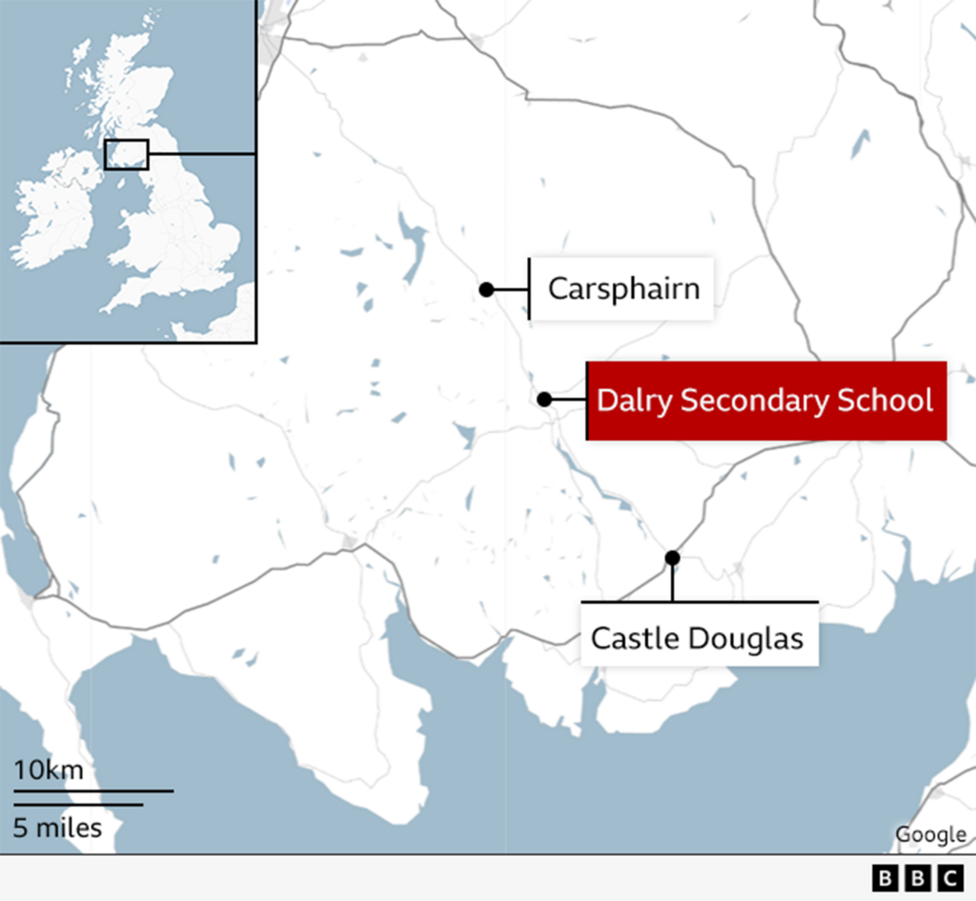
Dalry Secondary provides education for pupils from S1 to S4, after which students transfer to Castle Douglas High School, located approximately 16 miles (25 km) away, for S5 and S6.
The school has been at the centre of an extended debate regarding its future, with parents previously celebrating a decision to halt the "mothballing" of any secondary school in the region in 2024.
Despite this, pupil numbers have continued to decline, and following consultation, the council has proposed closing the school permanently.
In the 2025/26 academic year, the school had 13 pupils; this number is forecast to decrease to eight as most children in the catchment area attend other schools.
A report highlighted that transferring the remaining pupils to another secondary school could "provide access to a wider curriculum, larger peer groups and more sustainable staffing structures."
Anne McEwan, chair of the parent council, expressed disappointment that the closure recommendation is being presented to councillors without alternative proposals.

"The future of rural education in Scotland needs to be considered in a different way to non-rural education," she said.
"The current situation in Dalry gave DGC an opportunity to lead the way on what rural education can look like and be a real trailblazer.
Instead we are left with closure as the only proposed way forward and none of the steps taken by the council previously which led to an early decline in pupil numbers are being considered or addressed."
The parent council has urged councillors to reject the closure proposal and to identify at least two "viable alternatives."
However, a report to the education committee stated that all "reasonable alternatives" had been considered and closure was deemed the "most appropriate response."
The report cited declining pupil numbers, limited opportunities for peer interaction, challenges in delivering a "broad and balanced curriculum," and high running costs as key issues facing the school.
What steps are needed to close a rural school?
The Schools (Consultation) (Scotland) Act 2010 outlines the procedures required to close a school.
For rural schools like Dalry, the local authority must identify the reasons for closure and determine whether it is the most appropriate course of action.
The second phase involves consulting on the proposal for a minimum of six weeks, including at least 30 school days.
Subsequently, a report is submitted to Education Scotland, which must prepare an assessment of the educational impact within three weeks.
The next phase, without a specific timescale, requires the local authority to publish a consultation report.
After a minimum of three weeks, the authority makes a final decision and, if closure is decided, informs the Scottish Government within six working days.
Ministers then have up to eight weeks to decide whether to "call in" the proposal for further scrutiny.
If called in, the matter proceeds to a School Closure Review Panel, which has up to 17 weeks to issue its verdict.
If consent is refused, no new attempt to close the school can be made within five years unless there is a "significant change" in circumstances.
- Scotland's smallest secondary school recommended for closure
- What will become of Scotland's smallest secondary?


