
"I never, I never": Watch Twana Jamal's reaction when BBC confronts him about people smuggling
A convicted people smuggler, once described as "the godfather" of the French migrant camps, is residing in Leicestershire and is believed to be seeking asylum while working illegally, according to a BBC investigation.
Twana Jamal was sentenced to five years in prison in France in 2016, where authorities identified him as one of the most successful people smugglers ever apprehended.
Prosecutors stated that the Iraqi Kurd, who was 36 years old at the time, earned up to £100,000 weekly by facilitating illegal crossings of immigrants across the Channel.
Following a tip-off earlier this year, the BBC traced Jamal to the village of Blaby, observing him working, driving a car without a licence, and apparently using a false name.
Jamal's presence in the UK raises significant concerns regarding the effectiveness of current border controls in vetting asylum seekers with serious criminal records abroad.
Immigration officials informed the BBC that since the UK's departure from the European Union, it has become more challenging to access criminal records from certain countries.
Additionally, law enforcement sources in mainland Europe revealed that 15 other convicted people smugglers are currently living in the UK under assumed identities.
The man known as 'Pasha'
The BBC's exposure of Jamal emerged as part of an investigation that led to the arrest of prominent people smuggler Kardo Jaf, detailed in the BBC Radio 4 podcast To Catch A King.
A new figure is reportedly managing people-smuggling routes into the UK. Investigators Sue Mitchell and Rob Lawrie sought to uncover his identity.
Following a tip-off, the BBC learned that Jamal, another major player in the trade, was living and working in the UK. He was described as driving a BMW and appearing "very very rich."
Like Jaf, Jamal was associated with the so-called Ranya Boys, a Kurdish gang group that European law enforcement agencies say has dominated cross-channel people smuggling for the past 15 years.
Details from Jamal's 2016 trial in France revealed that from approximately 2012 to 2016, he operated out of the Grand Synthe camp near Dunkirk, charging customers £4,500 to £5,000 for passage to the UK.
At that time, freight lorries were the preferred method for cross-channel smugglers, rather than small boats.
The court also heard that Jamal's nickname in the camps was "Pasha," a Turkish term meaning a person of high rank.
Jamal claimed mistaken identity during his French court proceedings, but was convicted and informed he would be deported to Iraqi Kurdistan after serving his sentence.
2016: Grande Synthe camp in northern France, where Jamal ran his people smuggling operation
Despite serving time in a French prison, Jamal entered the UK and, when confronted, stated he had applied for asylum and was "still waiting."
Several legal barriers exist for criminals seeking asylum in the UK. The law mandates refusal for anyone who has served 12 months or more in prison overseas.
It is possible that Jamal's criminal record was not checked or that he used a false identity.
During his trial, the court heard that Jamal used multiple aliases—so many that prosecutors said he would write his assumed name inside his baseball cap to remember his identity.
'This city is ours'
The BBC narrowed their search for Jamal using multiple sources, one of whom arranged a call with Jamal under false pretenses and recorded the conversation.
Jamal said he was now based in Leicester, and boasted: "We know everyone in this city, this city is ours."
He was making "good money," and told the contact there was work available "moving cigarettes" from a warehouse.
Jamal also admitted driving a car without a licence but said he was not concerned about being investigated or caught.
"No-one touches us here," he said. "Even the police won't stop you."
Using this information, the BBC searched for businesses in Leicester connected to Jamal and found two mini-marts named Candy Corner in Blaby, a village of about 6,000 people near the city.
The two stores are located meters apart on opposite sides of the high street, with one adjacent to the local Conservative MP's constituency office.
Over several days, the BBC observed activity at the brightly colored shops, which sell vapes and sweets late into the evening.
The BBC had a photo from Jamal's 2016 French court appearance showing him flanked by police and wearing a weightlifter's vest.
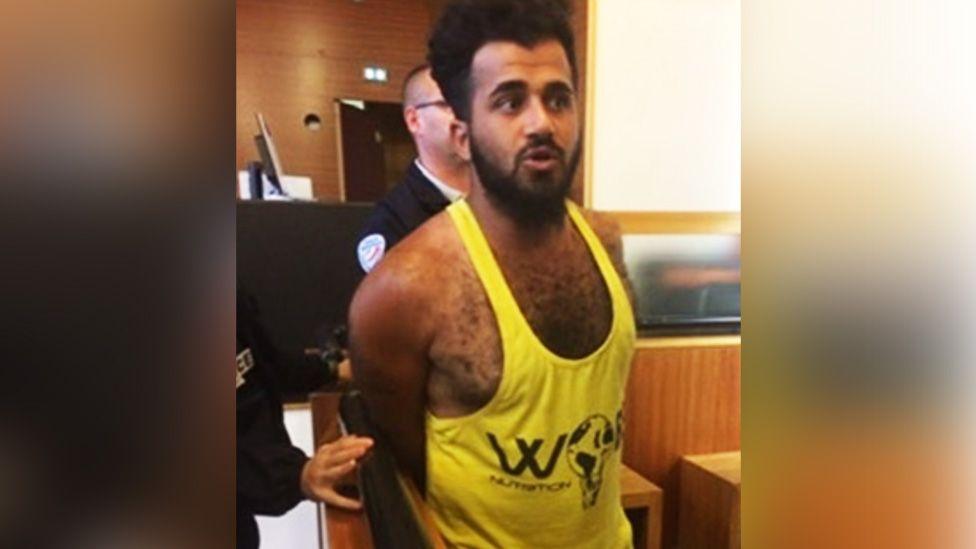
Soon, someone resembling Jamal was seen, now dressed smartly in jeans and what appeared to be a cashmere coat.
To confirm his identity, the BBC made an undercover visit to one of the shops where he was working the till and initiated a conversation.
He introduced himself as "Sultan" and displayed a tattoo on the back of one hand matching one seen on Jamal's social media, where he calls himself Sultan Pasha.
If Jamal was claiming asylum, he should neither have been working nor driving, yet he was observed doing both over several days.
'I don't care'
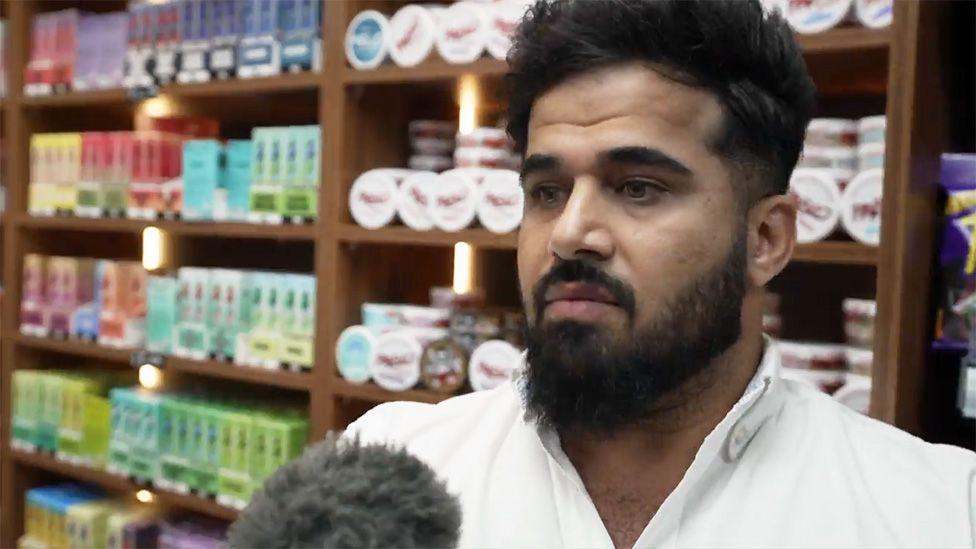
Finally, the BBC confronted Jamal at one of the mini-marts while he was sweeping outside.
He told us he had never been involved in people smuggling and had not been jailed in France. Jamal claimed to have been in the UK since 2009.
When shown the 2016 French courtroom photo, he did not deny it was him. However, when confronted with the evidence of his arrest, he replied:
"I don't care."
Jamal also denied working at the mini-mart despite being seen behind the till and moving stock.
He refused to disclose his real name but said the Home Office and immigration services were aware of it.
When asked why he was driving without a valid licence, Jamal responded:
"So what? Did I hit you?"
Sufficient checks?
Jamal's case is not unique. European law enforcement officers have identified 15 convicted people smugglers from France, Germany, and Belgium believed to be living in the UK under false identities and claiming asylum.
One man convicted in France now resides in Manchester selling used cars and is thought to remain involved in people smuggling.
Another convicted individual is based in Blackpool, has claimed asylum under a false name, and boasts on social media about having leave to remain.
Since Brexit, the UK no longer shares data with many EU countries, complicating checks on asylum seekers' criminal and immigration records, according to Lucy Morton of the Immigration Services Union.
"If we were able to share databases, even if just with our nearest neighbours, with Germany, with Belgium, with Holland and France, say - then, yes, we'd know that they had a conviction for people smuggling," she said.
Asylum seekers are fingerprinted upon arrival in the UK and checked against UK police databases, but these do not necessarily reveal convictions from other countries.
The Home Office stated:
"All asylum claimants are subject to mandatory security checks to confirm their identity for the purpose of immigration, security and criminality checks."
This was reiterated in November by the Minister for Border Security, Alex Norris, who added that details of these checks are not publicly disclosed to protect their integrity.
The Home Office further noted that the UK maintains several agreements enabling the sharing of criminal record information and that immigration enforcement actions are at their highest level ever, with arrests for illegal working up 83%.
Get in touch
Do you have any comments or questions about this story?


