

Family Faces Uncertainty Over Proposed AI Data Centre in Auchtertool
Lindsey Charnley and her family relocated to the tranquil village of Auchtertool with the hope that her children would experience a peaceful rural upbringing.
Her youngest son, Teddy, aged nine, has undergone 27 brain surgeries over the past four years. Exposure to noisy environments triggers severe pain for him.
However, their continued residence in the Fife village is now in jeopardy due to plans to construct one of the world’s largest data centres directly adjacent to their property.
Data centres serve as hubs that store, process, and operate vast amounts of data and software essential to internet functionality. Currently, 24 such centres are in the planning stages across Scotland.
Scotland’s abundant renewable energy resources make it an attractive location for these facilities, but local communities have expressed significant concerns.
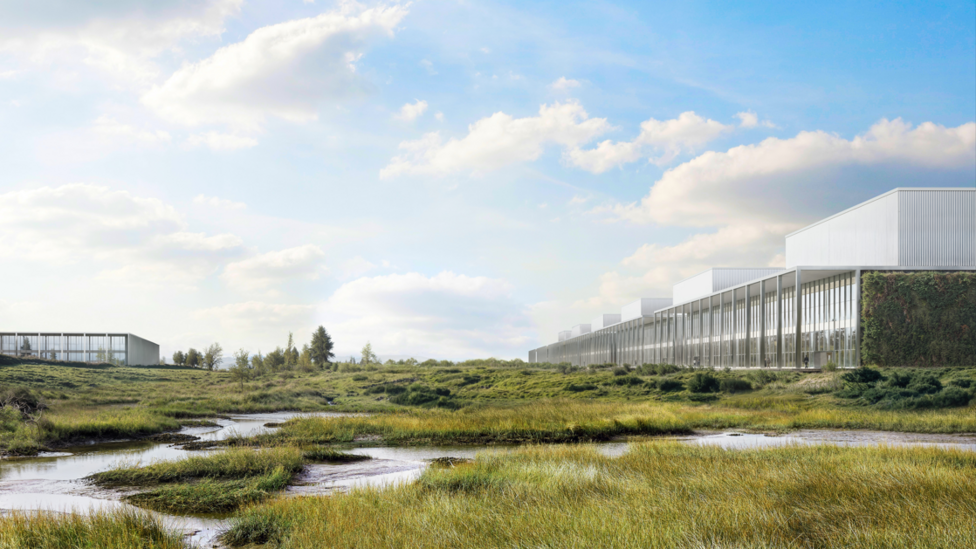
The proposed 600MW data centre in Auchtertool is set to cover 60 hectares (150 acres) and operate continuously to support artificial intelligence (AI) applications.
Developers highlight that the project would generate 120 jobs in an area recently affected by major job losses following the closure of the Mossmorran chemical plant.
They have committed to engaging with local residents individually to address their concerns.
"I can't believe anyone would think it is appropriate to build a data centre the same size as our village on our doorstep," Lindsey said.
"There are so many concerns, but for my family it will be the noise and chaos from the construction, my son won't cope with that."
"We are still trying to figure out how best to support his pain so the noise levels are a huge factor for us," Lindsey added.
"If the centre goes ahead we can't stay here. We will have to uproot.
"All his medical staff are nearby and his additional support needs school, it will be a complete disaster for us."
Data Centre Scale and Community Impact
Currently, Scotland hosts 15 operational data centres, with the largest in Lanarkshire having a capacity of 12MW.
Since the Scottish government introduced an action plan in 2021, there has been a surge in applications for hyperscale data centres—those with power capacities exceeding 100MW.
The Cato data centre in Auchtertool remains in the early planning phase, with the Scottish government assessing whether an environmental impact assessment is necessary.
ILI Group, the company proposing the project, also plans similar hyperscale data centres in North Lanarkshire and Ayrshire.
Local residents have united to express their opposition.
Michael Hodgson and his partner Jonathan Leitch have lived in Auchtertool for 13 years and are concerned about the potential effects on their holiday rental business.
"It's a quiet log cabin surrounded by trees and nature," Michael said.
"The construction noise and the development would destroy the attraction of staying here and consequently a drop in bookings would hit us greatly."
The proposed data centre would be located directly across the road from Michael’s home and Airbnb property.
"It is going to be 600MW - just 50MW less than the largest one in Nevada which is 650MW," he added.
"At 35m (114ft) high, it would be three times the height of my house.
"The village will be left in the shadows of the data centre.
"It's huge. It is like having a tower block laid on its side plonked in the middle of the countryside."


Campaigns and Public Protests
Action for Protecting Rural Scotland, a campaign group, has called for a moratorium on hyperscale data centres.
The group advocates for comprehensive research to fully understand the impacts before approving further applications.
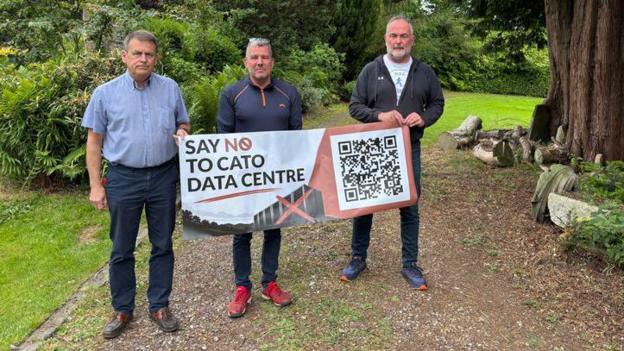
On Wednesday, approximately 50 individuals from Edinburgh, Falkirk, Fife, the Borders, and other areas gathered outside the Scottish Parliament to protest against data centre developments nationwide.
Protesters chanted slogans such as "say no to data centres" and displayed signs reading "Say No to Cato Data Centre," "Stop Hermiston AI Data Centre," and "Save the Lammermuir."

Reasons Behind Scotland's Data Centre Boom
The planned data centres would primarily utilize renewable electricity, predominantly generated by Scotland’s wind turbines.
However, due to grid capacity limitations, turbines are often curtailed or "turned off," leading to significant compensation payments to wind farm operators.
Mark Wilson, CEO of ILI Group, stated their intention to better utilize this surplus energy.
"The head of the National Grid said that if you are going to put a data centre in the UK, put it in Scotland because if it is going to help with that extra supply, billions won't be wasted and it should eventually bring consumer household bills down.
"Scotland is in a position not a lot of other countries are and we feel this is an opportunity we cannot afford to miss," he said.
Wilson acknowledged that the Auchtertool plans have met with negative community feedback.
"We want to talk to people individually, listen to their concerns and consider what we can do to alleviate their worries," he said.
The combined energy capacity of their planned hubs in Ayrshire, North Lanarkshire, and Fife would total 1540GW.
"We believe we will create a blueprint for an all-green AI data centre that will be replicated all over the world," Wilson added.
He also noted that the construction of these hyperscale data centres could generate hundreds of new jobs.
"We believe the sites for our data centres are the right sites for Scotland.
"The site in Fife is already in an industrial area which is ideal for employment.
"It is also close to the Mossmorran power plant that shut down recently causing job losses.
"We are creating hundreds of apprenticeships so we can retrain those who worked at Mossmorran to move into the data centre or renewable energy sector."
Political Response and Planning Considerations
The Scottish Greens raised the issue during the final First Minister's Questions before the summer recess, urging John Swinney to support a moratorium on planning approvals for such data centres.
Swinney acknowledged environmental concerns related to hyperscale data centres and stated he was giving "active consideration" to whether local authorities should receive new national planning guidance.
He suggested that such guidance could help balance the rapid expansion of these centres with Scotland’s national energy and climate objectives.
A Scottish government spokesperson emphasized that the perspectives of communities affected by these developments must be central to decision-making processes.
They added that planning authorities are responsible for evaluating the environmental implications of all developments requiring planning permission.
Get in Touch
What stories would you like to cover from Edinburgh, Fife, and the east of Scotland?


