

Government urged to cut energy taxes before bailouts
The government should reduce taxes on energy bills prior to considering bailout measures, Kemi Badenoch has stated.
The Conservative leader told the BBC's Sunday with Laura Kuenssberg programme that direct payments to households would entail a cost in the form of increased taxes.
However, when questioned, she did not rule out direct payments if energy bills were to surge significantly.
Context of energy price pressures and government responses
Last week, Chancellor Rachel Reeves indicated that the government would offer support to "those who need it most" if energy bills escalated due to the ongoing US-Israeli conflict with Iran.
Iran has effectively blocked the Strait of Hormuz, a critical oil shipping route, causing wholesale oil and gas prices to soar.
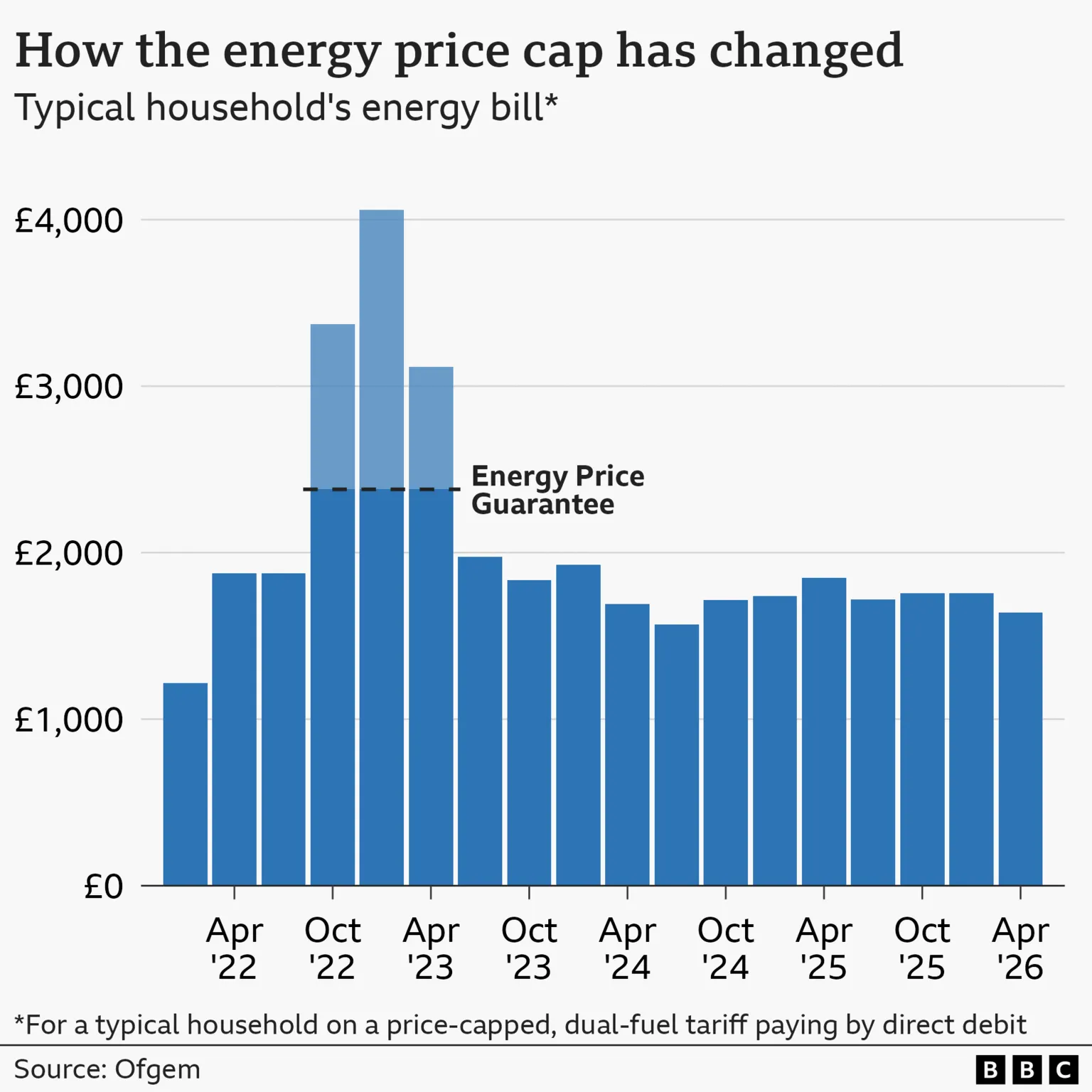
Energy bills for millions in England, Scotland, and Wales are set to decrease for three months starting in April under Ofgem's quarterly updated price cap. However, following this period, bills are expected to rise due to the conflict's impact.
Badenoch's stance on support measures
When asked who should receive support if energy costs increase, Badenoch expressed a preference for the government to "take the burden off everybody" by lowering taxes on energy bills.
"I'm not ruling out anything. What I'm saying is let's start off with taking the taxes [off]."
She criticised the government for focusing support on benefit recipients while raising taxes on others.
The Conservative Party has pledged to eliminate green levies on energy bills, including the Renewable Obligations Certificate and the Carbon Tax, which finance renewable energy projects.
Pressed further on whether she was excluding direct payments to households, Badenoch reiterated:
"Let's not pretend that these huge bailouts don't come with a cost."
She referenced the rise in interest rates following Conservative government interventions to support households during the Covid-19 pandemic.
Under former Conservative Prime Minister Liz Truss, the government provided universal energy bill support following Russia's full-scale invasion of Ukraine.

The current administration has indicated that universal support is unlikely this time.
Reeves has stated that any support package would be limited by government borrowing rules and the objective to maintain low inflation and interest rates.
Opposition and other party positions
Liberal Democrat leader Sir Ed Davey has proposed universal assistance with energy bills.
The party's energy security spokeswoman, Pippa Heylings, emphasised that the government "cannot simply ignore the millions of families who don't get benefits, but are already facing a cost of living crisis".
The Green Party has called on ministers to guarantee that bills will not increase in July when the price cap is updated.
Reform UK has advocated scrapping VAT and green levies on household energy bills if elected.
Conservative proposals on domestic energy production
Meanwhile, the Conservatives are urging the government to maximise domestic oil and gas production in the North Sea and to abolish the windfall tax on oil and gas companies.
Badenoch acknowledged that this approach would not directly reduce energy bills but suggested that profits and taxes from drilling could be used to subsidise them.
The government has prohibited licenses for new oil and gas fields in the North Sea but maintains that oil and gas will remain part of the UK's energy mix for the foreseeable future.
Education Secretary Bridget Phillipson defended this strategy as "pragmatic," stating that the UK needs to transition away from fossil fuel dependence and invest more in domestic energy sources.
Reform UK's Zia Yusuf criticised previous Conservative governments for increasing taxes on North Sea drilling and introducing green levies on energy bills, saying:
"They are shameless arsonists offering to rebuild your home having spent 14 years burning it to the ground."
Further information and newsletter promotion
for our Politics Essential newsletter to keep up with the inner workings of Westminster and beyond.



