

The day so far
US President Donald Trump urged Iran on Tuesday to "do the smart thing" and reach a deal, emphasizing that despite the fragile ceasefire in the Middle East, he did not want to cause further Iranian casualties.
"They should do the smart thing, because we don’t want to go in and kill people. Really don’t," Trump told reporters in the Oval Office when asked about Iran. "I don’t want to, it’s too tough."
Washington stated that Iran had not violated the delicate ceasefire on Tuesday, following an exchange of fire the previous day as US forces sought to reopen the Strait of Hormuz. The US military reported destroying six Iranian small boats, along with cruise missiles and drones, after President Trump deployed the navy to escort stranded tankers through the strait in an operation named "Project Freedom."
US Defense Secretary Pete Hegseth addressed rumors about the US possessing "kamikaze dolphins," stating the US does not have such marine mammals but declined to confirm or deny any related capabilities. This was in response to reports suggesting Tehran might be using marine mammals as weapons amid the Gulf crisis.
The United Arab Emirates' defense ministry reported that its air defenses were responding to missile and drone attacks originating from Iran, marking a second consecutive day of assaults after a four-week period of relative calm since the US announced a ceasefire. The UAE had earlier confirmed it was attacked by Iran on Monday as the US moved to reopen the Strait of Hormuz.
Ukrainian President Volodymyr Zelenskyy stated he discussed Iran’s airstrikes against Bahrain and the Strait of Hormuz during a meeting with Bahrain’s King Hamad bin Isa Al Khalifa.
"Our country is facing similar terrorist strikes almost every day, and our people have relevant experience in full-scale defence," Zelenskyy wrote on X. "Ukraine is ready to security expertise with Bahrain and help strengthen the protection of life."
An Israeli court extended the detention of two Gaza flotilla humanitarian activists until 10 May, according to the rights group Adalah, which plans to appeal the decision, as reported by .
Iran’s Foreign Minister Abbas Araghchi is scheduled to travel to Beijing for talks with his Chinese counterpart regarding bilateral relations and regional and international developments, according to a statement on Iran’s foreign ministry Telegram account. While China condemned the initial US and Israeli strikes on Iran that began the conflict in late February, it has since maintained a largely neutral stance and called for diplomatic solutions.
US Secretary of State Marco Rubio is set to meet Pope Leo on Thursday, with the US ambassador to the Holy See, Brian Burch, indicating the discussion will include a "frank conversation" about the Trump administration’s policies.
"Nations have disagreements, and I think one of the ways that you work through those is ... through fraternity and authentic dialogue," Burch said.
Pakistan’s Prime Minister Shehbaz Sharif condemned the attacks on the US-allied UAE following a barrage of missiles and drones that struck the Gulf nation yesterday. The UAE experienced repeated attacks for the first time since a ceasefire was established in early April. One attack caused a fire at a key oil facility in Fujairah and injured three Indian nationals, according to authorities.
The Israeli military issued additional forced displacement orders for residents in southern Lebanon, specifically for the towns of Jabsheet and Sarafand. The military’s Arabic-language spokesperson Avichay Adraee stated that these residents should evacuate their homes
"immediately and move away from the villages and towns for a distance of at least 1000 metres to open areas."
India’s Ministry of External Affairs condemned the attack on Fujairah in the UAE, which injured three Indian nationals, calling it "unacceptable" and demanding an immediate end to the targeting of civilian infrastructure and innocent civilians. Officials in Fujairah reported that a fire broke out at the Fujairah Oil Industry Zone following what they described as a drone attack originating from Iran. Civil defense teams were promptly deployed to contain the blaze, according to a statement from the Fujairah Media office.
Cargo vessel struck in Strait of Hormuz, says UK maritime authority
Further updates from the briefing include news that a cargo vessel was struck by an unknown projectile within the Strait of Hormuz, according to the United Kingdom Maritime Trade Operations (UKMTO) agency. The report was received at 7:30 pm UK time.
"UKMTO has received a report of an incident within the Strait of Hormuz. A verified source reported a cargo vessel has been struck by an unknown projectile. Environmental impact is unknown at time of report. Vessels are advised to report any suspicious activity to UKMTO, whilst authorities investigate."
Rubio plays down Trump's feud with the pope ahead of Vatican trip
Marco Rubio denied that his upcoming trip to the Vatican was intended to "smooth things over" with Pope Leo following Donald Trump’s public criticism of the Pontiff, who has been an outspoken critic of the war against Iran.
"It’s a trip we had planned from before, and obviously we had some stuff that happened and no, look, there’s a lot to talk about with the Vatican."
When asked about concerns from US lawmakers who view the US naval blockade as an act of war, Rubio insisted that Iran is attempting to normalize its control over the Strait of Hormuz.
"Under no circumstances can we ever allow them to normalize the fact that they get to blow up commercial ships and put mines in the water. So the response to that is, we’re going to blockade your ships.
That’s not an act of war, that’s a defensive measure – it’s a counter to what they have decided to do. You know what is an act of war? Putting mines in the water."
Regarding Iran’s nuclear program, Rubio stated that despite Iran’s claims of not seeking nuclear weapons, their actions have not aligned with these statements.
"They have an opportunity here to agree to something that will make it clear that they are not interested.
One thing is to say we don’t want a nuclear weapon, another thing is to do the things that prove you don’t want a nuclear weapon."
Rubio emphasized that Iran must make a sensible choice to pursue diplomacy, which could lead to reconstruction, prosperity, stability, and reduced global threat.
"The alternative is growing isolation, economic collapse, and ultimately total defeat.
They really shouldn’t test the will of the United States."
He added that the US prefers the straits to be open as they historically were, without mines or tolls.
"Anyone can use it. No mines in the water, nobody paying tolls. That’s what we have to get back to, and that’s the goal here."
Rubio outlined the effects of US sanctions and blockade on Iran’s economy, stating inflation is at 70%, the currency is in freefall, and the blockade costs Iran up to $500 million daily in lost revenue. He added that 90% of Iran’s trade has been halted, causing permanent damage to its oil infrastructure.
"This is all crippling Iran’s economy and it is being done in response to Iran’s piracy,"he said.
"It cannot be that [Iran] has these straits and they blow up any ship that moves, and the only ships that get to go through were theirs."
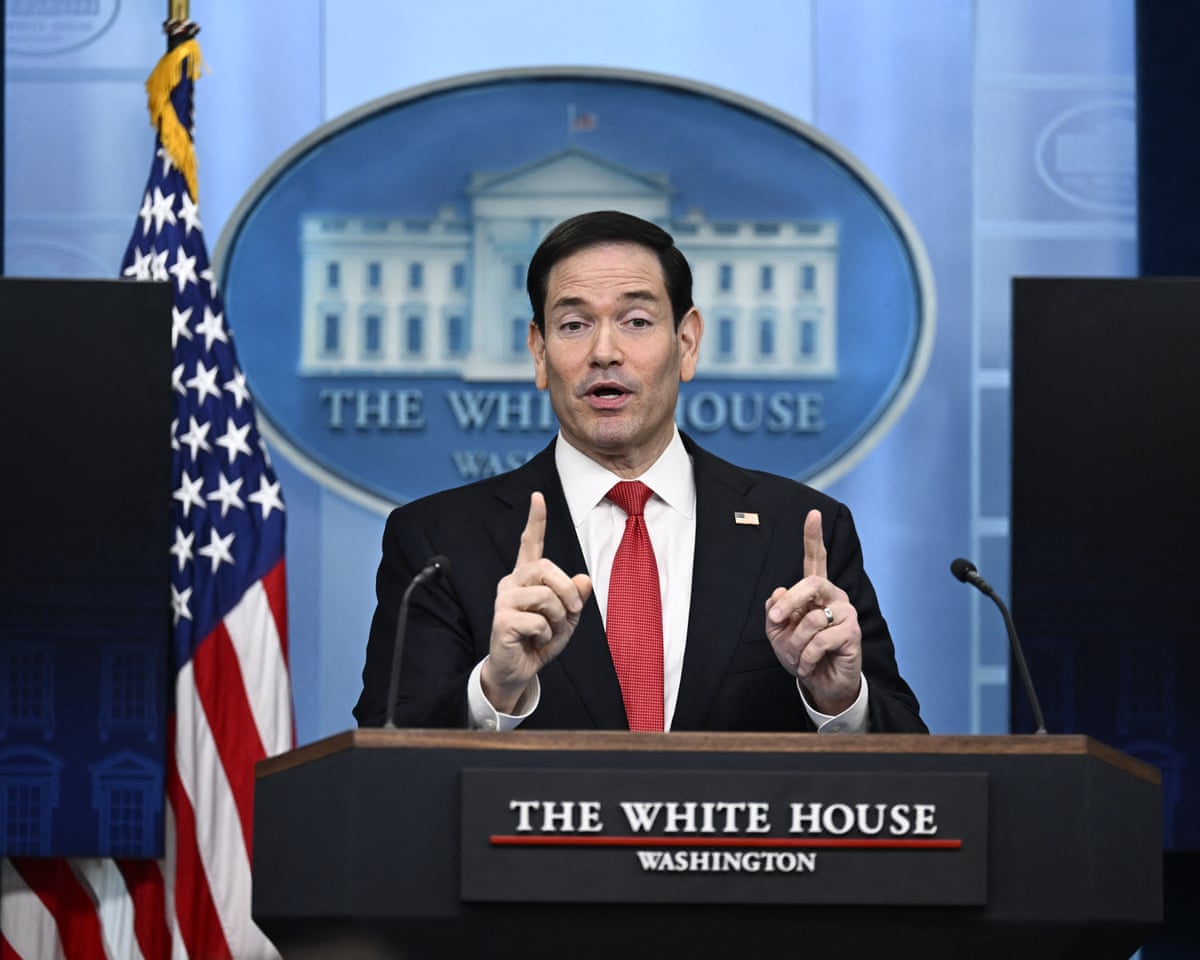
Rubio insists that 'Project Freedom' is a 'defensive operation'
Rubio described "Project Freedom" as a defensive operation.
"There’s no shooting unless we’re shot at first. We’re not attacking them, but if they are attacking us, you need to respond to that.
We’re not going to let some fast boat come up on a ship and shoot it up. We’re going to respond and we’ve been successful at it."
He noted that 10 civilian sailors have died amid the Strait of Hormuz conflict and described others stranded in the Gulf as being "held hostage" by Iran.
"They’re at the mercy of this piracy … They’re sitting ducks, they’re isolated, they’re starving, they’re vulnerable."
'Project Freedom' is rescue effort for mariners 'left for dead' in Strait of Hormuz, says Rubio
Rubio framed "Project Freedom" as a rescue mission.
"The goal of it is, frankly, to rescue almost 23,000 civilians from 87 different countries that are trapped in the Gulf and left for dead by the Iranian regime,"he said, referring to crew members stranded at sea amid the Strait of Hormuz crisis.


