

Missile Attacks Damage Qatar's Ras Laffan Gas Field
A major gas field in Qatar has suffered missile attacks resulting in "extensive damage," according to the country's state-run energy company. The strikes, attributed to Iran, come after reports that Israel targeted a petrochemical complex in Iran. These events have caused a significant increase in gas prices worldwide.
What is Ras Laffan and What Does It Do?
Ras Laffan Industrial City is Qatar's primary facility for producing liquefied natural gas (LNG), a key energy source used globally for cooking, heating, and electricity generation. It accounts for approximately one-fifth of the world's LNG supply.
Beyond LNG processing, Ras Laffan hosts a gas-to-liquids plant, LNG storage facilities, and an oil refinery. The industrial city is situated about 80 km (50 miles) northeast of Doha, near Qatar's North Field, an extensive gas field spanning over 6,000 sq km (2,315 sq miles).
Operated by QatarEnergy, the site also involves several international energy companies, including US firms ExxonMobil and Chevron, as well as the UK's Shell. Production at Ras Laffan has been halted since early March, shortly after the outbreak of conflict in the region.
Impact on Gas Prices
QatarEnergy confirmed that Ras Laffan experienced two missile attacks: one causing "extensive damage" to Shell's Pearl gas-to-liquids facility, and another resulting in "sizeable fires and extensive further damage" to multiple LNG facilities.
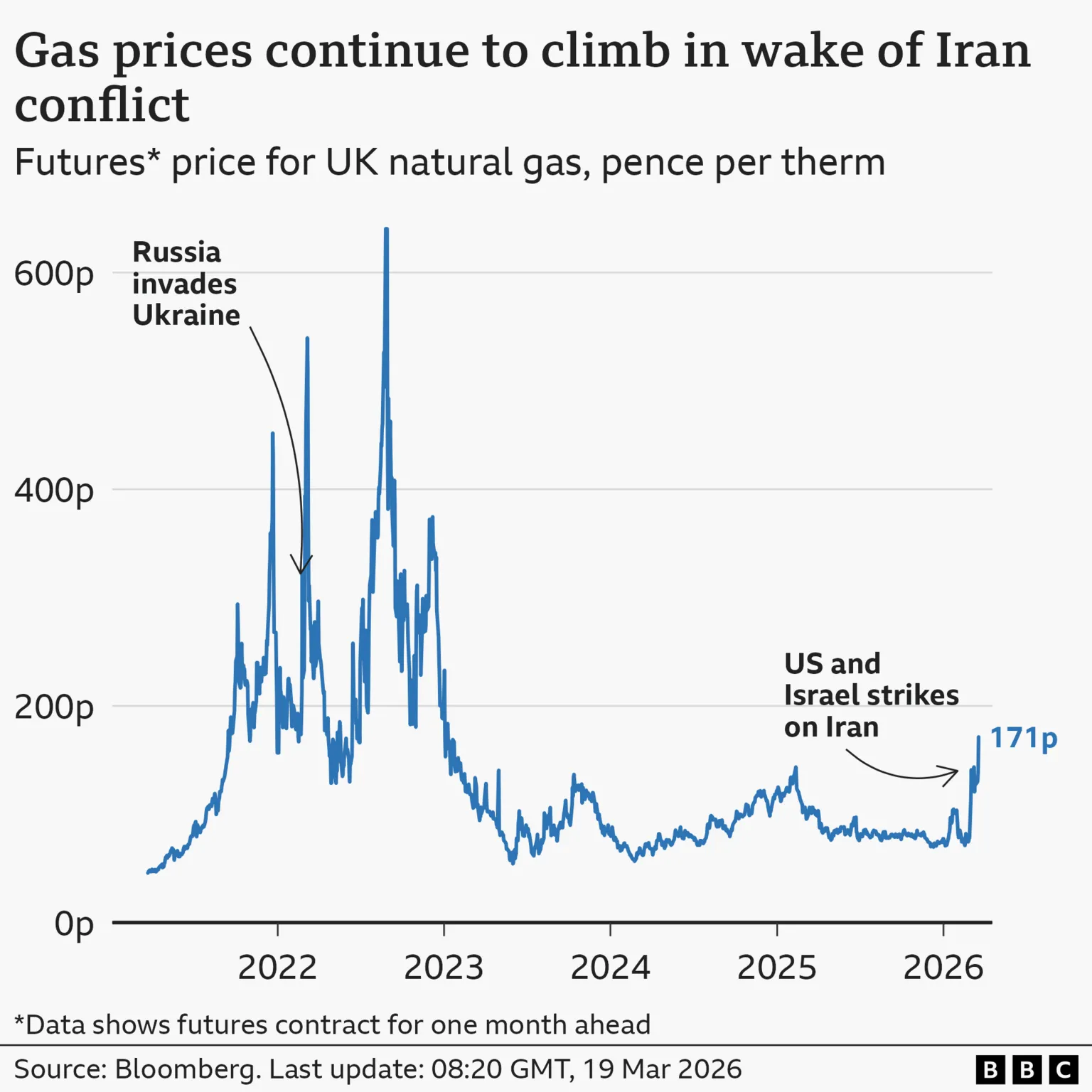
Gas prices, already increasing since the conflict began, surged sharply following the attacks. When trading opened on Thursday morning, UK gas prices briefly rose over 30%, currently standing about 22% higher at 170 pence per therm. European gas prices also increased by approximately 20% on the same day.

Matthieu Favas, commodities editor at The Economist, described the price increase as "huge." Analysts express concern that these attacks represent an escalation in the conflict and that supply disruptions may persist longer than initially anticipated.
Future Outlook
Energy research and consultancy firm Wood Mackenzie stated that the attacks on Ras Laffan "fundamentally reshape [the] global LNG outlook," with the timeline for recovery likely to be "significantly extended."
"Market expectations had been for a short disruption, with a controlled restart restoring supply to pre-conflict levels by mid-2026. That outlook now appears increasingly unlikely," said Kristy Kramer, head of LNG strategy and market development.
Nick Butler, former head of strategy at BP and former adviser to Gordon Brown, concurred that the market anticipates worsening conditions.
"This will almost certainly cut off a level of supply of LNG to the world market. The price of gas in the world market will therefore inevitably rise, because that gas can't be substituted very quickly at all, and maybe not for a very long time."
However, Favas noted that current prices remain well below the peaks observed after Russia's invasion of Ukraine.
Effects on the UK
Even consumers using alternative energy sources such as solar or nuclear are affected because gas constitutes a significant portion of the UK's overall energy mix. The energy regulator, Ofgem, uses gas as the "marginal source of power," which determines wholesale electricity prices in the UK.
Consequently, increases in gas prices substantially impact electricity costs.
"In the short term, someone is going to have to pay more and we need to be planning for that," Butler said.
"I think now we've come to a stage where the government will have to come in with a plan for energy security and a plan for protecting people who are going to pay these higher prices in two or three months' time as the market works through."


