

Strikes on Oil Depots in Tehran and Karaj
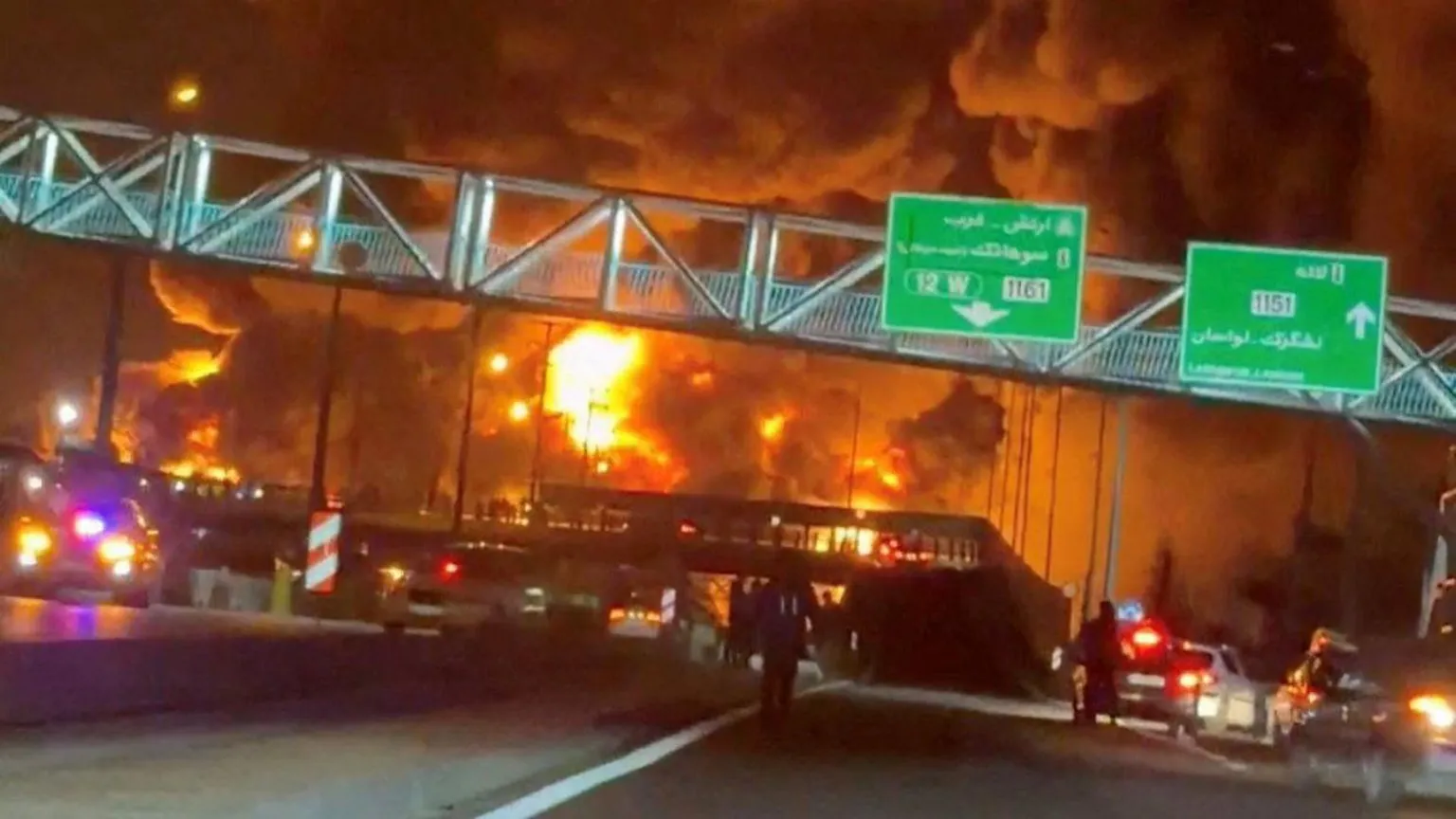
Iranians have recounted to the BBC the moments when several oil depots were struck overnight, as the United States and Israel continue their military campaign against Iran.
One resident described the scene, saying:
"It was as if night had turned into day."
According to local news agencies citing a source within Iran's oil ministry, fuel depots were targeted in Tehran and Karaj, a city west of the capital.
Video footage showed a street in Tehran engulfed in flames near one of the depots, where a man could be heard reporting that shops and homes were burning.
A resident from Karaj told the BBC:
"Karaj was calm for a day but now it's turned wild again – they've blown it up."
Another man in his 30s from Karaj described the experience:
"It started with a red light that lit up everything followed by a wave that jolted the door. Then the sky was lit again and a huge red cloud appeared. We didn't know what was happening."
He added that he went to his rooftop and saw the local oil depot on fire.
For their safety, the BBC is withholding the identities of the Iranians interviewed.
Environmental Impact and Public Response
Iran's environmental authorities have announced they are monitoring air quality in Tehran and have advised residents to remain indoors.
A woman from Tehran reported:

"You can smell the burning. I can't see the sun. There is a horrible smoke. It's still there, I'm very tired."
Another man from Karaj described the strike's aftermath:
"The strike on the depot caused a huge explosion and it was on fire for hours."
Context of the US-Israeli Attacks
The US and Israeli strikes on Iran began following the assassination of Iran's Supreme Leader, Ayatollah Ali Khamenei, and have now entered their second week. In response, Iran has launched strikes against US allies and assets across the region.
Iran's Assembly of Experts has stated it has reached consensus on Khamenei's successor, though the name has not been publicly disclosed.
US President Donald Trump has defended the attacks by asserting that Iran's government poses an imminent threat to the United States, citing concerns over Iran's nuclear program. Iran maintains that its nuclear activities are entirely peaceful.
According to Iran's UN ambassador, Amir Saeid Iravani, the US-Israeli strikes have resulted in at least 1,332 Iranian civilian deaths and thousands of injuries.
Public Opinion Among Iranians
Despite the destruction, some Iranians in Tehran expressed support for the strikes.
A man in his 20s from Tehran stated:
"We the people have taken refuge in our homes and are eagerly awaiting the destruction of the government so we can take to the streets like we did before."
He also mentioned that state television has been warning that anyone who "speaks or acts in favour" of the US, Israel, or Reza Pahlavi, the exiled son of Iran's last shah, "will be killed."
Another woman from Tehran described the war as "terrifying" but considered it a necessary cost to remove the current regime:
"Maybe it's hard to understand for people who aren't here, but for ordinary people there really was no other choice. Otherwise, believe me, we wouldn't want to pay such a huge price for war."
"Iranians aren't warmongers or foolish - they've just suffered so much that they've reached their limit, and all they want is a normal life."
However, another woman from Tehran expressed concern about the potential consequences if the war ends with the current regime still in power:
"Even if the war ends and we survive alive… I'm sure the costs will be very high and it will be worse than before for a long time. Especially if these remain in power."
"I can't even tell who would take power."
BBC Persian Service
BBC Persian is the Persian-language service of , reaching 24 million people worldwide, the majority of whom are in Iran. Despite being blocked and routinely jammed by Iranian authorities, it remains a significant source of news for Iranians.


