

Rescues and Prayers a Day After Venezuelan Earthquakes
The death toll from the powerful twin earthquakes that struck Venezuela on Wednesday continues to rise, marking a devastating blow to a nation already engulfed in uncertainty.
It has been less than six months since Nicolás Maduro, the left-wing leader who had governed Venezuela since 2013, was captured by US forces during a dawn raid on his presidential compound in Caracas. Maduro was subsequently taken to New York to face trial on drug-trafficking charges.
Since Maduro's capture, Venezuela has been led by his ally and former vice-president, Delcy Rodríguez. This leadership transition has disappointed opposition supporters who had hoped the Trump administration would install opposition leader María Corina Machado.
Rodríguez's handling of the earthquake response has highlighted both the changes and continuities since the January raid, as well as the significant challenges confronting Venezuela's deteriorated infrastructure.
The Extent of the Damage Becomes Clear
Rodríguez addressed the nation on the state television channel VTV more than two hours after the earthquakes occurred. Prior to her address, official information was scarce, partly due to communication outages in the hardest-hit areas. Additionally, restrictions imposed on independent media under Maduro's government have led to the closure of hundreds of local radio stations and news outlets, which historically provided localized updates.
During her televised speech, Rodríguez was accompanied by her brother Jorge Rodríguez, who, as president of the National Assembly, had sworn her in as interim president shortly after Maduro's capture. Interior Minister Diosdado Cabello, a steadfast Maduro ally, also stood beside her.
Unlike his frequent appearances in military fatigues before the US intervention, Cabello stood silently next to Rodríguez, dressed in civilian clothing, as did her brother.
Rodríguez appeared visibly shaken as she delivered her remarks, calling
"first and foremost" for unity from the Venezuelan people, who have been deeply divided for over a decade between supporters of Maduro and his predecessor Hugo Chávez, and their opponents.
She declared a state of emergency and appointed General Juan Ernesto Sulbarán, commander of Venezuela's National Guard, to lead the emergency response efforts.
Military Influence and Infrastructure Challenges
During the more than 25 years of Chávez and Maduro's rule, key government positions have been occupied by high-ranking military officers. Many state ministries have been managed by generals, and analysts have suggested that the lack of specialized expertise among those in charge has contributed to the degradation of Venezuela's infrastructure.

Under the scrutiny of the Trump administration, Rodríguez has recently replaced the general overseeing the Ministry of Housing with a civilian architect, and the general leading the Ministry of Electricity with an electrical engineer.
Nevertheless, years of shortages—worsened by US sanctions—and mismanagement have led to significant deterioration, particularly in public housing stock.
A shortage of cement, caused by the collapse of the state-owned cement industry following its nationalization under Chávez, has prevented essential repairs on buildings and homes, increasing their vulnerability to collapse.
Emergency Services Struggle with Limited Resources
The dominance of the military over the past two decades has often prioritized military equipment over modernizing civil protection units with updated tools and vehicles.
Aware of these limitations, Rodríguez expressed gratitude to foreign governments offering assistance.
She specifically mentioned US President Donald Trump and his administration, stating they had been
"in constant contact with all our authorities offering support and solidarity".
Rodríguez also reported conversations with the presidents of the Dominican Republic and El Salvador, and extended thanks to the president of Chile—all leaders of right-wing governments.
While offers of aid are expected following such a catastrophic earthquake, Rodríguez's acceptance of assistance marks a departure from Maduro's policy of only accepting help from ideological allies.
She emphasized,
"The solidarity between our people is an invaluable source of strength in moments like these".
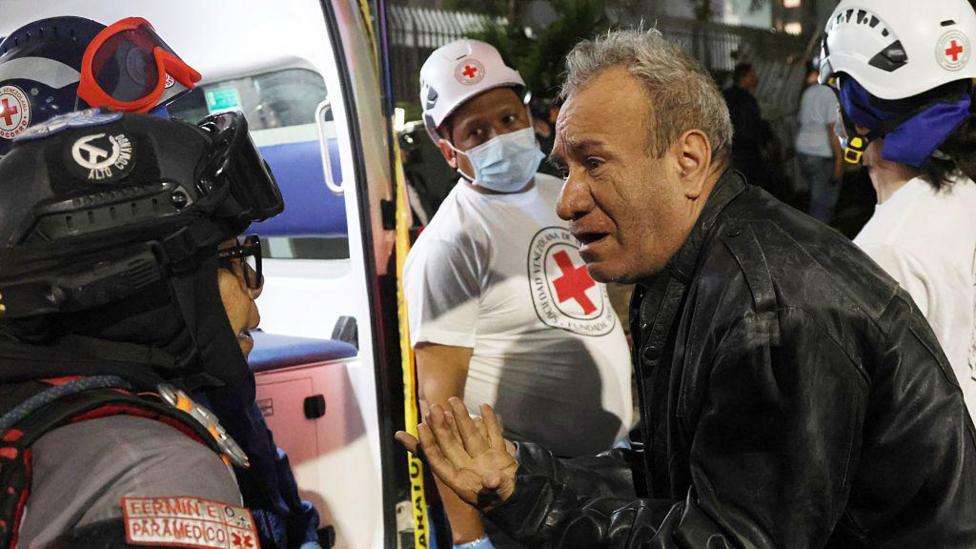
For Venezuelans confronting scenes of destruction, especially families searching for loved ones trapped beneath rubble, this openness to external aid offers a glimmer of hope amid anguish and uncertainty.
- Rescuers race to find Venezuela quake survivors: What we know so far
- "I thought I was going to die" - Venezuelans describe earthquake panic


