

Powerful Earthquakes Strike Venezuela, Causing Extensive Damage and Casualties
Rescue teams are urgently searching through debris to save lives following two strong earthquakes near Venezuela's capital, resulting in at least 235 fatalities and over 1,500 injuries.
In Caracas and the nearby coastal city of La Guaira, cries for help were heard from beneath collapsed buildings.
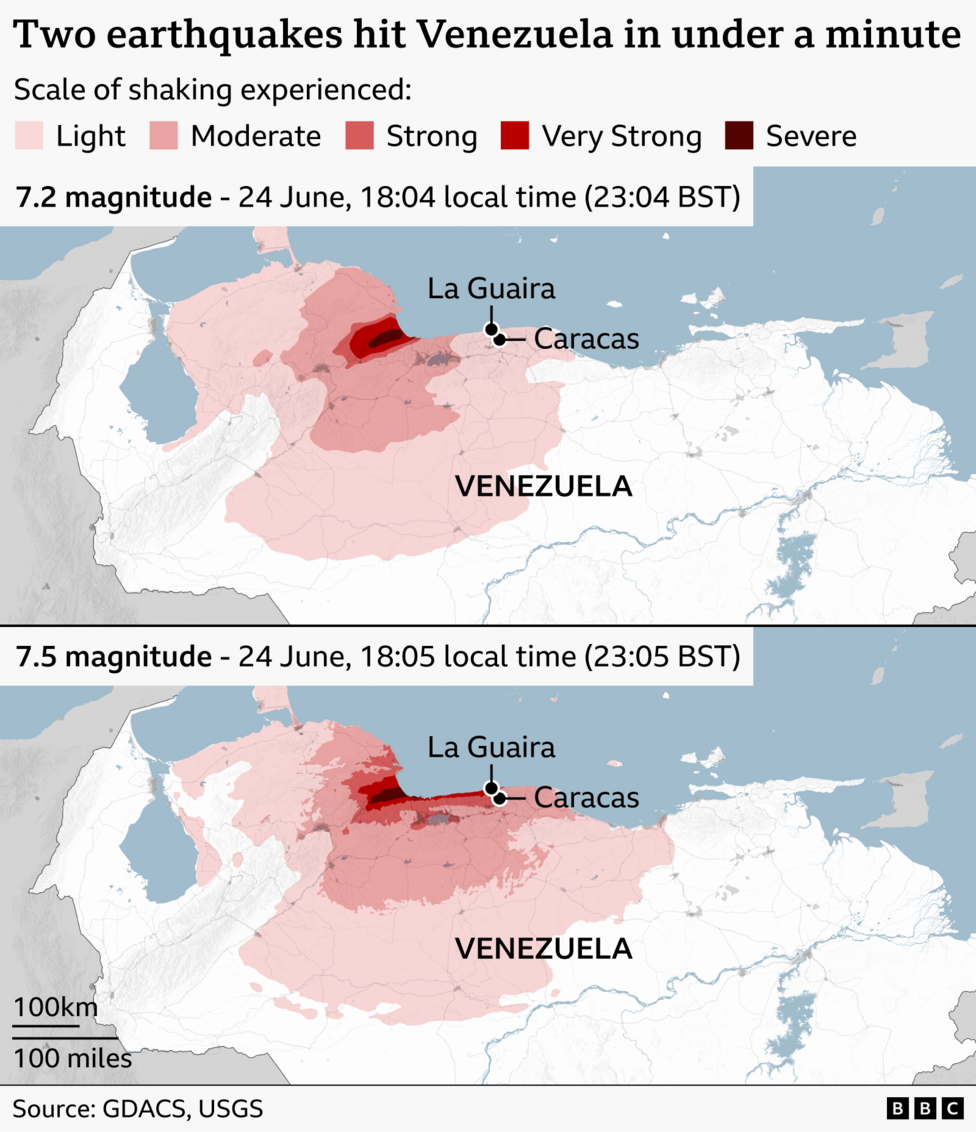
The initial earthquake measured 7.2 in magnitude and was quickly followed by a stronger 7.5-magnitude quake, according to the US Geological Survey (USGS). Both quakes were shallow, intensifying the destruction.
Many more casualties are feared, with numerous individuals rendered homeless or too fearful to remain in damaged structures, opting to sleep outdoors.
The earthquakes occurred at 18:04 local time (22:04 GMT) on Wednesday, a national holiday in Venezuela, increasing the likelihood that more people were at home than on a typical weekday.
USGS reported the first quake's depth at 20.3 km and the second at 10 km.
Jorge Rodríguez, president of Venezuela's National Assembly, announced on Thursday that the death toll had risen, following a state of emergency declaration by interim President Delcy Rodríguez.
Several nations have pledged assistance. The United States committed $150 million (£113 million) in aid and is deploying transport ships and aircraft to support search and rescue and rapid relief operations.
Current Situation as Rescuers Race to Locate Survivors
Jorge Rodríguez stated that 250 buildings were damaged or destroyed, primarily in La Guaira, where BBC footage confirmed a 10-storey hotel had collapsed. On Thursday, residents continued searching for missing relatives.
Juan Ortiz, a medical student in Caracas, told the BBC that one close friend was confirmed dead, another was presumed trapped under rubble, and about 20 acquaintances in the coastal area were missing.
"I'm in shock and confusion, and frustrated that I can't help," Ortiz said.
Buildings also collapsed in Caracas, Interior Minister Diosdado Cabello reported, with additional damage in Trujillo, Yaracuy, Carabobo, Aragua, and Miranda states.
Gustavo Duque, mayor of Chacao in the greater Caracas area, reported 11 deaths and 23 rescues at one collapsed building site on Thursday.
"We're trying to rescue as many people alive as possible," Duque said in a social media video update, explaining efforts to clear rubble so specialists can access survivors.
Venezuela's main international airport in Maiquetía, near Caracas, was closed due to severe damage, interim President Delcy Rodríguez stated. Footage from inside the terminal showed dust and debris falling from the ceiling.
Approximately 250 km northwest of Caracas, verified video showed a multi-storey building, reportedly a hotel, collapsed in Tucacas on the coast.
Aftershocks continue, with at least 30 recorded since the initial quakes, Delcy Rodríguez told state-run Venezolana de Televisión.
Emergency services are actively searching through debris in Caracas following the tremors.

Casualty Estimates and Geological Context
The death toll is expected to rise. The USGS stated, "High casualties and extensive damage are probable and the disaster is likely widespread."
USGS estimated a 42% chance of over 10,000 deaths and a 33% chance of more than 100,000 fatalities, based on factors including previous similar earthquakes and the affected population size.
These estimates serve to guide emergency response and are not precise predictions. They consider quake size, depth, building quality, and timing.
Venezuela is situated at the convergence of two tectonic plates, with the earthquakes likely caused by sudden friction release between them.
Caracas-based journalist Luis Hernandez told day that power outages and internet disruptions complicate damage assessment amid the country's economic crisis.
"Due to the economic crisis in the country, it is very difficult for us to assess," Hernandez said.
Cabello indicated that the Altamira and Los Palos Grandes neighborhoods in Caracas were most severely affected.
These areas were also heavily impacted by the last major Caracas earthquake in 1967, which killed 200 people.
The second earthquake is the strongest to hit Venezuela since 1900, according to USGS records.
BBC Mundo's Nicole Kolster described the quake as the strongest she has ever experienced.
"It's the strongest quake I've ever felt in my life," Kolster said. "It was so strong that I thought the building was going to fall on top of me."
The tremors were felt hundreds of kilometers away in Bogotá, Colombia.
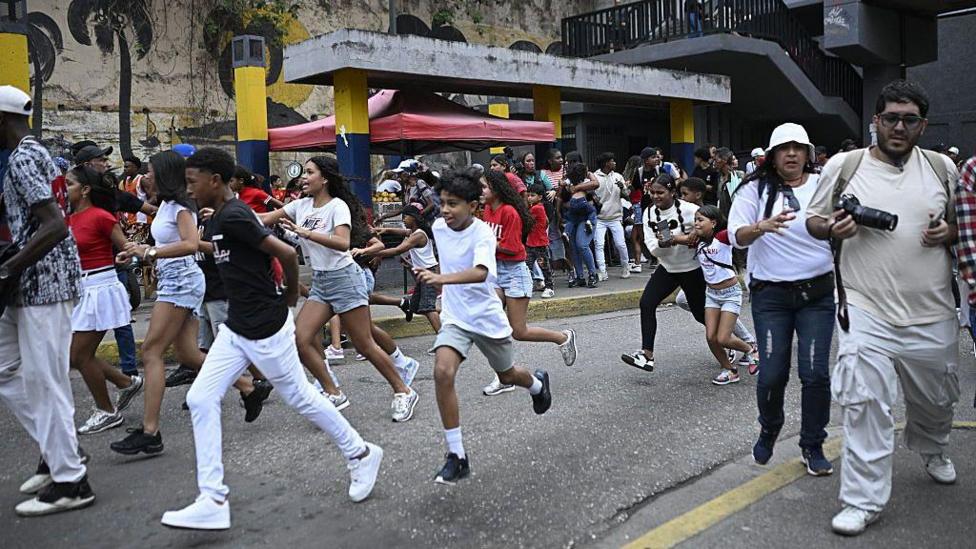
People were seen running into the streets after the consecutive quakes.
National and International Response
Venezuelan opposition leader María Corina Machado expressed solidarity on social media.
"My heart, my infinite embrace, and my prayers are with every Venezuelan home in these hours of anguish," Machado wrote on X.
Delcy Rodríguez reported that rescue efforts are ongoing, with aid arriving from the US, Dominican Republic, El Salvador, Mexico, and Qatar.
The disaster marks a significant challenge for Venezuela amid political uncertainty and is the first major test of its new relations with the US since President Donald Trump ordered the capture of President Nicolás Maduro in January.
Trump stated he had instructed his administration to prepare for rapid response.
"The two major earthquakes that just hit the great people of Venezuela are both massive in scale and have left a devastating number of deaths," Trump wrote on Truth Social. "The US stands ready, willing and able to help!"
US Secretary of State Marco Rubio announced immediate deployment of search and rescue teams, medical aid, and humanitarian assistance.
The Trump administration has aimed to reshape relations with Venezuela since Maduro's seizure of power, supporting interim President Delcy Rodríguez early on.
Additional reporting by Esme Stallard and Gabriela Pomeroy.


