

Vance Repeatedly Praises Orbán on Ukraine During Unprecedented Budapest Visit
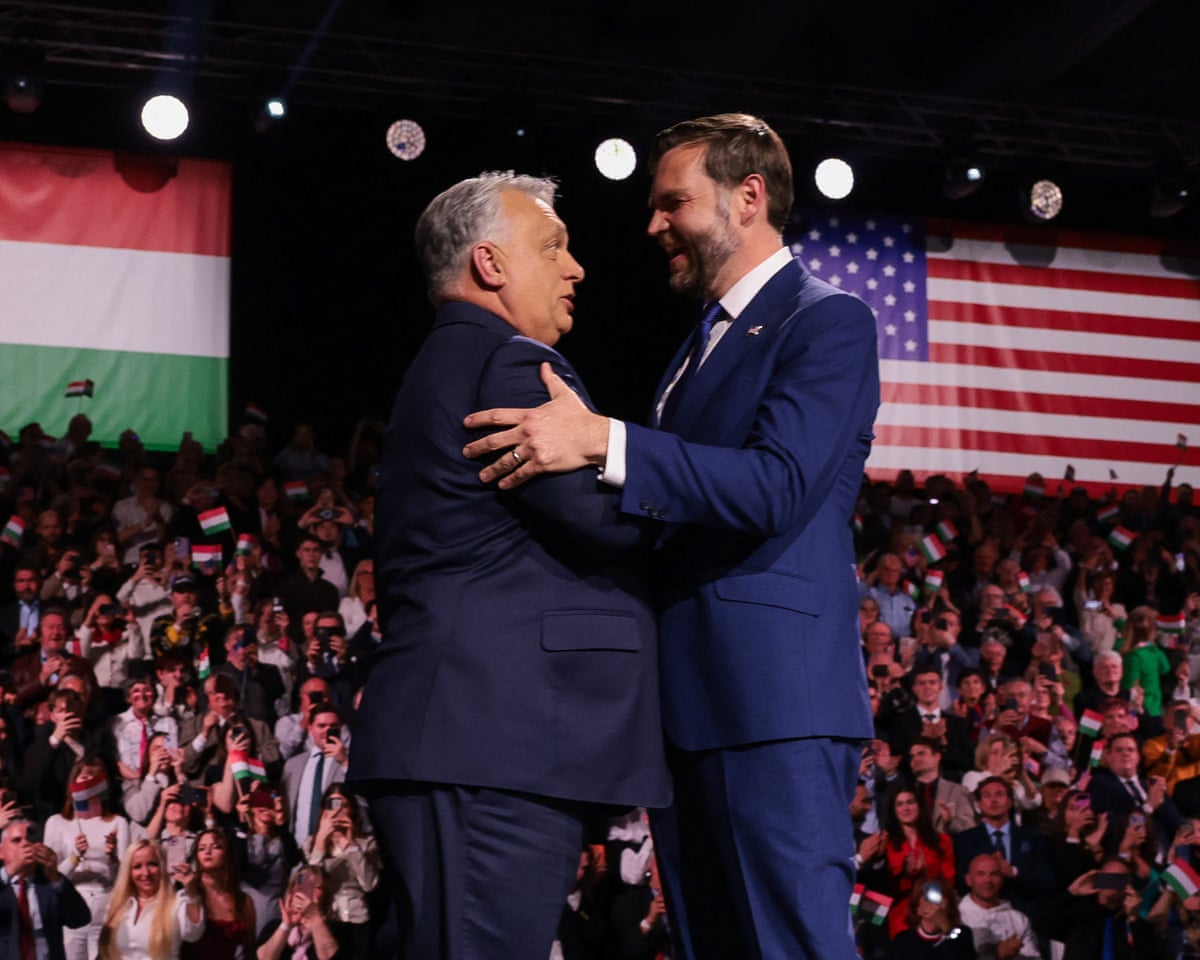
US Vice-President JD Vance has expressed strong support for Hungarian Prime Minister Viktor Orbán, describing him as a “very, very important partner for peace” and commending his handling of the Ukraine conflict. Vance stated that Orbán “does a good job, because he does,” and emphasized that many European capitals have not been as helpful to peace efforts between Russia and Ukraine as Hungary has.
He rejected European Union criticism of Orbán’s policies as a “scandal.” Acknowledging the unusual nature of his visit, Vance said,
“It’s the reason why I’m here. This is unprecedented. It’s unprecedented for an American vice-president to come the week before an election.
The reason why we’re doing it is because we thought there were so much garbage happening against Viktor in this election, that we had to show that there are actually a lot of people and a lot of friends across the world who recognise that Viktor and his government are doing a good job, and they’re important partners for peace.”
Returning to the topic of Ukraine, Vance expressed disappointment with much of the political leadership in Europe, stating that many leaders “do not seem particularly interested in solving this particular conflict.” He acknowledged some support from leaders such as Italy’s Giorgia Meloni and certain western European capitals, at least behind the scenes, but emphasized that Orbán has encouraged a deeper understanding of the conflict.
Vance suggested that progress depends on decisions by both Ukraine and Russia, implying Kyiv might need to consider territorial concessions to end the war. He said,
“What I would say to both the Russians and the Ukrainians is, you know, we’re talking about haggling at this point over a few square kilometres of territory in one direction or another. Is that worth losing hundreds of thousands of additional Russian and Ukrainian young men? Is that worth an additional months or even years of higher energy prices and economic devastation?
We think the answer is clearly no. But it takes, you know, two to tango. So while Viktor and president Trump are going to continue to work towards a peaceful settlement, fundamentally we can only open the door. The Russians and the Ukrainians have to walk through it.”
Iran Truce Described as 'Fragile' by JD Vance Amid Internal Regime Disagreements
On the topic of Iran, Vance explained that he was delayed to the Budapest meeting due to late-night discussions concerning the Middle East. He stated that the military objective of “decimating the Iranian military” has been achieved, and the focus has shifted to reopening the straits, with former President Trump urging Iran to “stop trying to hold the world’s economy hostage.”
Vance described the resulting truce as “fragile,” referencing Trump’s remark that “the Iranians are better negotiators than they are fighters.” He noted that some Iranian factions responded positively to the truce proposal, while others have been dishonest about military accomplishments and the nature of the agreement.
“This is why I say this is a fragile truce. You have people who clearly want to come to the negotiating table and work with us to find a good deal, and then you have people who are lying about even the fragile truce that we’ve already struck.”
Vance issued a cautionary message to Iranian leadership, quoting President Trump’s instructions to the negotiating team to work in good faith. He said,
“The president … has told me and he’s told the entire negotiating team, the secretary of state, the special envoy, Steve Witkoff, he said: go and work in good faith to come to an agreement. … If the Iranians are willing, in good faith, to work with us, I think we can make an agreement; if they’re going to lie, if they’re going to cheat, if they’re going to try to prevent even the fragile truce that we’ve set up from taking place, then they’re not going to be happy.”
“He’s told us to come to the negotiating table. But if the Iranians don’t do the exact same thing, they’re going to find out that the president, the United States, is not one to mess around.
He’s impatient. He’s impatient to make progress. He has told us to negotiate in good faith. And I think if they negotiate in good faith, we will be able to find a deal. That’s a big if. And ultimately it’s up to the Iranians how they negotiate. I hope they make the right decision.”
JD Vance Criticizes EU and UK Energy Policies
Vance reiterated his admiration for the United States’ relationship with Europe and expressed hopes for its success, framing his criticisms as stemming from a desire to see improvement. He specifically criticized the energy policies of European partners, including the United Kingdom, which he described as “way underinvested in their energy resources.”
He questioned the affordability of energy for middle-class citizens in the UK, stating,
“But is it a scandal that middle class Brits, that people who are working hard and playing by the rules, can’t afford to heat their home, can’t afford to transport themselves to work because their leadership has made energy so expensive? …
It is not magical that the United States has lower energy costs in the United Kingdom. It’s because we’ve made smart decisions and their leadership is not. They could change course, and we hope that they will.”
Vance also criticized the European Union’s regulation of US social media platforms, describing the bloc’s bureaucracy in Brussels as problematic.
Addressing accusations of foreign influence, Vance called it “darkly ironic” that he was accused of such while actively campaigning for Orbán in Budapest shortly before the election. He urged Hungarians to “reject these foreign influence operations” of foreign endorsements.
When questioned about alleged Ukrainian intelligence efforts to influence elections in the US or Hungary, Vance referenced controversial remarks by Ukrainian President Volodymyr Zelenskyy, who had threatened to disclose an individual’s address to armed forces in comments about Orbán. Vance described Zelenskyy’s comments as “completely scandalous” and “preposterous.”
He emphasized what he perceives as foreign interference in the Hungarian election, stating,
“I’ve also been told that the vice-president of the United States coming and saying that Viktor Orbán is doing a good job and is a helpful statesman to the cause of peace, that’s foreign influence.
But what’s not foreign influence is when the European Union threatens billions of dollars withheld from Hungary because you guys protect your borders; that’s apparently not foreign influence.
What’s not foreign influence is when the Ukrainians shut down pipelines, causing suffering among the Hungarian people in an effort to influence an election that’s allegedly not foreign influence.
It doesn’t pass the smell test.”
Vance asserted that the US has never threatened Hungary regarding its voting choices, emphasizing respect for Hungarian sovereignty. He criticized foreign actors, including EU bureaucrats and foreign governments, for threatening Hungarian voters with repercussions based on election outcomes, stating this should anger the Hungarian people.

He reiterated his endorsement of Orbán and called for the Hungarian people to reject foreign influence and Brussels bureaucrats in defending their sovereignty.
The event began with Vance praising the Mathias Corvinus Collegium (MCC), noting he was there at Orbán’s personal request to speak to its students. He criticized left-wing elites and praised the MCC for upholding the foundations of Western civilization.
Vance’s Visit and Its Impact on Orbán’s Election Prospects
Political analyst Ashifa Kassam, reporting from Budapest, noted that Vance’s visit places the US administration directly into a contentious campaign where polls suggest Orbán faces a significant challenge to his 16-year tenure. Kassam observed that Hungarians are contending with economic stagnation, declining public services, and corruption, while Orbán faces an unprecedented challenge from Péter Magyar, a former senior member of Orbán’s Fidesz party.
Kassam highlighted the shared rhetoric between Orbán and the Maga movement, including opposition to Brussels, migration, and Ukraine, alongside praise for “the values of western civilisation” as described by Vance. Despite the global headlines generated by the visit, analysts expressed skepticism about its potential to influence the election outcome.
JD Vance’s upcoming speech at the MCC was to be introduced by Balázs Orbán, chair of the MCC and political director in Viktor Orbán’s office (no relation). The discussion was to be chaired by MCC’s director general, Zoltán Szalai.
A panel preceding Vance’s session was focused on portraying Orbán as a strategic visionary and the only European leader genuinely seeking to end the war in Ukraine. However, tensions between Ukraine and Hungary remain high, with Orbán’s government blocking EU funding for Kyiv and further sanctions on Russia. Recent revelations include Orbán’s offer to Russian President Vladimir Putin to assist him, saying “I am at your service” during an October call, intensifying scrutiny of Budapest’s Kremlin ties as Vance arrived.
Ukraine’s Response to Iran Ceasefire and Commitment to Diplomacy
Ukrainian President Volodymyr Zelenskyy responded to the Iran ceasefire news by expressing support for ending the Russian invasion of Ukraine through a deal. He stated,
“A ceasefire is the right decision that leads to ending the war. It means saving lives, abandoning the destruction of cities and villages, and allowing power plants and other infrastructure to operate normally – and thus provides the time and conditions necessary for diplomacy to deliver results. Ukraine has always called for a ceasefire in the war waged by Russia here in Europe against our state and our people, and we support the ceasefire in the Middle East and the Gulf that paves the way for diplomatic efforts.
Ukraine tells Russia once again: we are ready to respond in kind if the Russians stop their strikes.”
Zelenskyy added that Ukraine has been involved in the Middle East and Gulf regions, helping to protect lives and develop security capabilities. He emphasized the global implications of security in these regions, noting that instability affects economies and living costs worldwide.
In Budapest, preparations were underway for Vance’s “fireside chat” at the MCC, scheduled to begin shortly.
Spain’s Prime Minister Responds to Iran Ceasefire with Caution
Spanish Prime Minister Pedro Sánchez, known for his critical stance on Trump’s Iran policy, responded to the ceasefire news by cautioning against premature celebration. He said,
“Ceasefires are always good news – especially if they lead to a just and lasting peace. But this momentary relief cannot make us forget the chaos, the destruction, and the lives lost.
The Spanish government will not applaud those who set the world on fire just because they show up with a bucket. What’s needed now are diplomacy, international legality, and PEACE.”
Morning Update: Vance’s Budapest Visit and European Reactions
JD Vance continues his stay in Budapest, where he is expected to address the conservative Mathias Corvinus Collegium following his previous day’s endorsement of Prime Minister Orbán, five days before Hungary’s key election. His remarks, which included criticism of alleged foreign interference in the vote and open support for Orbán, have stirred controversy.
Meanwhile, European leaders welcomed the news that former President Trump did not follow through on his earlier threat of catastrophic consequences, instead reaching a provisional ceasefire agreement with Iran.
European Commission President Ursula von der Leyen praised the agreement for bringing “much-needed de-escalation” and enabling negotiations for a lasting solution. French President Emmanuel Macron described the deal as “a very good thing” and expressed hope for its full respect and inclusion of Lebanon. Finnish President Alexander Stubb also supported efforts to end the war and build a permanent ceasefire in the Strait of Hormuz and the broader Middle East.
However, the relief may be temporary as Dutch Prime Minister Mark Rutte was scheduled to meet in Washington with Trump, US Secretary of State Marco Rubio, and US Secretary of Defense Pete Hegseth following recent alliance tensions. Observers awaited developments on whether Rutte’s diplomatic style would influence Trump’s rhetoric.
Jakub Krupa reports from Europe Live on Wednesday, 8 April 2026, providing ongoing coverage of these developments.


