

EU Upholds Biometric Border Controls Amid Concerns Over Delays
The European Union has declined requests from airports and airlines to halt the rollout of new fingerprinting and facial recognition border controls, despite acknowledging the existence of "20 difficult spots" causing queue congestion.
With the peak summer holiday season imminent, EU officials conceded that the new entry/exit system (EES) is "not perfect" but emphasized that a complete suspension is "not needed" and "not possible," a message they intend to convey to travel industry representatives.
Under the EES, non-EU travelers must register fingerprints and facial images upon their initial entry into the Schengen zone, with biometric verification required on every subsequent exit and re-entry.
Last week, airlines, airport representatives, and the International Air Transport Association (Iata) urged for a suspension of the system until next summer, citing concerns over operational chaos in popular holiday destinations.
Iata reported that passengers have faced "delays and missed connections" in countries including Portugal, Spain, Italy, Greece, and Belgium. Ryanair also issued warnings about congestion at airports in Alicante, Málaga, and Palma.
Nevertheless, EU officials argue that partial activation of the system in some countries but not others is unfeasible, as it could result in "the unfortunate situation of travellers stranded at border crossings." For example, a British passenger entering the Schengen area at a border with operational controls but exiting through one without could be mistakenly recorded as overstaying the 90-day travel limit within any 180-day period, potentially leading to future entry refusals.
The EU is reportedly postponing the launch of a separate pre-authorisation visa system, the European Travel Information and Authorisation System, akin to the US ESTA, according to the Financial Times.
Officials stated that among the 1,500 border crossing points, only 20 are considered "difficult spots," and they are pressuring the member states responsible to implement measures to alleviate congestion.
One of the most problematic locations is a small regional airport where 3,000 passengers arrived within one hour but could not be processed swiftly due to only four biometric booths. Officials noted this issue is seasonal, affecting the area "two or three months a year."
Lisbon has already reduced queue times by deploying additional staff, and 50 new Frontex border agency personnel are being assigned to Brussels airport.
"I think we have recurrent progressive improvements everywhere," an EU official stated.
The controls have been in development for eight years, designed to address vulnerabilities in border security exposed by the 2015 and 2016 terror attacks in Brussels and Paris.
The system's introduction faced multiple delays before finally launching, with member states given options to opt out temporarily while technology and fingerprinting logistics were tested.

According to the new EES regulations, airports and ports may temporarily suspend the system if queues become unmanageable; however, this opt-out is set to expire in September.
To date, "no member states have requested" a suspension beyond September, despite calls from the travel industry.
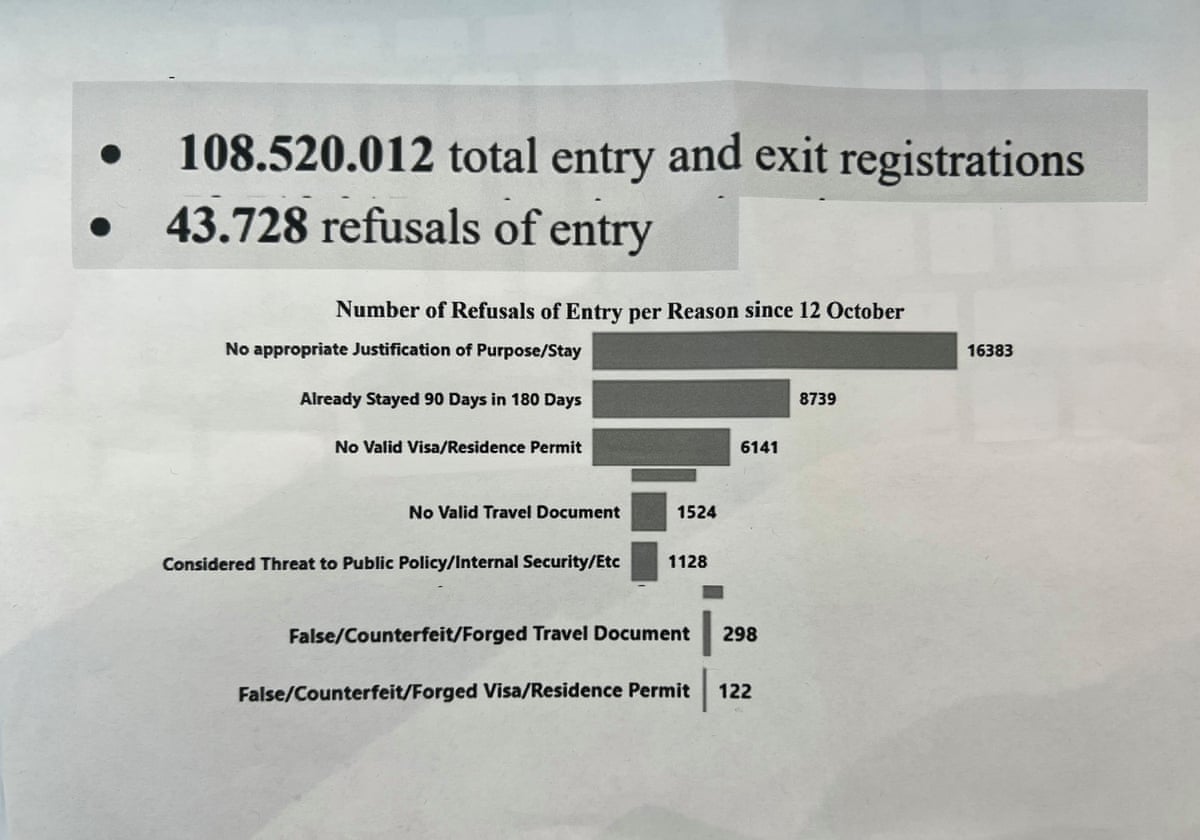
The EU asserts that the system is already delivering intended results, having recorded 110 million journeys in and out of the Schengen area and refused entry to approximately 44,500 individuals.
These refusals include passengers attempting illegal re-entry due to overstaying visitor allowances or using second passports or false documents.
Previously, travelers with dual nationality could circumvent the 90-day visitor limit within any 180-day period by switching passports. The new system's biometric verification detects such overstays.
EU officials disclosed that the primary reason for entry refusals is "no appropriate justification of visit or stay." The second largest group, about 9,000 individuals, were refused for overstaying the 90-day visitor allowance.
More than 1,000 people were stopped at borders for being "considered a threat to internal security," and 300 were caught using false passports or travel documents.
Delays in full system implementation at Eurotunnel have been attributed to issues with French technology, despite an £80 million investment in infrastructure that remains partially inactive.
French border officials were expected to use iPads or tablets to verify fingerprints and facial images of drivers and passengers, but this technology has yet to be deployed.
A mobile application developed by Frontex, intended to allow passengers to upload data prior to travel, is fully operational only in Sweden and partially in Portugal.
Following discussions with air transport leaders, a European Commission spokesperson stated that efforts are ongoing with national authorities to resolve issues related to IT systems hindering automation and to advance the rollout of the pre-registration app.
The Commission also reminded airports of available funding to support additional Frontex personnel deployment at border points experiencing high pressure.


