

What did the court decide?
The appeal court upheld a lower court’s verdict from March 2025 that found Marine Le Pen guilty of misusing European Union funds. However, it reduced the length of both parts of the original sentence – a ban on holding public office and a partially suspended jail term.
The appeal court imposed a 45-month ban from holding public office on the three-time presidential candidate, with 30 months suspended. Le Pen, who has transformed her far-right National Rally (RN) from an extreme fringe group to the largest single party in the French parliament, was also sentenced to a three-year jail term, with two years suspended and the remaining year to be served under house arrest with an electronic ankle tag.
In March 2025, the lower court had sentenced Le Pen to a five-year ban from holding public office, effective immediately, and a four-year prison term, with two years suspended. This ruling effectively put her fourth presidential campaign on hold pending the appeal.
What was the case about?
Marine Le Pen, along with 23 former Members of the European Parliament (MEPs), assistants, accountants, and the National Rally party itself, faced accusations of embezzling funds intended for employing European parliamentary assistants. The funds were allegedly diverted to pay party staff in France.
The defendants were suspected of having embezzled approximately €4.4 million between 2004 and 2016. Initially, the party was under the leadership of Jean-Marie Le Pen, Marine’s father, and after 2011, under Marine Le Pen herself. Among the employees declared as parliamentary assistants were a personal secretary and a bodyguard.
The lower court stated that
“Marine Le Pen asserted herself with authority and determination within the framework established by her father,”playing a
“central role” in “optimising” a system designed to “save [the party] money thanks to the European parliament”.
Le Pen denied the allegations, claiming her party was the victim of a political attack. Along with 10 others, she appealed the verdict, maintaining during her second trial that the party had no system aimed at embezzling EU funds and that it had acted in
“complete good faith”.
Prominent nationalist figures such as Viktor Orbán in Hungary and Matteo Salvini in Italy condemned the lower court’s verdict as a
“violation of democratic norms”.Former US President Donald Trump described it as a
“very big deal”,drawing parallels to his own legal challenges in the United States.
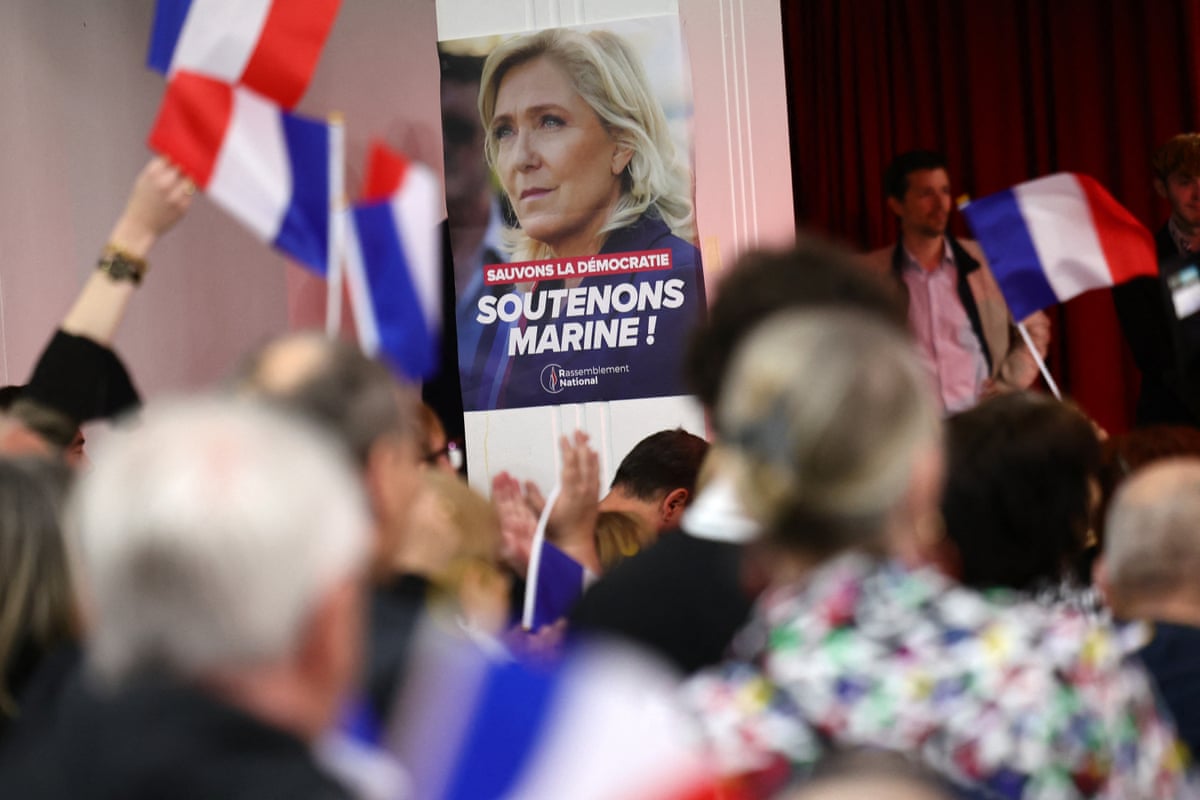
What does the appeal court decision mean for Le Pen?
The appeal court stated that it sought to
“assess the penalty in light of any infringement of the right to stand for election”,emphasizing that
“voters’ freedom of choice – a prerequisite for the expression of the democratic vote – must be a consideration”.

By reducing her ineligibility for office to 15 months (from a total of 45 months, with 30 months suspended), the court effectively allowed Le Pen to run for the presidency, since the 15-month period began with the lower court’s verdict in March 2025.
However, the court also ordered her to wear an electronic ankle bracelet for one year, which complicates her ability to campaign effectively. The specific terms of her house arrest and electronic monitoring will be determined by a separate judge in the coming weeks.
Typically, an order of
“house arrest under electronic monitoring”means the individual may leave home only during fixed, pre-approved hours and to predetermined locations. Occasional exceptions can be requested but are not guaranteed.
What has she decided – and what could it mean for the elections?
Le Pen had previously stated she would not run for president if required to wear an electronic ankle tag, citing the impracticality of campaigning with restricted movement.
She had also ruled out appealing to France’s highest court, the Court of Cassation, which had indicated it would issue a ruling before the election if asked to review the case. She argued that such uncertainty could harm her party’s electoral chances.
However, on Tuesday evening, Le Pen announced she would take her case to the highest French judicial authority. She said she wanted to
“exhaust all the legal avenues available to me in order to defend my innocence in this case”and emphasized that
“the people will decide”.
By appealing to the Court of Cassation, the appeal court’s order for her to wear an electronic ankle tag will be suspended until a final ruling is made. Le Pen declared:
“Tonight, I am a candidate in the presidential election.”
The National Rally had already begun preparing for the possibility that its 30-year-old protégé, Jordan Bardella, would be the party’s candidate. Le Pen’s decision postpones that scenario at least until the Court of Cassation delivers its verdict.
Polls indicate that either Le Pen or Bardella would comfortably win the first round of voting, scheduled for 18 April. However, forecasts for the runoff are mixed, with some polls suggesting that a centrist candidate, former Prime Minister Édouard Philippe, could ultimately prevail.


