They offer independence, reduce emissions and congestion. But they are also endangering lives.
After the Sydney Harbour Bridge was closed to illegal ebikes and e-motorcycles on Wednesday, the Australian government declared the country faced a “real emergency”.
“[Illegal ebikes] are a total menace on the road,” the health minister, Mark Butler, said on Friday.
“Kids have done stupid things on bikes ever since the penny-farthing [but] the injuries that are coming into our hospital emergency departments are absolutely devastating.
“We’ve got to make sure we stop these things coming into the country [and] police are given the powers to crack down, to take them away, to crush them, to destroy them.”
Ebikes have been praised as a climate-friendly solution to urban traffic congestion, transport emissions, and even youth social media addiction, providing Australians with a way to increase exercise and save money.
However, they have also brought significant risks and have been involved in fatal incidents.
The state of New South Wales recorded 226 injuries related to ebikes in 2024. In just the first seven months of 2025, injuries surged to 233, along with four deaths.
The rest of Australia has experienced similar issues. In Queensland, legal ebikes were involved in 239 crashes in 2025, four of which were fatal, according to preliminary police data.
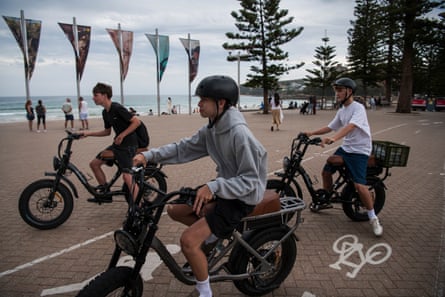
For teenagers like Ben Boucher, 16, ebikes represent a source of independence. Boucher purchased his ebike in late 2025 with savings from a part-time job. Most of his grade now rides to school, reducing commutes to about 10 minutes.
“It’s just easier to get around,” the Manly student said. “Suddenly everyone seems to have one: [there’s] so much hype.”
“I see these tiny kids riding them and I think that’s dangerous because they don’t understand road rules or anything,” Boucher added.
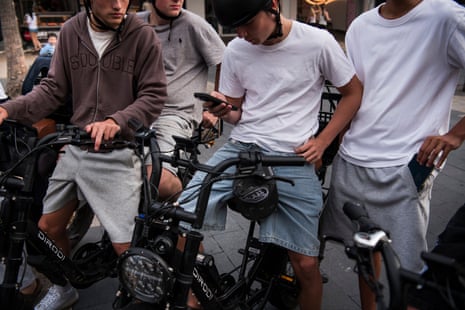
Francisco Furman, owner of Manly Bikes in Sydney’s north, reported that sales began to surge in 2022. However, after another death in December involving a rental-share ebike, the usually busy Christmas period saw a decline in business.
“We had a lot of cancellations, which is really affecting our business in a big way, we hold less stock,” he said.
‘Close the barn door’
NSW premier Chris Minns stated that governments are “trying to close the barn door” on the ebike boom, with nearly a million of these machines already on Sydney streets.
Industry experts attribute the surge partly to the federal government’s relaxation of import standards in 2021. These standards were tightened again in late 2025, requiring road-legal ebikes to have motors that activate only when the rider pedals and to be limited to speeds of 25 km/h and power of 250 watts. NSW, which previously allowed power up to 500 watts, has reduced the limit to 250 watts.
However, retailers such as Tadana Maruta, owner of Pedl Bikes in inner Sydney, doubt the power limits will significantly impact the issue.
“You put the drugs into the community and now people have tasted it, and now you want to take it out,” Maruta said. “It’s too late.”
“Ebikes can still be tuned to run at higher speeds, like cars, regardless of their engine’s wattage.
“All it takes is one clever kid, and there’s always one clever kid that will be able to do that.”
Customers can also continue to purchase ebikes that are illegal on public roads but allowed on private property: models that exceed 25 km/h, have high-powered throttles, or no pedals.

Such products outsell the 25 km/h road-safe versions, Maruta said. Retailers warn customers not to use them on streets, but these warnings are frequently ignored.
Illegal bikes and e-motorbikes participated in the Harbour Bridge rideout and accounted for more than half of the ebikes intercepted during a Melbourne police operation in August.
“There is a clear lack of understanding, or blatant disregard, for compliance,” Victoria police assistant commissioner Glenn Weir said at the time.
Enforcement and education
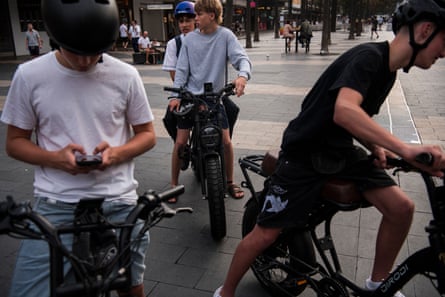
There have been increasing calls to crack down on “rideouts” like those on the Harbour Bridge, at a north Sydney golf course, and through Melbourne’s Docklands district.
Group cycling events grew popular in Australian cities during the Covid pandemic, often organised by and for urban teenage boys and promoted on social media. Attendance at these events swelled from dozens to hundreds.
Natalie Ward, deputy leader of NSW’s opposition, has called for “ebikie gangs” to be banned from the streets.
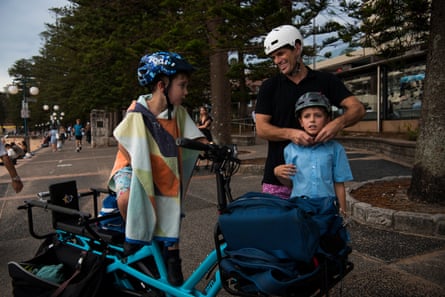
Regular riders such as Brookvale couple Kieran and Elle sympathise with this perspective.
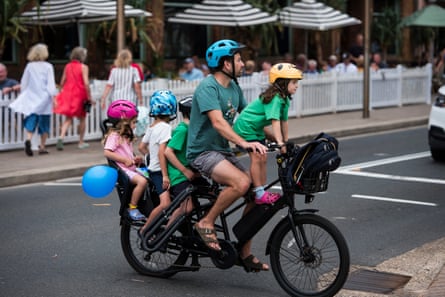
“They’re giving us a bad name,” said Kieran, travelling to dinner with his four- and one-year-olds strapped into child seats.
“We would never go over around 20 km/h, we just want to come down for a cruise on a Friday night.”
Daz, who works with rideout organiser Bike Life Australia, said police have begun surrounding gatherings to issue move-on orders and fines in bulk.
“There’s an energy when you ride in a pack like that, doing tricks with your friends,” said Daz, who declined to share his surname. “The boys need it, it helps them get out.”
Bike Life is working to coordinate more closely with police, Daz added.
Bicycle NSW advocates that heavy-handed enforcement should be a last resort and is calling for education of teenagers, parents, and retailers about the laws. The organisation is trialling an education program in hundreds of schools with plans to expand it across the state.
Max*, a 15-year-old Sydney student, recalled a class where he cracked one egg with a model helmet and another without, observing the difference.
“I was just like, ‘man, I don’t want that to be my head’,” said Max, who requested anonymity.
He unlocked his DiroDi Gen 4 fat tyre bike in January but avoids riding at high speeds due to safety concerns.
He noted that some classmates and their parents do not caution.
“I’m just wondering, like, do these people’s parents know they’re giving their 14-year-old kid a bike that can go over 50 km/h?” he said.