

Conflict Hampers Ebola Response in DR Congo
Ongoing conflict in the Democratic Republic of Congo (DR Congo) is significantly obstructing efforts to control the Ebola outbreak, the World Health Organization (WHO) Director-General Dr Tedros Adhanom Ghebreyesus has cautioned.
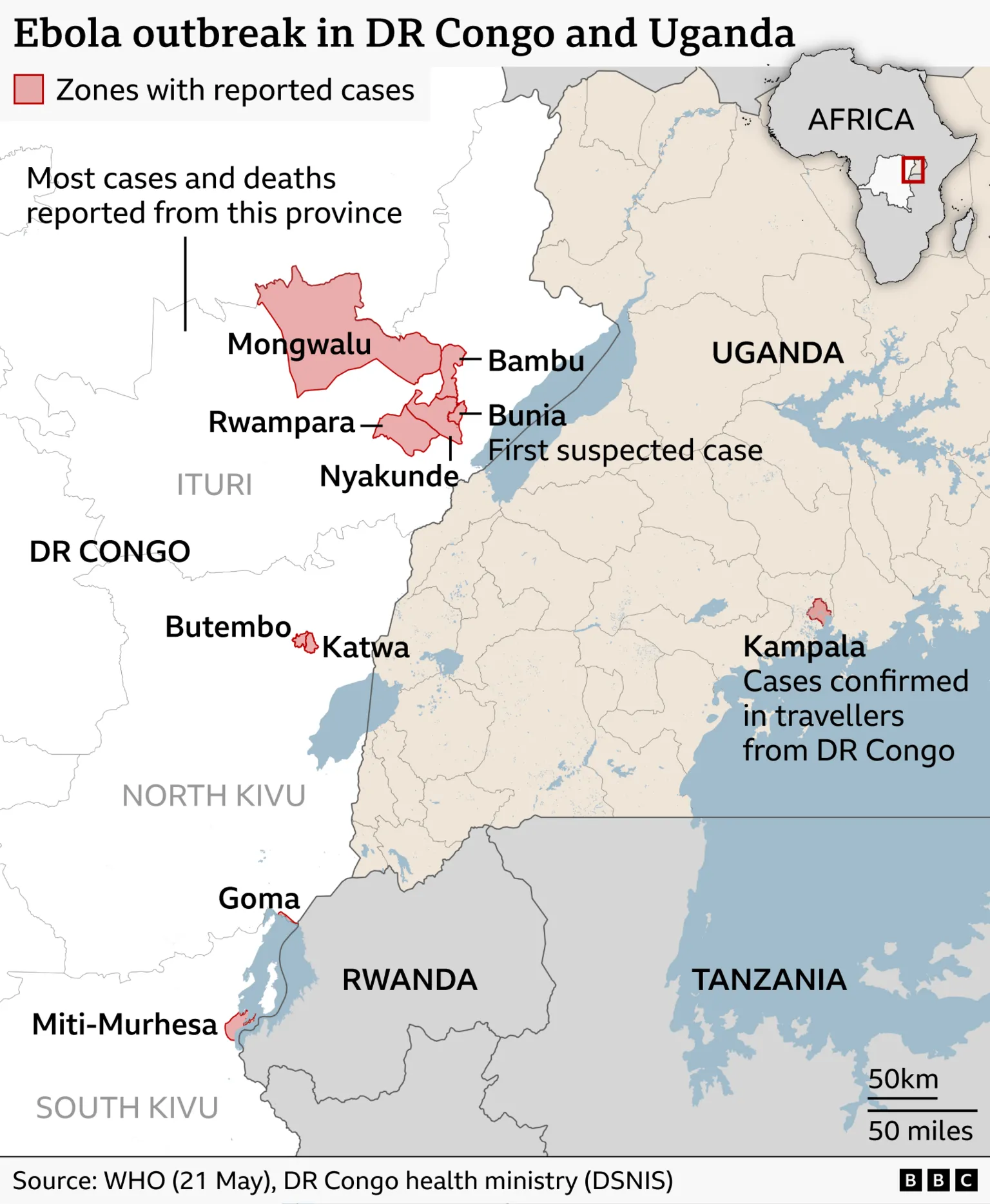
Dr Tedros identified Ituri province in eastern DR Congo as the epicenter of a "catastrophic collision of disease and conflict".
In a statement posted on X, Dr Tedros emphasized the challenges faced by health workers, stating that the WHO could not "build community trust or isolate the sick while bombs are falling." He is scheduled to travel to DR Congo this week to lead initiatives aimed at containing the virus.
Border Closures and Rising Death Toll
In response to the outbreak, Uganda has announced a temporary closure of its border with DR Congo. Since the outbreak was declared, there have been 220 suspected deaths attributed to Ebola.
Aid workers report difficulties in travel due to poor road conditions, compounded by ongoing conflict and mass displacement, which have further weakened the local health system. Additionally, reductions in international aid have exacerbated these challenges.
Ituri province, where the majority of cases have been reported, has been under military rule since 2021. This followed the replacement of civilian authorities with a military general in an effort to neutralize numerous armed groups operating in the area.
Humanitarian Access and Security Concerns
Dr Tedros highlighted the critical importance of humanitarian access to halt transmission in the region.
"Stopping transmission in the region depends entirely on humanitarian access,"
he said, adding,
"Yet ongoing clashes are driving mass displacement, pushing exposed contacts into overcrowded camps and severing critical containment corridors."
He further noted the risks faced by frontline workers and the impact of attacks on health facilities, which have made it nearly impossible to track cases and their contacts.
"Frontline workers are risking everything, while attacks on health facilities make tracking cases and their contacts nearly impossible."
Dr Tedros called on all parties involved in the conflict to agree to an immediate ceasefire to enable safe access for medical teams.
International Travel Restrictions
Concerns about the potential spread of the Ebola outbreak have prompted several countries to impose strict travel restrictions.
On Wednesday, Uganda announced that its border closure would take effect immediately. Only essential workers—including medical and humanitarian personnel, food transporters, and security staff—will be permitted to cross under stringent conditions.
Canada has implemented a 90-day entry ban for residents from DR Congo, Uganda, and South Sudan. The Bahamas has also introduced strict measures requiring foreign nationals from these countries to undergo quarantine or isolation.
Last week, the United States banned non-citizens who had traveled to any of the three countries from entering.
Current Situation and Medical Response
Congolese health authorities report that approximately 1,000 individuals are currently exhibiting symptoms consistent with Ebola.
The DR Congo country director for Médecins Sans Frontières (MSF) informed the BBC that establishing adequate infrastructure to contain the outbreak will require several weeks.
This outbreak involves a rare Ebola strain known as Bundibugyo, for which no vaccines or approved medicines currently exist.
Health officials in DR Congo have faced challenges in confirming cases among the 220 suspected deaths. To date, only 17 deaths have been confirmed by laboratory testing as caused by Ebola.
Medical teams are also engaged in an urgent effort to trace 3,600 individuals identified as contacts of infected patients.
About 2,000 diagnostic tests have been distributed, with an additional 4,000 tests scheduled for deployment. Experimental treatments, including an antibody developed in the United States, may soon be introduced.

Challenges in Containment Efforts
Ewald Stals, MSF director in DR Congo, described ongoing efforts to deliver medical supplies and personnel to the outbreak's epicenter. However, insecurity and poor transport infrastructure in Ituri province continue to impede progress.
"We're still far behind having a control on the situation,"
he told the BBC, adding,
"We still do not have a full picture of what is happening, and that is mainly due to insufficient testing. As long as that is the case, we can say that the virus is still ahead of us."
Increased Support from European Agencies
On Wednesday morning, the European Centre for Disease Prevention and Control (ECDC) announced plans to increase its presence on the ground.
The ECDC stated that more experts would be deployed through the EU Health Task Force to assist in outbreak response efforts.
Additional reporting was provided by Emery Makumeno in Kinshasa and Barbara Plett Usher in Nairobi.
For more news from the African continent, visit BBCAfrica.com.
Follow updates on Twitter @BBCAfrica, Facebook at BBC Africa, or Instagram at bbcafrica.


