

Prostate Cancer Screening Recommendations in the UK
The UK's National Screening Committee has advised that prostate cancer screening should be limited to a very small subset of men at high risk of the disease.
Currently, there is no national screening programme for prostate cancer, which remains the most common cancer among men.
This decision comes despite significant advocacy for expanded screening by prominent individuals such as Sir Chris Hoy, who is living with terminal prostate cancer, and Lord David Cameron, who recently disclosed his prostate cancer treatment.
Cancer Research UK has stated that although this outcome may disappoint many, the prostate-specific antigen (PSA) test presently used to detect prostate cancer lacks sufficient effectiveness to justify broader screening efforts, a conclusion supported by multiple large-scale clinical trials.
What Is Screening?
Screening involves inviting asymptomatic individuals to undergo tests to detect disease early.
Examples include routine mammograms for breast cancer in women and biennial at-home bowel cancer tests mailed to individuals over 50.
The goal is to identify cancer before symptoms develop, enabling earlier treatment and improved outcomes.
National Screening Committee's Recommendations
After reviewing all available evidence, the committee concluded that screening the vast majority of men for prostate cancer is not justified.
Screening is recommended only for men with specific genetic risk factors, particularly those with BRCA2 gene variants.
The guidance advises that this group should undergo screening every two years between ages 45 and 61.
Screening is not recommended for other high-risk groups, including black men and men with a family history of prostate cancer.
Rationale Behind the Committee's Conclusion
The committee emphasized that a mass screening programme for prostate cancer could cause more harm than benefit.
Tests for prostate cancer, such as the PSA test, are not sufficiently reliable and may lead to treatment of slow-growing cancers that would not have caused harm.
Treatments can result in significant side effects, including incontinence and impotence, which adversely affect quality of life.
While early detection and treatment can save lives, it remains challenging for clinicians to distinguish aggressive cancers from indolent ones, leading to potential overtreatment.
The committee said the number of lives saved by screening does not outweigh its harmful effects on healthy men.
Screening and High-Risk Groups
Contrary to expectations that all high-risk men would be included in screening plans, the committee limited recommendations to men with BRCA2 mutations.
Despite black men having twice the risk of prostate cancer, the committee did not recommend screening for this group due to uncertainties about the impact and a lack of clinical trial evidence.
Similarly, men with a family history of prostate cancer are not recommended for screening because of concerns about overdiagnosis and overtreatment.
Men with BRCA2 variants, however, tend to develop faster-growing and more aggressive prostate cancers at younger ages, making screening more beneficial for this subgroup.
Early treatment in these men is more likely to provide benefit that outweighs the risks of unnecessary treatment compared to the general population.
Testing for BRCA2 Variants
Identification of BRCA2 mutations requires genetic testing.
These gene variants affect both men and women and increase the risk of several cancers, including prostate, breast, and ovarian cancers.
Approximately three in 1,000 men carry BRCA variants, though many remain unaware unless they have family members known to be carriers and undergo confirmatory testing.
Experts anticipate that genetic testing will need to be expanded among high-risk men to better identify those affected.
Prostate Cancer Incidence and Mortality
Prostate cancer is the most frequently diagnosed cancer in men.
Each year, around 55,000 men in the UK receive a prostate cancer diagnosis, and approximately 12,000 men die from the disease annually.
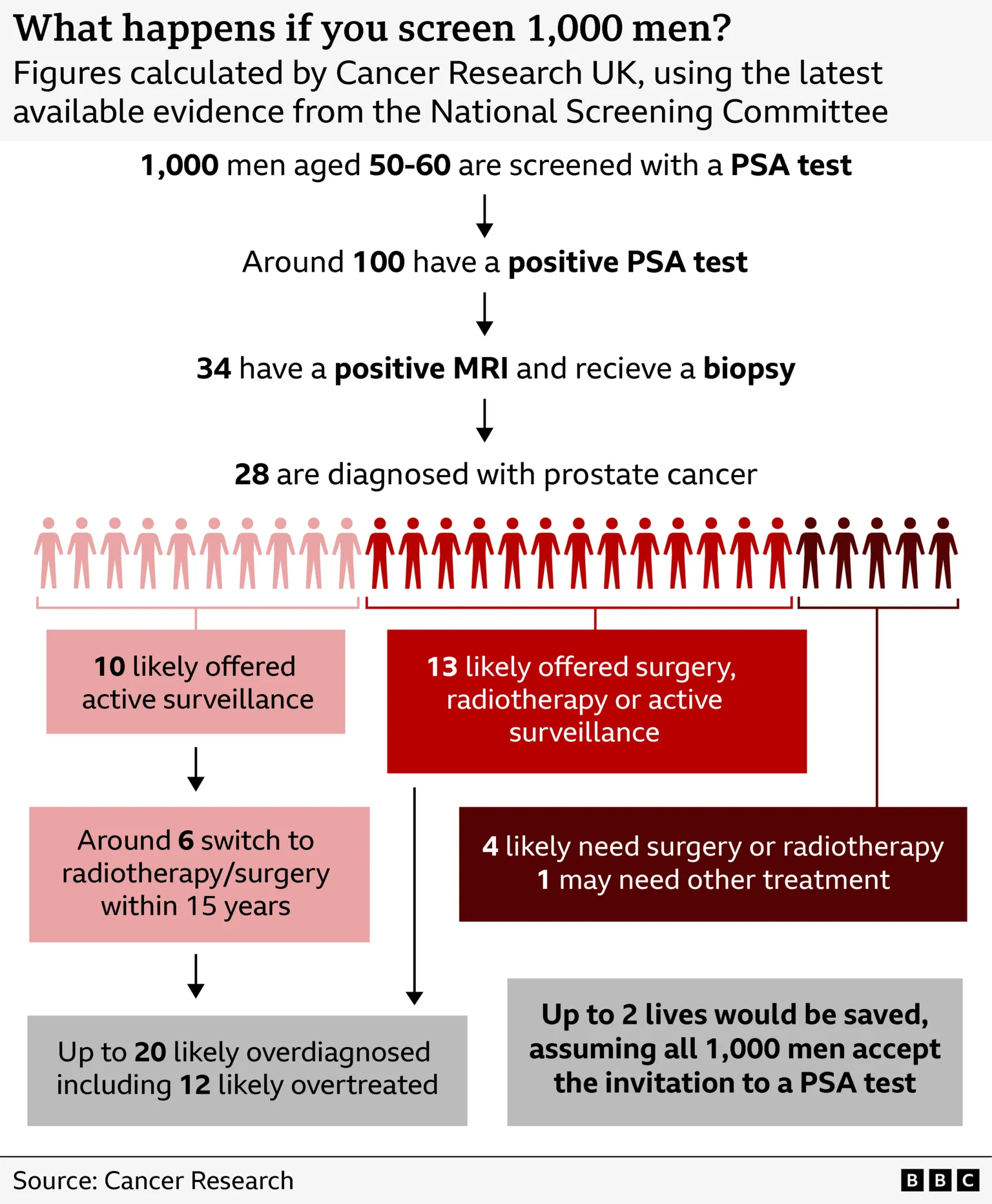
This graphic illustrates the impact of PSA testing in 1,000 men aged 50 to 60: 100 have a positive PSA result; 34 then have a positive MRI scan; 28 are diagnosed with prostate cancer; 20 are overdiagnosed; 12 receive overtreatment; and two lives are saved.


