

Irish Climber Faces Challenges After Everest Summit
Sarah Armstrong, a dentist from Crossmaglen, County Armagh, who suffered frostbite in seven of her fingers, is "adjusting to the new normal" following her successful summit of Mount Everest on 20 May.
Armstrong, 31, is among a select group of Irish climbers who have reached the peak of the world's highest mountain. In recent weeks, several climbers from across Ireland have also completed the ascent.
While Armstrong's achievement is remarkable, it came with significant risks. She is currently recovering from the effects of low oxygen levels and frostbite sustained during her expedition.
Speaking on BBC Radio Ulster's Good Morning Ulster programme, Armstrong expressed relief at being back in Ireland.
"I'm glad to be back on Irish soil," she said.
She added that overall she is "feeling much stronger" now that she has returned home.
Armstrong spent a total of 53 days on the Himalayan mountain. She encountered difficulties during her descent.
"The downhill typically is always much more challenging than the uphill because you're so extremely tired at that stage," she explained.
She described a critical moment when her oxygen supply ran out at the balcony, causing her to become cold rapidly and struggle until she was able to obtain more oxygen and return safely to Camp Four.
"On my descent, there was a time when my oxygen ran out at the balcony and that led to getting cold very quickly and struggling for a bit of time until I was able to source some new oxygen to therefore get safely back to Camp Four," Armstrong said.
Armstrong recounted experiencing a sense of panic during this period.

"Then, suddenly, for somebody who just felt so strong through the whole expedition and the whole push, I just suddenly wasn't very lucid," she said.
"So it's gathering yourself physically and mentally, really, to try and keep moving at that stage and keep it together."
She expressed gratitude for having made it down safely.
Armstrong continues to deal with frostbite affecting seven of her fingers, a condition caused by skin exposure to temperatures below 0°C.
"In time, the frostbite will hopefully recover well," she stated.
"Most of them are grade one, so they should recover with time. But how long, we don't know. It could be a few months, which isn't great when you work as a dentist.
As I say, I'm adjusting to the new normal at the minute."
Crowds and Conditions on Everest
This climbing season has seen more than 1,000 people reach the summit of Everest, marking it as the busiest on record.
A record number of 274 climbers scaled Mount Everest via Nepal on 20 May, following a delayed start to the spring season caused by a large ice block obstructing the climbing route.
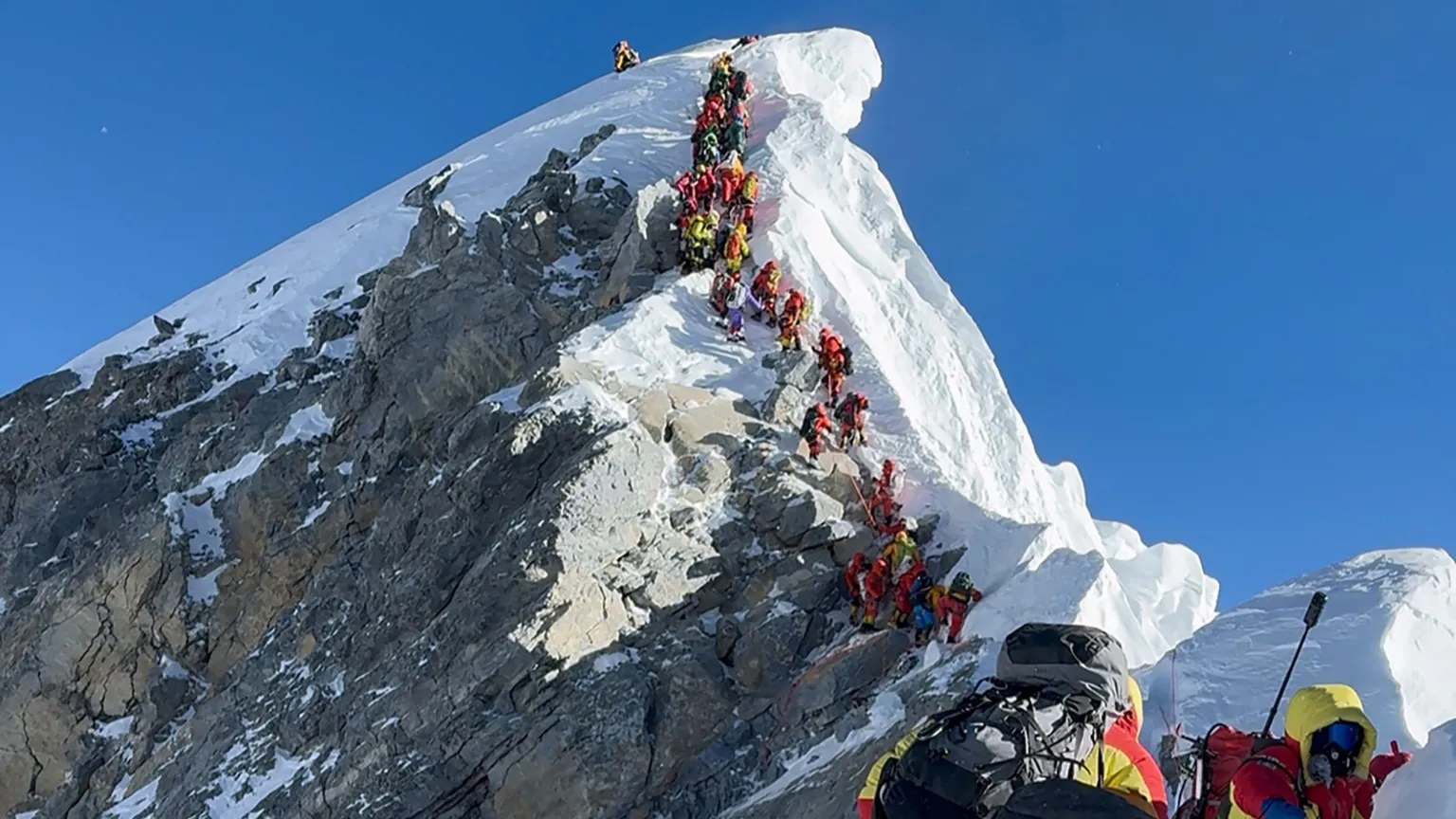
This was the same day Armstrong reached the summit.
"So that led to hundreds and hundreds of people on the mountain that day," she said.
Armstrong noted that the mountain was noticeably busy from Base Camp upward.
"This year the Tibetan side of the mountain was shut, which obviously meant the Himalayan side had more climbers."
She described the journey from Camp Three to Camp Four, which normally takes five to seven hours, but on that day she spent 12 hours on the rope due to standstill queues.
"And again, on the summit push, the Hillary Step, which is a well-known area just before the summit, I stood there in -35 with wind chills right up to 40 mile an hour for nearly two hours standstill," Armstrong said.
Risks Highlighted by Sherpa Incident
Separately, a Nepali climbing guide, Hillary Dawa Sherpa, was found crawling down Everest six days after he was last seen alive, having become separated from his clients. He had previously been presumed dead.
This incident raises concerns about the growing high-altitude tourism industry and highlights the dangers Sherpas face while working on Mount Everest.


