

Introduction to Mating Season
This tale of a sexually driven bear embarking on a journey of self-discovery after his partner leaves him during hibernation is certainly provocative. But can it capture the emotional warmth of its predecessor?
In the opening minute of Netflix’s animated comedy Mating Season, a bear awakens, urinates uncontrollably throughout his cave, stumbles outside, witnesses two passionate raccoons copulating, and then descends into a profound sense of shame. At this stage, it is almost unnecessary to highlight that Mating Season is the spiritual successor to the outrageous, witty comedy Big Mouth, so deeply does it embody that show’s essence.
By this point, viewers will likely know whether the show suits their tastes. Big Mouth, despite its popularity, polarized audiences like few other series. It focused on the challenges of puberty and sexual awakening, crafted with precise attention to its core audience of hormonally charged adolescent boys. One could argue it was perhaps too precise, as its relentless use of juvenile humor, including explicit sexual content, flatulence, and profanity, alienated many viewers.
Frankly, that was their loss. Beneath the layers of overt offensiveness, Big Mouth arguably stood as one of television’s most heartfelt shows. Adolescent boys embody a perplexing blend of overconfidence and acute awkwardness, and Big Mouth captured both aspects with equal skill. For a particular demographic of young males, it was inevitable to see themselves reflected in one of the characters.
Animal Characters and Themes in Mating Season
Achieving that level of identification is more challenging in Mating Season, as all characters are animals, and sex is portrayed less as recreation and more as essential for survival. Josh, the aforementioned urinating bear (voiced by Zach Woods), realizes that it is literally mating season. After an extended hibernation, he discovers his girlfriend has left him for a dominant alpha bear. Consequently, he is left despondent, unable to decide whether to, as he puts it,
“devote myself to masturbation,”or to reengage in mating efforts. In this context, the phrase is scarcely metaphorical.
On the surface, the narrative centers on the recently dumped. Across its 10 episodes, Mating Season follows Josh as he experiments with dating apps, engages in spiritually unfulfilling sexual encounters, and ultimately reaches a tentative balance. However, much like Big Mouth, the storyline primarily serves as a framework for a variety of eccentric elements.
Much of the show’s eccentricity is driven by co-creator Nick Kroll’s character, an exceedingly confident raccoon. This role provides Kroll ample opportunity to perform his trademark style of loudly delivering crude remarks, while also fulfilling a narrative purpose. The most difficult aspect of youth and singledom is the perception that everyone else is experiencing extraordinary sexual success, and Kroll’s raccoon embodies that notion.
Nevertheless, all characters are biologically accurate animals, governed by instincts distinct from human impulses. This biological fidelity introduces a degree of separation between the characters and the audience that the creators may not have anticipated.
For instance, one episode focuses entirely on the copulatory tie—the phase when a male canine’s bulbus glandis swells and the female’s vaginal muscles contract, locking them together. Additionally, significant attention is given to the hippopotamus’s ritual of spraying its mate with feces. While the show refrains from kink-shaming, its close adherence to animal behavior—illustrated by Kroll’s character shouting
“Express your anal glands all across my goddamn pelt!”during copulation—shifts the narrative from a relatable sexual development story to an exploration of animal grossness.
Disney Influence and Visual Style
Another notable aspect of Mating Season—which viewers may interpret positively or negatively—is its exploitation of the Disneyfication of its characters. Bears, deer, and raccoons have long been familiar archetypes in classic hand-drawn Disney films of the previous century. When these animals appear, they evoke memories of characters like Bambi, Baloo the bear, or Meeko from Pocahontas. This familiarity makes it jarring when these characters engage in uninhibited mating behaviors.
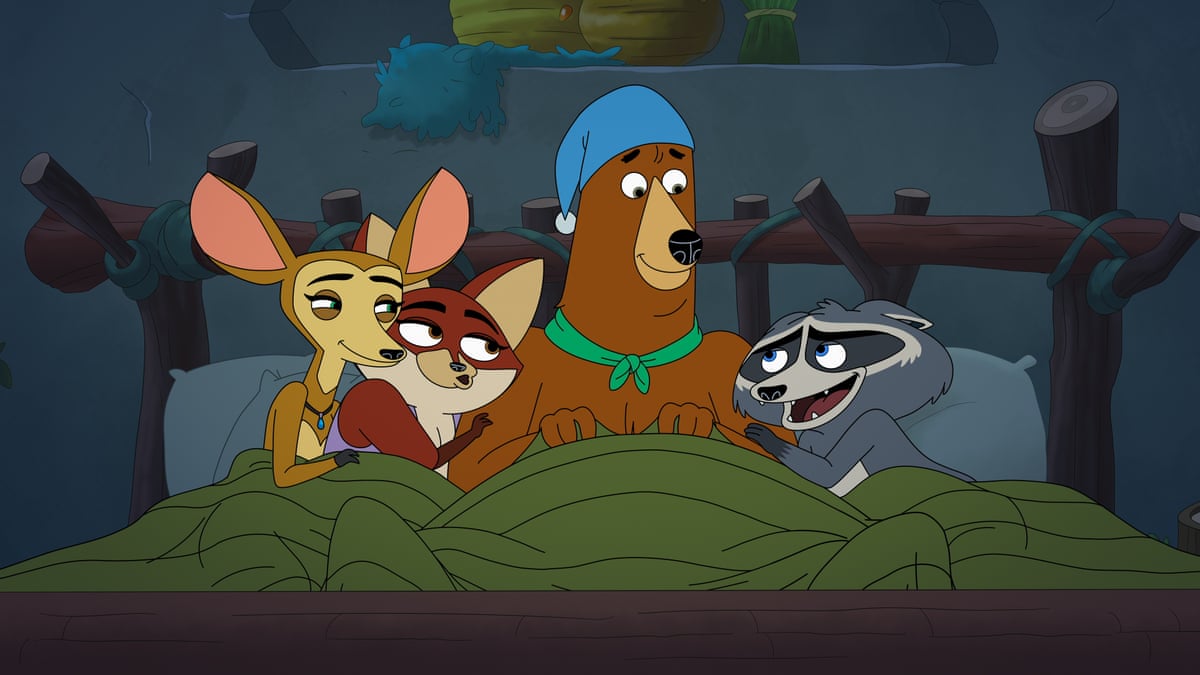
To emphasize this point, the 1941 Disney short The Little Whirlwind features a scene where Mickey Mouse becomes so captivated by the aroma of a freshly baked cake that the scent physically lifts him and floats him toward it. A variation of this trope appears in Mating Season, except the character is drawn floating toward an animal’s anus, murmuring
“Nummy nummy nummy”.
Conclusion: A Disgusting Comedy with Heart
Despite these elements, once viewers move past the initial shock, Mating Season emerges as another profoundly crude sex comedy imbued with more heart than it is often credited for. If the show endures and evolves as Big Mouth did, it may develop into something truly distinctive.
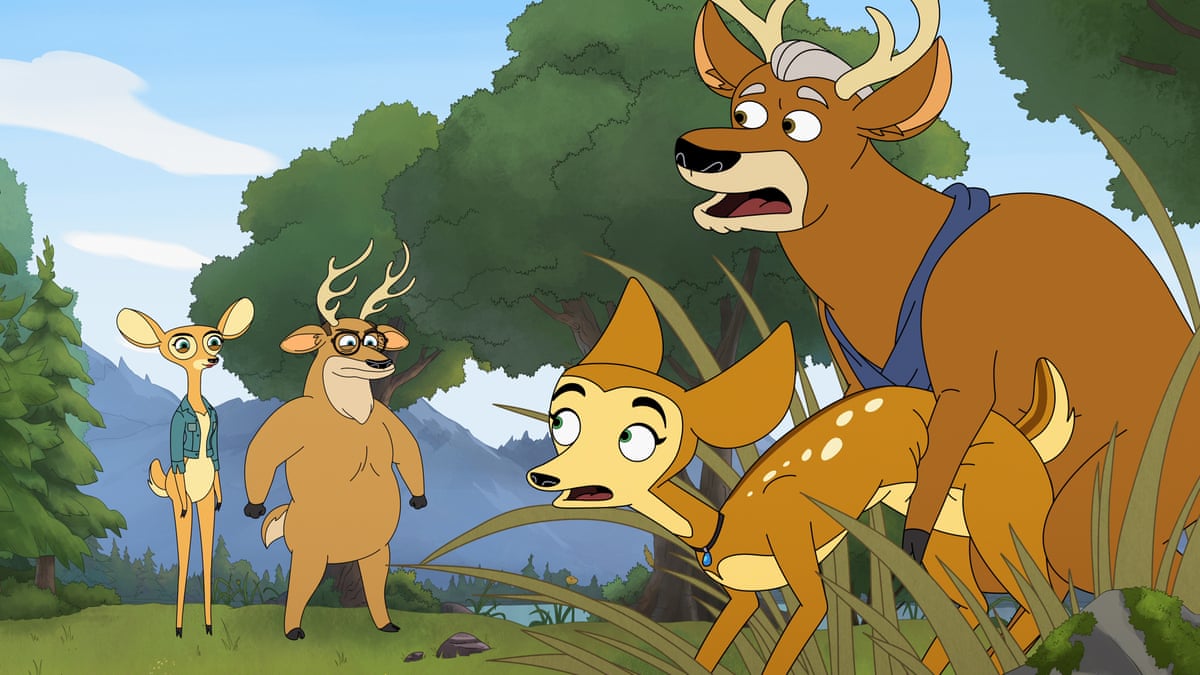
Playing the field … (from far left) Cassie (Ashly Burch), Alan (Jason Alexander), Fawn (June Diane Raphael) and as Charles (David Duchovny) in Mating Season. Photograph: Courtesy of Netflix


