Introduction: Markets Hit by Iran Crisis and Tech Sell-Off
Good morning, and welcome to our continuous coverage of business, financial markets, and the global economy.
Stock markets across Asia-Pacific are retreating today amid investor concerns over potential US interest rate hikes, escalating conflict in the Middle East, and a slowdown in the AI sector.
Major indices are all down; South Korea’s KOSPI index dropped nearly 9% at one point, triggering a temporary trading halt, while Japan’s Nikkei 225 index declined by 3.8%.
The sell-off follows a difficult Friday on Wall Street, where the S&P 500 fell 2.64%.
Friday’s decline was prompted by a stronger-than-expected US employment report, leading many traders to anticipate an increase, rather than a decrease, in US interest rates.
Technology stocks have also suffered significant losses recently amid concerns that the AI race is evolving into a contest over capital raising and expenditure, as companies like ChatGPT and Anthropic prepare for stock market listings.
Combined with renewed Middle East conflict today, these factors contribute to further global market losses.
Kyle Rodda, senior financial market analyst at Capital.com, explains:
"Things could get a bit hairier today in the markets after a flare-up in geopolitical tensions over the weekend. Iran launched strikes on Israel for its attacks on Hezbollah targets in Beirut, leaving a nervous wait for the Israeli response. There is the heightened risk the war escalates again as peace talks between the US and a clearly emboldened Iran stall."
The Agenda
At 4pm BST, US inflation expectations will be released.
After Friday’s losses, US tech stocks may recover some ground today. Nasdaq Composite futures indicate a 0.6% rise.
Derren Nathan, head of equity research at Hargreaves Lansdown, states:
"Despite the overnight sell-off in Asia, US investors look to be taking a more measured view with futures in the tech-led NASDAQ holding firm compared to a 0.4% decline in the more broadly focussed Dow Jones Industrial Average. With SpaceX, potentially the largest IPO in history, now teed up on the launch pad for Friday, and UK retail investors being offered unprecedented access, the market mood in this week’s countdown will be closely monitored."
Meanwhile, the Stoxx Europe 600 Technology Price Index is down nearly 0.5% this morning.
Nvidia CEO: Tech Stock Sell-Off Is a Buying Opportunity
Nvidia CEO Jensen Huang described the recent global tech stock sell-off as a buying opportunity, according to Bloomberg.
During his visit to Seoul, Huang emphasized that the AI infrastructure buildout has only just begun.
He said:
"We’re at the beginning of it, and whatever happened to the stock market, you should be very happy because now you can buy at a discount. Everybody should be very excited."
Oil Hits $98 After Explosions in Central Tehran
Reports of explosions in central Tehran this morning have driven oil prices higher.
Brent crude reached $98 per barrel, a 5% increase today from $93.08 on Friday night.
Israel’s IDF posted on X that dozens of air force fighter jets have "completed an extensive strike" on "strategic defence systems".
Our colleagues have analyzed the AI boom in detail, including charts from their report.
Europe’s Stoxx 600 share index has fallen to a two-week low this morning, pressured by escalating Middle East tensions and a global AI stock sell-off.
Why AI Stocks Are Selling Off
Charu Chanana, chief investment strategist at Saxo, explains that while Friday’s strong US jobs report triggered the sell-off, the underlying issue is crowded positioning in AI and semiconductor stocks.
Chanana identifies five reasons for the decline in AI sector shares:
- AI crowding: Semiconductors and AI-related stocks became default long trades. When many investors hold the same winners, even minor disappointments can cause large sell-offs.
- Top-heavy leadership: A small group of AI leaders carried much of the index’s gains, making the market more fragile on declines.
- Expectations too high: The reaction to Broadcom showed that "good" results are insufficient; investors demand upside surprises, stronger guidance, clear monetization, and proof of accelerating AI demand.
- AI funding concerns: AI is capital-intensive. Moves by Alphabet and Meta highlight the need for significant investment in AI infrastructure, raising questions about capital discipline, dilution risk, and return on spending.
- Geopolitical risk: Rising Middle East tensions, oil price volatility, and fading peace prospects add uncertainty, accelerating market declines when already stretched.
Tate & Lyle Agrees to Takeover
UK ingredients developer Tate & Lyle has agreed to be acquired by US rival Ingredion in a £2.7bn deal, lifting its shares 12% this morning.
Once known for sugar refining, Tate & Lyle now produces sweeteners, fibers, and stabilizers for food manufacturers.
Victoria Scholar, head of Investment at, comments:
"This is a very attractive offer for Tate & Lyle at 595p a share plus 20p a share in dividends, equivalent to a 64% premium prior to its recent surge. The announcement comes at a time when the UK business has been struggling with a weak share price performance and disappointing financial results, leaving the company vulnerable to a takeover. There are clear synergistic benefits to the deal, with both companies focused on growth in the sugar substitute space. For Ingredion, the acquisition will help boost its presence in Europe too. Sugar is very much out of fashion. Rising awareness of its negative impact on health combined with the growth in weight loss jabs has shifted consumer preferences towards healthier alternative products instead. Shares in Ingredion are down 6% over the last month and 9% so far this year."
Nvidia's Huang Draws Crowd at Chicken Restaurant
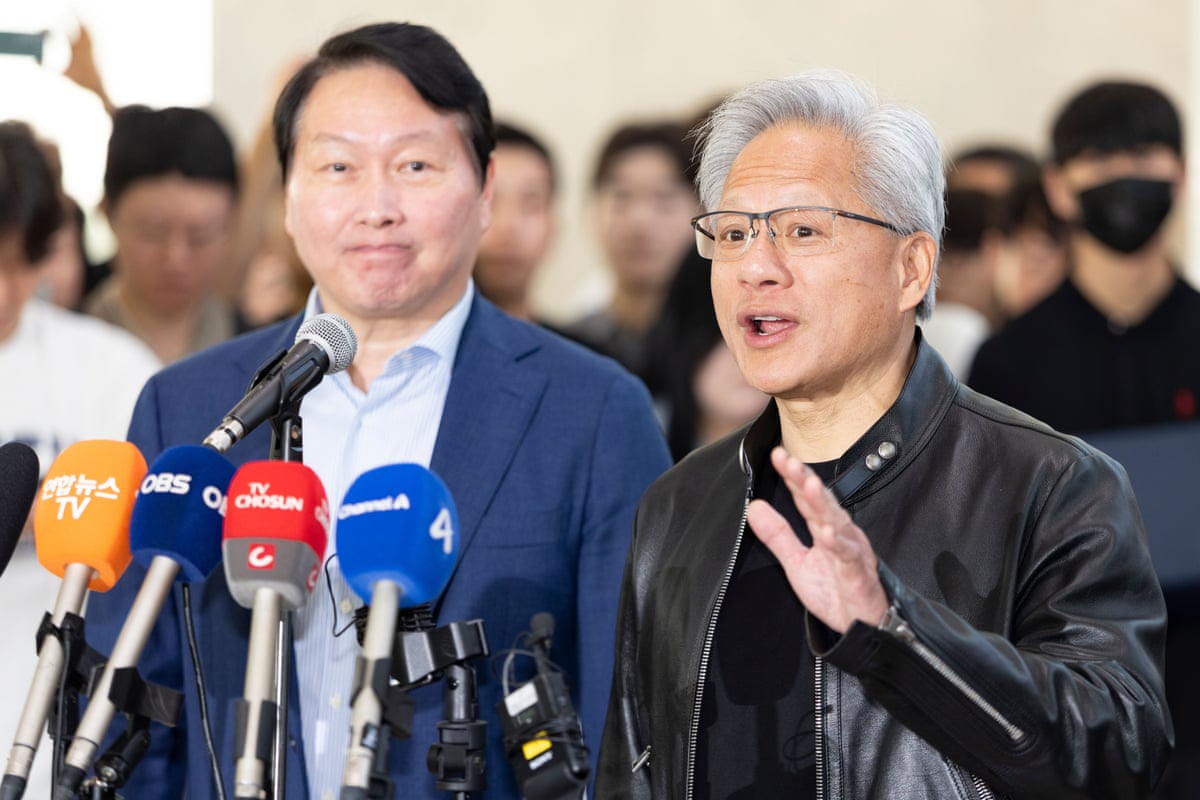
The AI stock sell-off did not dampen spirits at Kkanbu Chicken restaurant in Seoul last night, where Nvidia CEO Jensen Huang met with senior SK Group executives.
Huang and SK chairman Chey Tae-Won shared beer, fried chicken, and distributed food to a large crowd gathered at the venue.
The pair celebrated a partnership to advance development, design, and manufacturing of next-generation memory for AI factories.



European Tech Firms’ Shares Slide
Shares of European companies central to the AI boom are sharply down at the start of trading.
Chipmakers such as Besi (BE Semiconductor Industries) fell 4.5%, and ASML, a chipmaking equipment manufacturer, declined 3.2% on the pan-European Stoxx 600 index, which is down nearly 0.9%.
German tech firm Aixtron dropped almost 6%, and Finland’s telecom company Nokia declined 5%.
This follows significant losses among South Korean tech firms overnight.
Government bond prices are falling in early trading, pushing up borrowing costs in the US, UK, and eurozone.
The yield on UK 10-year bonds rose by 3.5 basis points to 4.93%, with shorter-dated bond yields also increasing.
FTSE 100 Joins Sell-Off
London’s stock market opened lower amid concerns over missile attacks between Israel and Iran.
The FTSE 100 index of blue-chip shares fell 42 points, or 0.4%, to 10,326 points at the start of trading.
Rolls-Royce was the top decliner, down 4.3%, following criticism from United Airlines’ head over delayed Airbus plane orders.
British Airways parent company IAG declined 2.6%.
Oil producers rallied, with BP and Shell both up 1.5%.
UK Companies Favor Temporary Over Permanent Hiring
Britain’s jobs market cooled sharply in May as employers reduced permanent staff hiring, according to a survey released this morning.
The monthly Report on Jobs from KPMG and the Recruitment and Employment Confederation showed permanent job placements fell at the fastest rate since July 2025.
German Factory Orders Fall More Than Expected
German factory orders declined 3.8% in April, signaling potential weakness in Europe’s largest economy amid rising costs and weakening demand due to the Iran conflict.
Automotive orders fell 5.3%, while electrical equipment orders dropped 16.3%, according to Destatis.
BoE’s Taylor Sees No Need for Higher Interest Rates
Bank of England policymaker Alan Taylor, considered dovish, indicated no need to raise UK interest rates further to counter inflationary effects from the Iran war.
Taylor told :
"I think interest rates don’t need to go higher as they’re quite restrictive at the moment. I feel comfortable where we are unless we get the worst-case scenario. But I really want to get that sense that this is moving behind us."
Under the BoE’s worst-case scenario, energy prices surge and remain high, causing price and wage increases.
Taylor visited the HS2 Birmingham Curzon Street station construction site and noted supply chain pressures affecting steel, copper, concrete, and other raw materials.
He added:
"It’s a very volatile world right now."
Market Impact from Multiple Factors
Kathleen Brooks, research director at XTB, commented on the market situation:
"As we start a new week, the market is digesting a large upside surprise in US payrolls, tech stock jitters, a huge week for macroeconomic data and an increasingly fragile ceasefire in the US, after Iran and Israel both attacked each other, which could end the truce which has been in place since April. Oil prices have jumped 4% and Brent crude is back above $97 per barrel."
Circuit Breakers Triggered as South Korea’s Market Tumbles
Major chipmakers led the decline on South Korea’s stock market today.
Samsung Electronics dropped 9.2%, and SK Hynix fell 6.4%, pulling the KOSPI index down over 8%, triggering circuit breakers.
"Circuit breakers were activated at 0003 GMT, halting trading for 20 minutes for the first time in three months. It was the third time they were triggered this year, and the ninth in history. The KOSPI had surged through most of 2026, as the AI boom pushed up the value of South Korea’s chipmakers."
Oil Jumps 4.8% After Middle East Attacks
Oil prices are approaching the $100 per barrel mark following new missile strikes in the Middle East.
Brent crude, the international benchmark, rose 4.8% to $97.60 a barrel after Iran launched missiles in response to Israeli strikes on Beirut’s southern suburbs.
The fragile ceasefire in the Middle East appears to be breaking down, diminishing hopes for reopening the Strait of Hormuz and resuming energy flows from the region.