

Whistler’s Mother: A Masterpiece Born of Chance and Genius
When his 15-year-old model unexpectedly left, Whistler’s mother stepped in to pose. Now, as the celebrated painting returns to Britain, its restorer reflects on the artist’s brilliance and the challenges posed by his choice of paint.
“One does like to make one’s mummy just as nice as possible.”These words were spoken by James Abbott McNeill Whistler about his renowned painting of his mother Anna, officially titled Arrangement in Grey and Black No 1. Known for his lack of modesty, Whistler’s statement now appears as a rare understatement. Over the past 150 years, the painting, commonly called Whistler’s Mother, has achieved a status in America comparable to the Mona Lisa. Anna has continuously toured museums across the US and internationally. This month marks its first return in nearly two generations to London, where Anna sat for the portrait in Whistler’s Chelsea studio, as part of an exhibition.
I became intimately familiar with every detail of the painting during its restoration for the Musée d’Orsay, commissioned by the Louvre, which owns the artwork. Whistler remains unique as the only artist whose portrait of his mother has attained such iconic status, and the painting’s history is equally compelling.
The artist himself was a larger-than-life figure, known for his sharp wit and memorable aphorisms. The young Oscar Wilde admired Whistler’s mordant humor, once exclaiming, “I wish I had said that,” to which Whistler replied with a rapier-like retort, “But you will.” Beyond his wit, Whistler was deeply respected. Walter Sickert, his assistant, described him as “A beacon of light and happiness to everyone who was privileged to come within its comforting and brightening rays.”
However, when Anna posed for her son in 1871, the painting’s future acclaim was far from certain. At that time, Whistler’s career was at a low point, and London critics were dismissive of his work. Arrangement in Grey and Black No 1 was created during a period of despair. Whistler had spent four years in Paris living a bohemian lifestyle, but realizing he could not compete with contemporaries like Manet and Monet, he relocated to London, where the art scene was stagnant and ripe for innovation.
After the early success of his dreamy 1858 painting At the Piano, Whistler’s fortunes declined. English collectors expected paintings to tell stories, but by his 30s, Whistler was pursuing what he called “the poetry of sight,” a concept distinct from the Impressionists’ focus on capturing light. Whistler’s interest in nature was limited.
The creation of the portrait was serendipitous. In 1871, the 15-year-old daughter of MP William Graham fled from a commissioned society portrait. Whistler then asked his mother to pose instead. The painting was executed on the reverse of a previously used canvas, possibly one he had been working on. Anna’s poor health allowed her to sit rather than stand in the studio. The footstool depicted may have served as a footwarmer in the cold, dim, north-facing studio on Cheyne Walk.
Suddenly, flashes of genius emerged. Whistler, though not an intellectual, possessed an artistic intuition akin to perfect pitch. He experimented with texture, rendering deep blacks almost like ink, while the limited color was applied in thick traditional paint. The background is a minimalist studio, a stark contrast to the Victorian era’s colorful and ornate interiors.
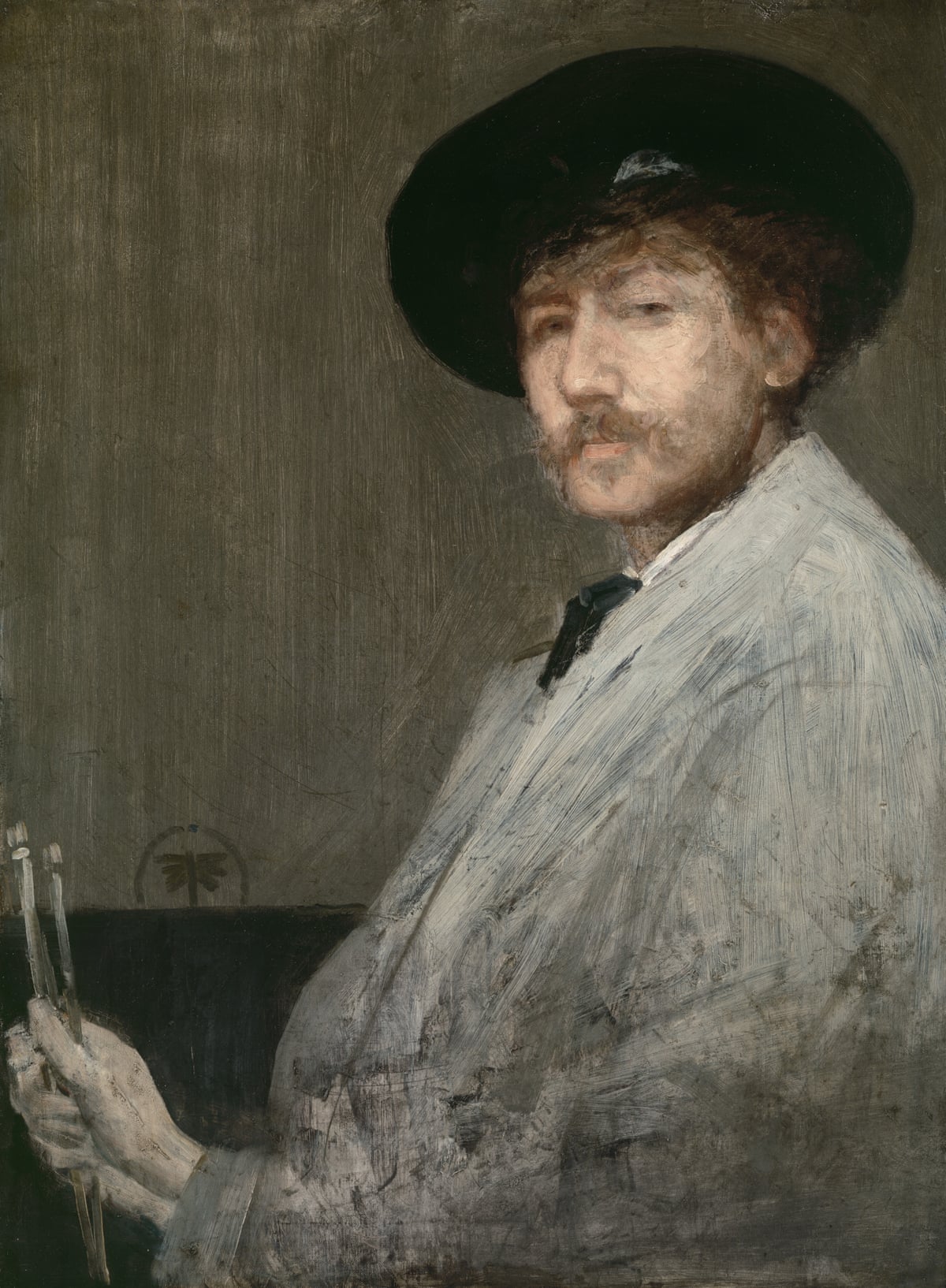
When exhibited at the Royal Academy, after considerable persuasion by friends, the painting puzzled critics. An Examiner newspaper reviewer acknowledged the probable accuracy of the likeness but dismissed the work as “not a picture,” criticizing its exclusive use of grey and black. It was only after the French government purchased the painting in 1891 that British art circles recognized their oversight. It took another thirty years for Britain to fully appreciate the revolutionary nature of Whistler’s work.
With this painting, Whistler established himself as the first in a lineage of great American painters, including Edward Hopper, Andy Warhol, and Mark Rothko. From a restorer’s perspective, Whistler’s burst of creativity was distinctly American. Warhol once admitted, “My pictures won’t last. I used cheap paint,” a sentiment Whistler might have shared. The blacks in Anna’s skirt had already altered by the time the French state acquired the painting. Whistler’s decision to have it relined prematurely caused the paint to soak into the canvas, complicating restoration. The painting’s fragility parallels the deterioration seen in Rothko’s works stored in museum cellars worldwide.
Despite these challenges, the painting’s core remains a powerful portrayal of motherly affection. Anna wrote that Whistler “had no nervous fears” and kissed her when the work was finished. The portrait contains no artifice. Anna wore a widow’s plain black dress and white bonnet, reflecting her Puritan faith, which she and Whistler respected deeply.
Whistler accompanied his mother to Sunday mass, and when she moved in with him and his girlfriend Jo Heffernan on Cheyne Walk, she integrated seamlessly into his artistic circle, which included figures like Aubrey Beardsley and Algernon Swinburne. The only time she expressed discomfort was when she found the maid posing nude in the studio, prompting her to close the door quickly.
During the extensive restoration process, Whistler’s Mother was displayed adjacent to Ingres’s grand portrait of Napoleon in full imperial regalia. Yet, the emperor could not overshadow the humble widow from the Carolinas. This is fitting: if every life had one empress, it would surely be one’s mother.


