

Introduction to Holzinger’s Venice Performance
On a damp morning in Venice, prominent figures from the art world, umbrellas dripping, boarded a boat with tiered seating to witness a unique performance in the lagoon. Across from them, a barge equipped with a large crane extended its boom high above the water, its heavy anchor chain disappearing into the murky depths.
Naked women, adorned only with tattoos and boots, appeared on the barge’s deck. Under the direction of a bandleader wearing rubber waders, some performers took up instruments, producing an intense, immersive soundscape. An electric guitarist secured herself to the slippery crane, ascending to a dizzying height and performing while perched on a steel bar. She was accompanied by a vocalist who emitted screams and squalls reminiscent of Yoko Ono. After twenty minutes of heavy drone music, the crane’s boom lifted a cast-iron bell from the cold water. Inside the bell, suspended upside down, was a long-haired woman who began to swing her body side to side, causing the bell to ring across the Venetian skyline.
Welcome to the world of Florentina Holzinger: an Austrian dancer, artist, choreographer, and leader of a renowned European performance collective. Holzinger, representing Austria at the Venice Biennale, has built a reputation over the past decade for performances in European theatres and opera houses that have incited fainting spells and tabloid controversies. These controversies often stem from her use of nudity, blasphemy, sexuality, body-piercing, and human waste—whether real or simulated.
Holzinger’s Theatrical and Operatic Work
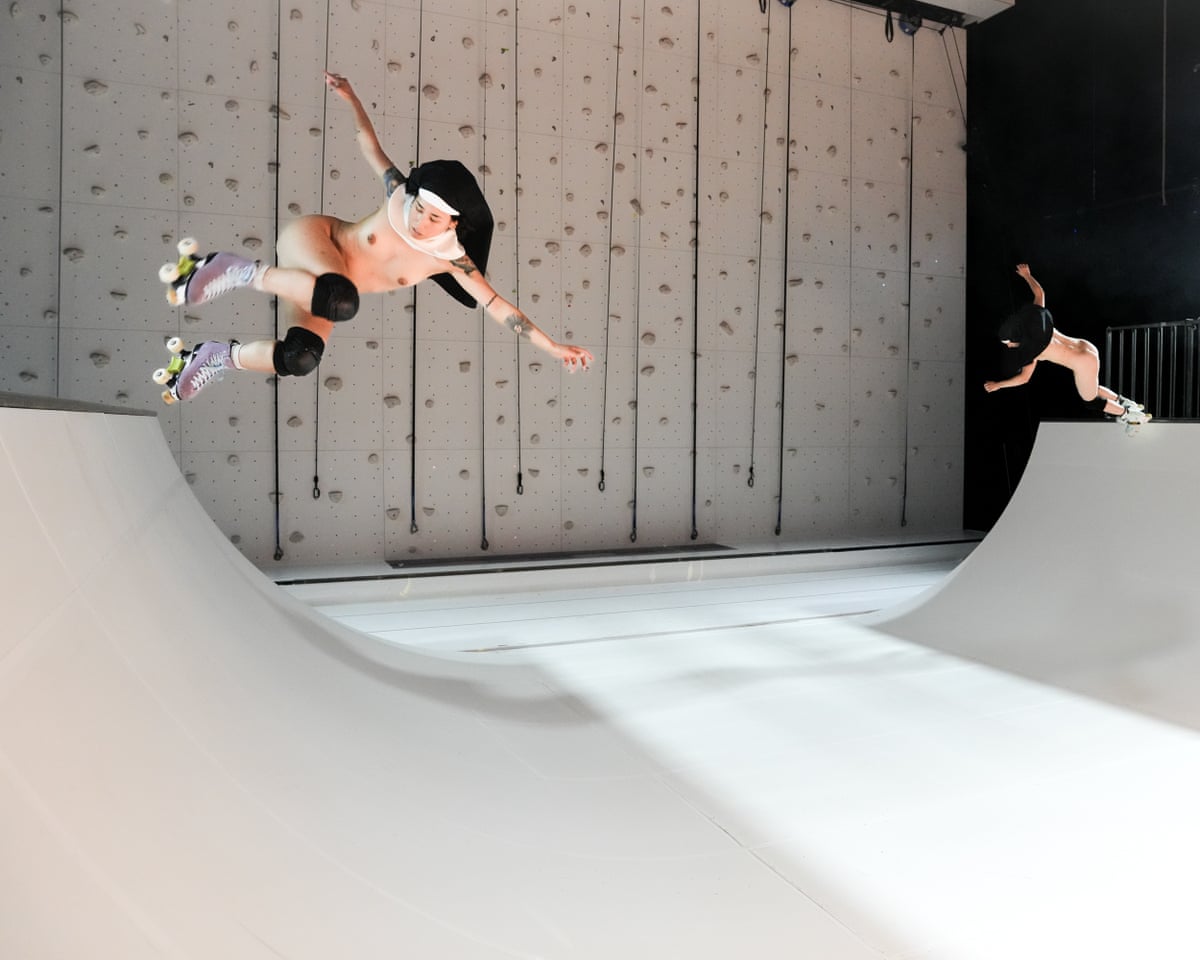
On stage, Holzinger presents an otherworldly presence. Earlier this year, during the climax of the opera Sancta, she was seen suspended in the air by bolts piercing her back, striking a thunderous metal sheet with the force of an apocalyptic angel. Sancta has toured European opera houses for two years, opening with a 30-minute performance of Paul Hindemith’s 1921 opera Sancta Susanna. The production features a vast climbing wall backdrop, from which performers in harnesses suspend themselves like spiders, demons, and crucified figures.
The opera takes the form of an alternative mass dedicated to liberation and acceptance. It includes a close-up magician performing miracles, a pregnant pope elevated by a robotic arm, and nuns executing roller-skate tricks. For Holzinger, incorporating a half-pipe on stage answered the question of how nuns—seen as elevated and otherworldly—should move. She explained,
“They are not going to be walking on the floor in a mundane way, but they are, of course, floating, skating: somehow this ramp made sense for us.”
Seaworld Venice: The Austrian Pavilion
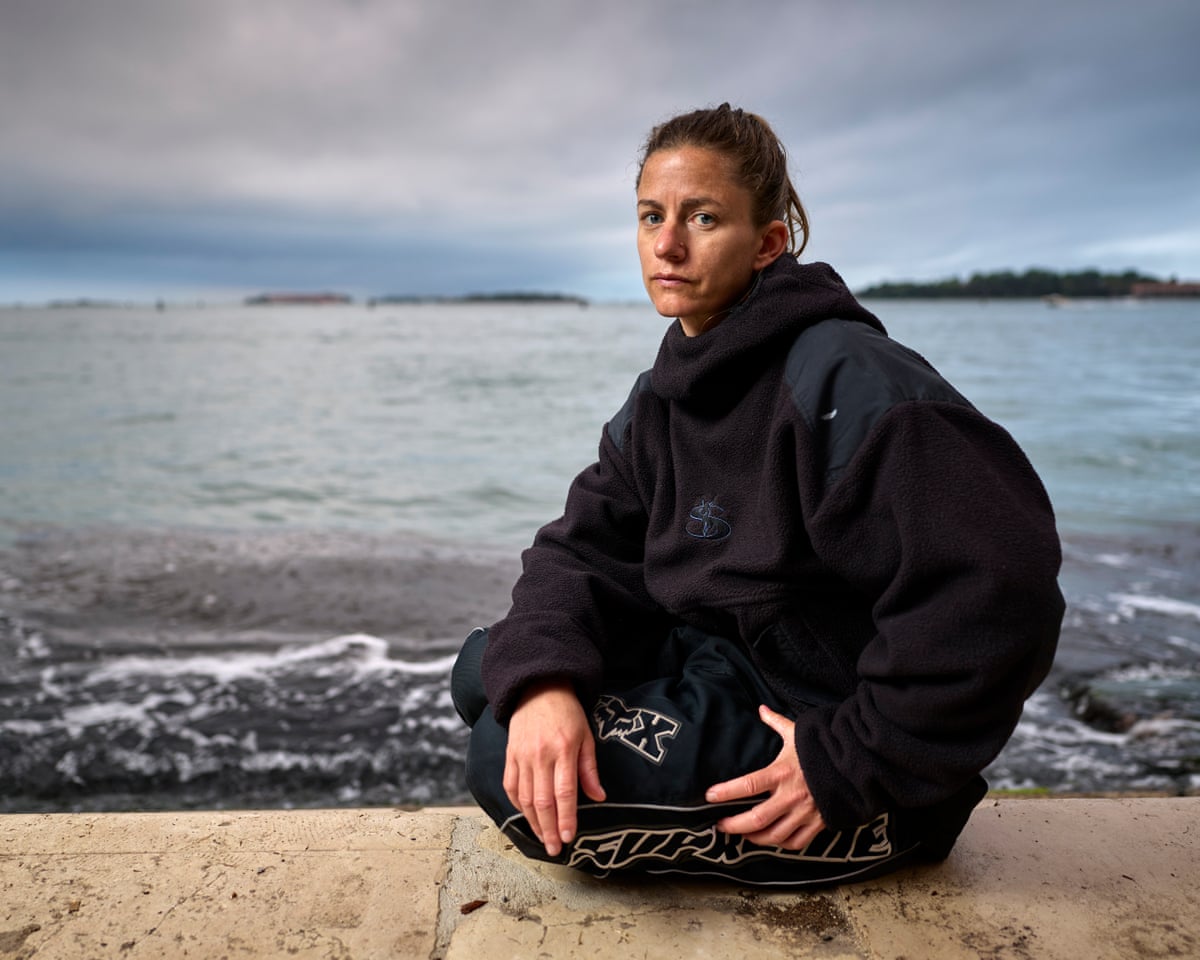
Holzinger herself was the woman hoisted naked from the Venice lagoon, hanging from the bell. In performance, she appears Amazonian—muscular, impervious to cold and pain. Offstage, she is bright and mischievous, discussing topics ranging from Vatican research to the late performance artist and skate-training in Barcelona. She wears thick fleece, seemingly restoring her core temperature after hours of exposure.
Adapting her work into a performance installation for the biennale required adjustments. Outside the protective environment of the theatre, risks are constant. Holzinger remarked just after the opening of Seaworld Venice,
“We are always in a ‘brace, brace’ position when it comes to performance. We are not naive. We know what the reactions can be. But nothing could have prepared us for this. I wake up in the morning thinking, ‘What will this day bring?’”
Her company performs eight hours daily in all weather conditions, with audiences freely moving around the Austrian pavilion. Many visitors are unprepared for a display where full nudity is the baseline. Holzinger noted,
“Venice is really the birthplace of the reclining nude: the horizontal, erotic depiction of women. How can this nudity be deemed so provocative when it comes to real bodies?”
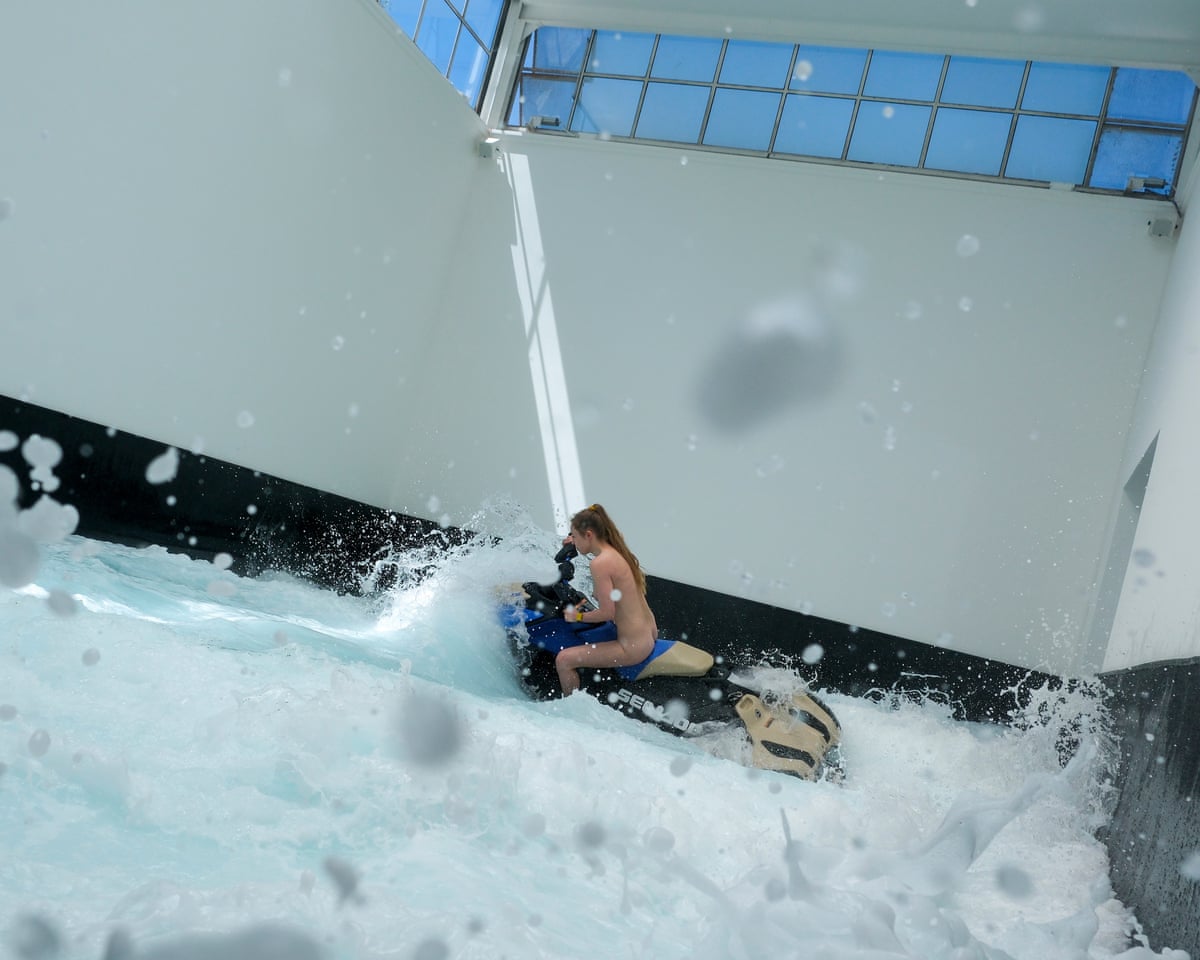
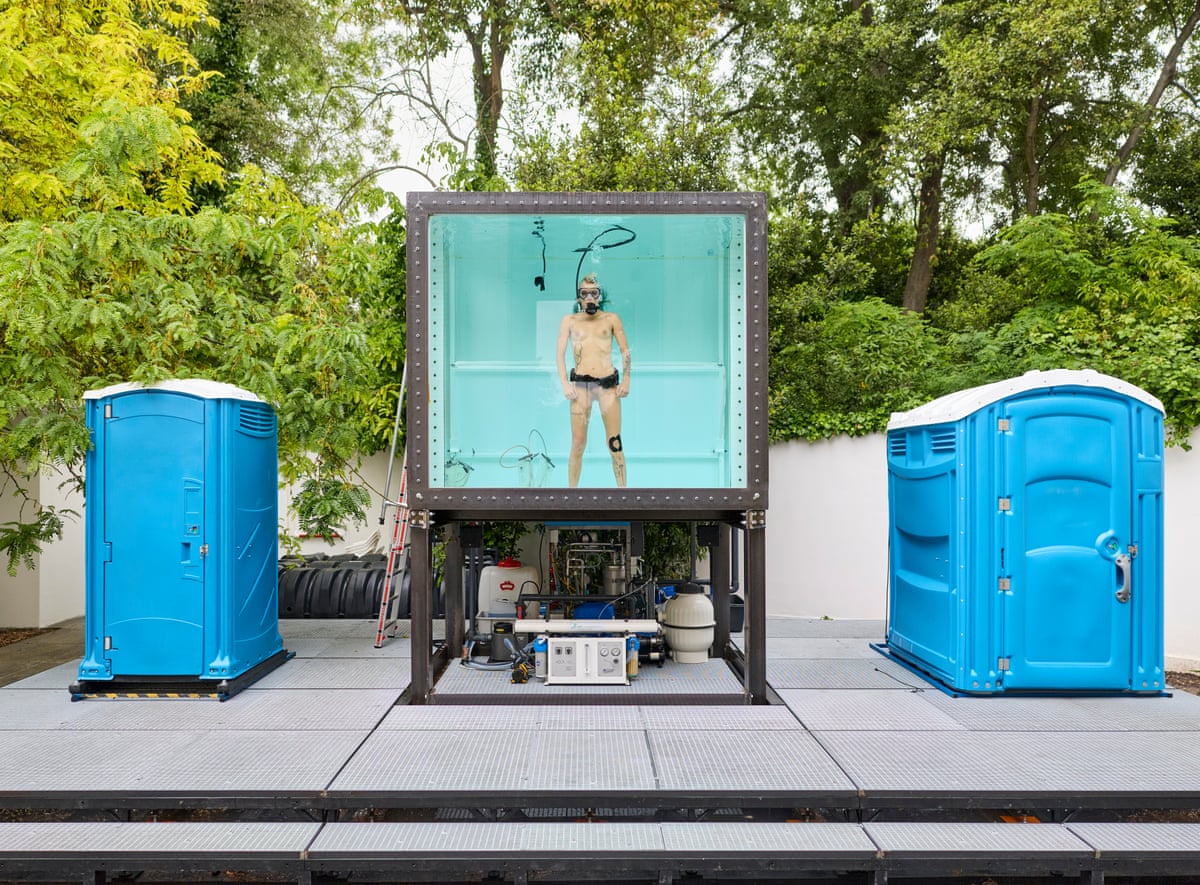
Seaworld Venice is a hybrid space—part temple, gallery, theme park, and sewage processing plant. Sections of the pavilion contain pools where Holzinger’s company perform jetski stunts, contortion acts, and pose suspended from climbing harnesses like a living Renaissance altarpiece. In the central courtyard, a performer wearing a scuba mask remains submerged in a glass tank for four hours at a time. The water surrounding her is the filtered output of two adjacent portable toilets.
Audience Interaction and Social Media Challenges
During the biennale preview, esteemed art world visitors treated the pavilion like a human zoo. The author recounts following a globally famous museum director who ignored a “No photography” sign, filmed the entire jetski performance, and posted it on Instagram. Holzinger commented,
“It’s really not my style or my ethics to police people. But it’s still outrageous that nobody seems to be able to perceive art without the screen.”
Due to the flood of social media posts, Holzinger’s Instagram account was temporarily suspended.
Roles and Labor Within the Performance
Performers rotate through various roles. One day they may execute jetski stunts; the next, they tend the lavatories and instruct visitors on their use—emphasizing no solids allowed. Holzinger reflected,
“I didn’t realise how important the role of the toilet women would be, but also how people treat the performers—thinking they are ‘just’ toilet women.”
She believes this attitude reveals much about the value assigned to different types of labor, asking,
“Is it more difficult to spend eight hours under the water or be a toilet woman?”>
Holzinger explained the rationale for installing lavatories in the pavilion, recalling her Venice application form which focused heavily on sustainability but offered limited space to describe the pavilion’s content. She said,
“That made it clear: for us, the content is the sustainability concept.”
The presence of a woman submerged in filtered urine starkly highlights the precarious environmental relationship between water and waste.
Environmental and Practical Considerations
Bodily functions confront the highbrow art world with base practicalities, often inconveniently, especially given the biennale’s limited facilities. Holzinger noted with a grin,
“The Austrian pavilion was always the unofficial toilet.”
Located at the rear of the site, visitors often arrive with full bladders after hours of touring. Holzinger continued,
“Everybody pees behind the Austrian pavilion. It always smells like a toilet. And we thought, ‘Why not make a nice, clean, functioning toilet?’”
Thematic Depth and Performer Commitment
Holzinger’s work often explores weighty themes, including the Catholic Church’s control over women’s bodies. Her collaborators come from diverse backgrounds including circus, stunt work, body-piercing, and contemporary dance. Their dedication is literally inscribed on their bodies. The author recognized the performer submerged in the tank from a previous performance where she had a small incision carved into her abdomen. That performer now bears 25 such scars—one for each opera performance. Another, experienced in body-piercing, has completed approximately 200 suspensions in Holzinger’s shows. Holzinger described her back as a “book.”
Balancing Serious Themes with Absurdity and Humor
Despite the serious subject matter, Holzinger’s shows also serve as entertainment, incorporating absurdity and humor. Sancta featured a stoner Jesus, while Seaworld Venice includes a slapstick fake sewage system that “engineers” struggle to contain from exploding. Holzinger stated,
“Comedy is an essential part of art-making for me. Of course, I want to take on substantial existential questions. But I cannot do it without also trying to laugh it away. There always needs to be a suggestion of hope: a motivation to move forward and actively change things.”
She paused before adding,
“At the end of the day, I’m really not an artist who takes themselves so seriously.”
Her willingness to be vulnerable and even ridiculous contrasts with her serious commitment to art.
Exhibition Details
Florentina Holzinger’s Seaworld Venice is on display at the Austrian Pavilion until 22 November.


