

Art and Space: A 50-Year Journey at the Smithsonian
As the Smithsonian’s National Air and Space Museum marks its 50th anniversary, a comprehensive exhibition showcases the intersection of art and space exploration throughout history.
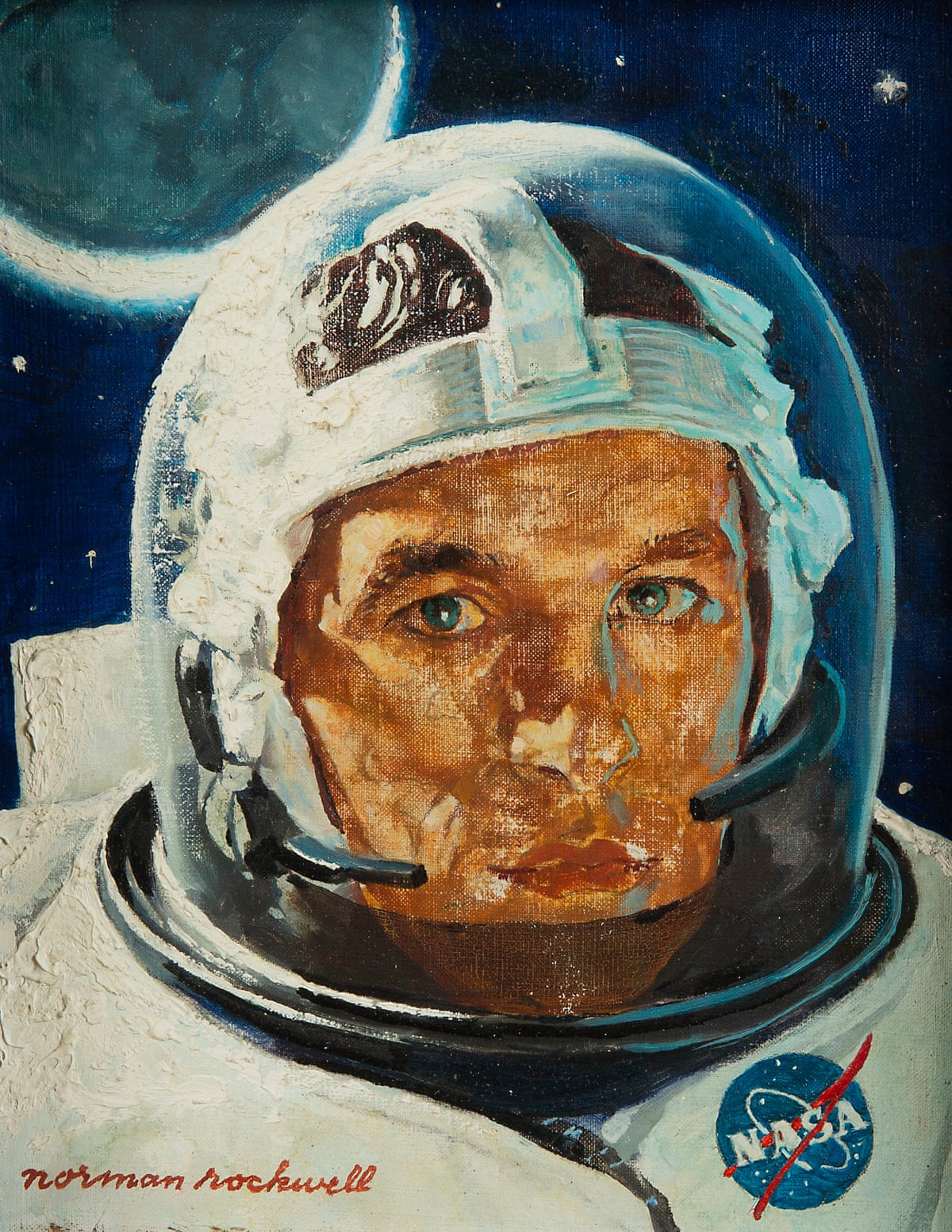
Depicted in a gleaming silver spacesuit, Alan Shepard holds his helmet, embodying the quintessential American astronaut hero. This iconic image paid homage to the first US astronaut in space and inspired a significant initiative.
James Webb, then administrator of NASA, was moved by the painting and initiated the agency’s own art program, recognizing that artists offer unique perspectives on the cosmos. From 1962 to 1974, the program was led by James Dean, who later became the first art curator at the National Air and Space Museum in Washington.
Dean transferred approximately 2,000 NASA artworks to the museum, whose collection has since expanded to over 8,000 pieces, including works by Alexander Calder, Henry Casselli, Annie Leibovitz, Norman Rockwell, and Alma Thomas. A curated selection is currently exhibited in the museum’s renovated gallery to commemorate its 50th year.
The National Air and Space Museum ranks among the world’s most visited museums. Its renowned exhibits include the Wright brothers’ flyer, Charles Lindbergh’s Spirit of St. Louis, the Apollo 11 command module Columbia, and Neil Armstrong’s Apollo 11 spacesuit. While the extensive collection of aircraft and rockets is expected, the art collection offers a surprising and enriching dimension.
“Why do we collect art?” asked Kristen Gresh, curator of the art collection. “Flight originated from the imagination. It originated from the hands of artists. Whereas we have artefacts in our museum that tell us what they did and how they flew, art shows us the human dimension of flight and how we experience it, how we feel about it.”
The exhibition presents compelling contrasts. Norman Rockwell’s response to the Apollo program is solemn and literal, rendered in muted tones, while Alma Thomas’s interpretation is figurative, vibrant, and filled with awe.
Norman Rockwell’s Realistic Depictions and Reflections
Famed for his Saturday Evening Post covers, Norman Rockwell was commissioned by Look magazine in 1964 to document NASA’s emerging space program. His realistic style aimed to make the daunting prospect of space travel accessible to the American public.
Rockwell’s painting United States SpaceShip on the Moon is a blend of research and imagination. Created about three years before Neil Armstrong’s historic moonwalk, the work was based on a full-scale model of a lunar module provided by NASA.
From a contemporary perspective, the painting contains some charming inaccuracies, such as the spacecraft’s color and an astronaut precariously standing atop the module. Nevertheless, in 1967, it was the closest the public had to a vision of the future.
Rockwell’s enthusiasm for the space program was tempered by tragedy. Following the Apollo 1 fire in 1967, which claimed three astronauts’ lives, his excitement diminished. In a draft of a 1969 speech delivered shortly before the first successful moon landing, Rockwell questioned the program’s priorities:
“Is the space program a lunatic idea now, when we in America are confronted with the problems of poverty, racial injustice, national security and the Vietnam war?”
“Would it be better to put all of this thought, energy, and money to improving conditions here on Earth?”
Despite his doubts, Rockwell maintained reverence for the human effort behind the machinery. Months after his speech, he painted Man on the Moon (Portrait of an Astronaut), featuring Armstrong, Buzz Aldrin, and Michael Collins in their white bubble helmets. The canvas also includes backup astronauts, engineers, program directors like Wernher von Braun, and the anxious wives of the Apollo 11 crew, all gazing upward toward the moon, united by shared aspiration.
Alma Thomas and the Space Age’s Vibrant Expression
Alma Thomas, who taught art for 35 years at a public junior high school in Washington, was inspired by watching rocket launches on her color television. The exhibition quotes her:
“The phenomenal changes of the 20th-century machine and space age … set my creativity in motion.”
Her 1970 painting Gantry uses vertical lines of vivid, natural colors to evoke the gantry structure at Kennedy Space Center, blending technological marvel with Florida’s natural landscape and water.
In Blast Off, Thomas captures the Saturn V rocket’s violent power with a dab of gray atop a towering, cone-shaped flame of orange and yellow, reminiscent of an Egyptian pyramid.

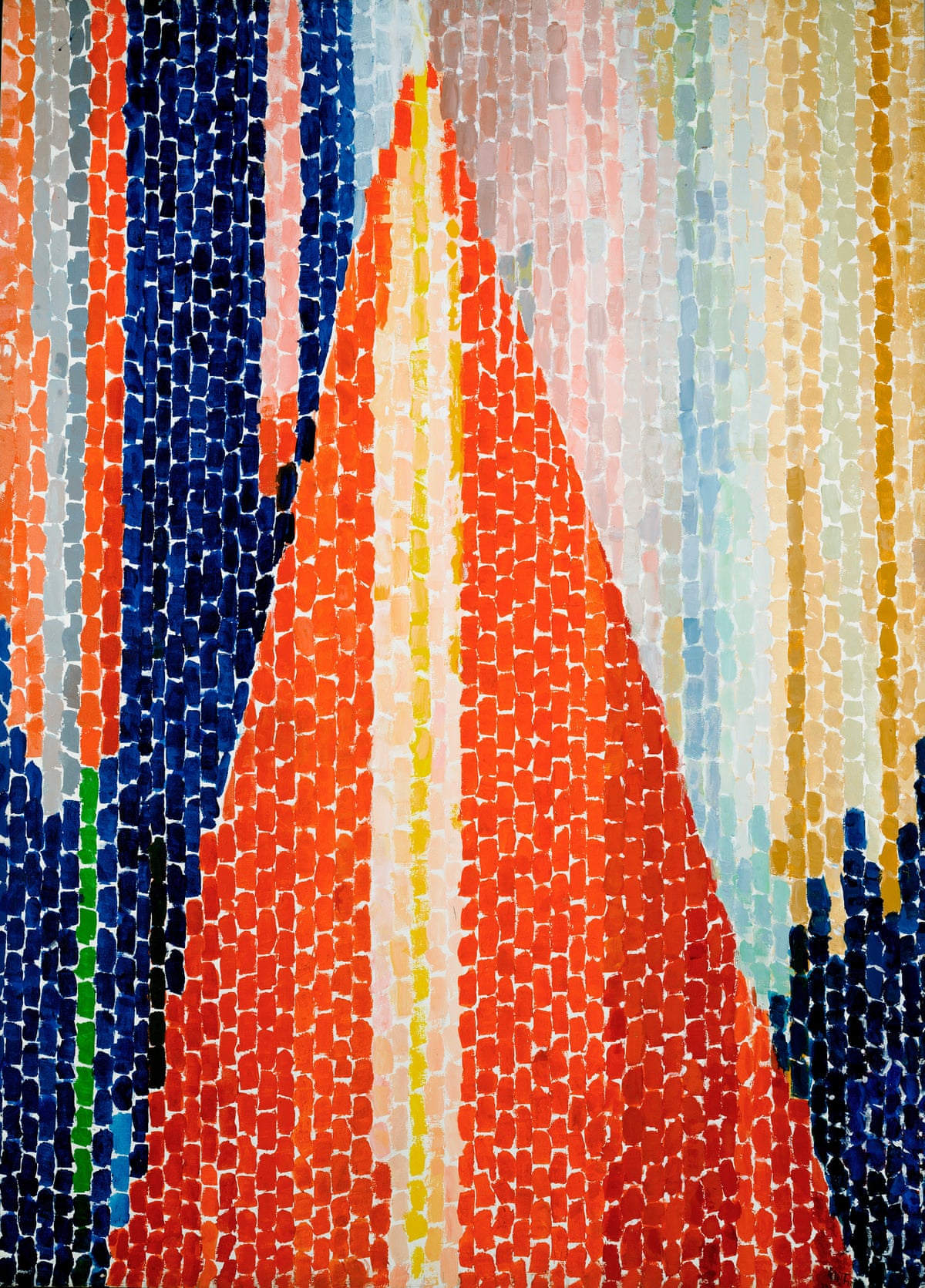
Her 1974 work Earthrise recalls the famous “blue marble” photograph from the Apollo 17 mission in 1972. The large circular canvas is filled with intricate, woven dashes of blue, punctuated by bright orange, pink, red, and green accents. The gallery interprets these vibrant colors as a “wish for diverse societies living in harmony within a colorful world.”
Artistic Perspectives on Flight and Space
The gallery also looks back to the dawn of commercial aviation. Georgia O’Keeffe’s Sky Above Clouds IV was inspired by her first commercial flight. From a plane window, she sketched vibrant blue rivers and shifting landscapes below, transforming geography into an abstract vision. The museum selected this work for its 1976 grand opening poster.
Catherine Stewart’s 2020 fabric piece Hidden Figures honors Katherine Johnson, the brilliant Black mathematician whose orbital mechanics calculations were crucial to NASA’s first human spaceflights. Covered in celestial coordinates and equations, Stewart imagined the garment as what Johnson might have worn to a hypothetical NASA celebration of the 1969 moonwalk.
Even surrealists engaged with lunar missions. Man Ray’s interpretation of the first moon landing initially appears as chaotic scribbles. However, curator Kristen Gresh explains:
“If you think about it, when we first landed on the moon and that emotional storm, it looks like the vortex of a tornado. Each artist interprets air and space differently and through their own experience and through their own eyes.”
Robert Rauschenberg: Pop Art and Flight
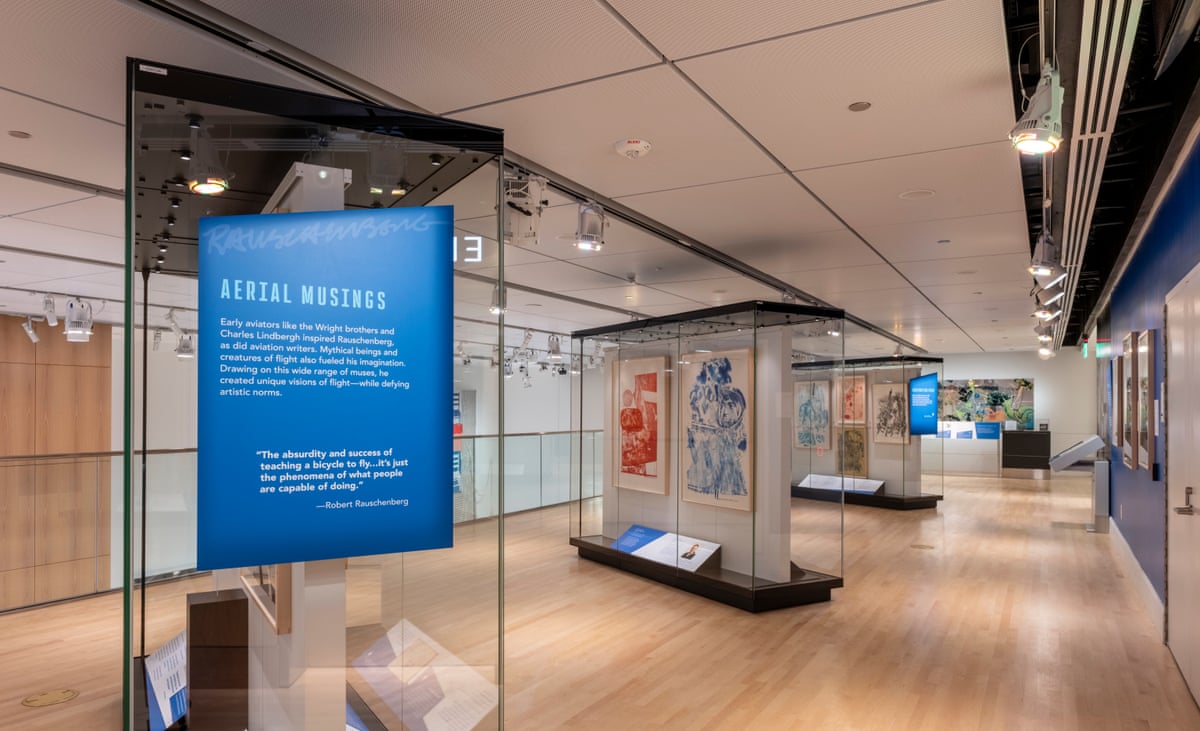
The fusion of art and science is especially evident in the gallery’s temporary exhibition, The Ascent of Rauschenberg: Reinventing the Art of Flight. Featuring 30 works by pioneering pop artist Robert Rauschenberg, many never before displayed, the exhibition explores his deep fascination with flight.
When asked which artwork, other than his own, he wished to have created, Rauschenberg replied:
“I would have liked to have been around to help the Wright brothers work on their concept of flight.”
Rauschenberg developed a close collaboration with James Dean, who provided NASA materials and visited his studio. In a 1969 letter featured in the exhibition, Dean wrote to Rauschenberg, affectionately called “Bob,” praising his work:
“Everything was just beautiful. You are exactly right for today (and tomorrow, too).”
Rauschenberg’s creations are intricate, layered meditations on flight. In Trust Zone, from his Stoned Moon Series, he juxtaposes the ethereal outline of a modern spacesuit and a map of Cape Canaveral with the fragile architecture of the Wright brothers’ flyer.
Gresh highlights Rauschenberg’s use of discarded airplane parts and visual puns. For example, bicycle wheels pay homage to the Wright brothers, who were bicycle mechanics before aviators. Even cardboard boxes that once held turkeys were transformed into birds in flight.
In Sky Garden, Rauschenberg reimagines the night sky with contemporary American figures. The winged horse Pegasus is humorously outfitted with actual airplane wings, Hercules is represented by boxer Muhammad Ali, and the Gemini twins are aligned with true astronomical star charts, demonstrating his work’s foundation in detailed research.
Perhaps the most remarkable Rauschenberg artifact is a tiny ceramic wafer known as the Moon Museum. Organized by sculptor Forrest Myers, this small tile features drawings by prominent artists of the era, including Rauschenberg, David Novros, John Chamberlain, Claes Oldenburg, Andy Warhol, and Myers himself.
Rauschenberg’s contribution was a single, straight pencil line. Gresh reflects:
“What does that line mean? From here to eternity. But also, when Rauschenberg approached his empty canvasses, he often just started with a pencil line. It’s almost like the same thing here.”
In 1969, another edition of this tiny tile was reportedly attached to the Apollo 12 lunar module and remains on the lunar surface, stored there, as Rauschenberg noted, “for future discovery.” It is the smallest and most distant piece of art he ever created.
Exhibition Details
The Art of Air and Space: Interpretations of Flight is currently on display at the National Air and Space Museum in Washington, DC.


