

Sinner Advances with Straight-Sets Victory
World No 1 Jannik Sinner secured a 6-3, 7-6 (0), 6-3 win over Japanese qualifier Shintaro Mochizuki to reach the Wimbledon quarter-finals, continuing to build momentum in his title defence.
During the latter stages of the second set, Mochizuki faced intense pressure, twice defending break points while trailing 3-4. Sinner was aggressively seeking the decisive break, but Mochizuki responded with skillful play.
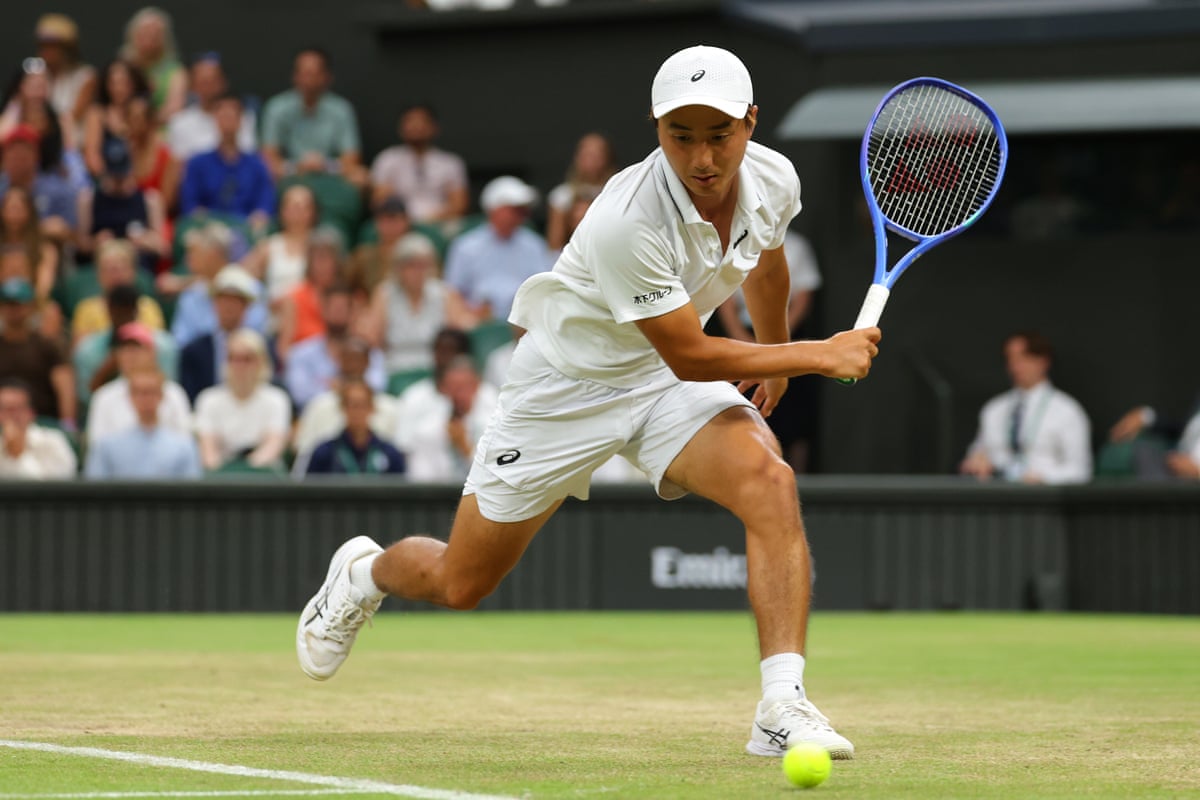
Mochizuki saved the first break point with a clever serve and volley, finishing with an impressive high backhand volley winner. He then thwarted Sinner’s second break opportunity with two consecutive exquisite volleys, including an outlandishly angled lunging volley that ended the point. He managed to survive a demanding 12-minute service game, maintaining his chance in the match.
The key takeaway from this match is Sinner’s confidence-boosting performance as he advanced to the quarter-finals. His earlier tension and erratic groundstrokes seen in his narrow five-set opening round win against Miomir Kecmanovic now seem distant. Sinner continues to serve at a high level and strikes the ball with increasing precision. After four rounds, he is positioned exactly where he aims to be in the tournament.
Mochizuki’s Courageous and Resourceful Play
For spectators on Centre Court and BBC One, the prevailing emotion was admiration for Mochizuki, who has been one of the tournament’s most endearing stories. Standing at a modest 5ft 9in, Mochizuki is among the smaller players in a sport where power is often paramount.
Smaller players typically endure a life of baseline scrapping and grinding, compensating for less power with other strategies. From early in his career, Mochizuki chose a different approach. Despite a vulnerable serve, the 23-year-old leverages his exceptional volleying skills by frequently approaching the net.

Although his forehand lacks ball speed, Mochizuki excels in hand-eye coordination, timing, and court positioning, using these to deflect opponents’ pace. His groundstrokes are unusually flat with minimal spin. While men’s tennis is generally forehand-dominant, his two-handed backhand stands out as his strongest weapon.
Combined with a low centre of gravity and excellent movement, these unique elements make Mochizuki an engaging player to watch and contribute to his success on grass courts. In his first Centre Court appearance, he demonstrated these layers of skill and instinct against a significantly higher-ranked opponent.
Mochizuki’s Physical Limitations and Career Context
Mochizuki’s physicality has been a major challenge, reflected in his pre-tournament results. Prior to this week, he held a 7-31 record in ATP main draw matches and was 0-6 in 2024. Solid performances in late 2023 earned him a career-high ranking of No 92, but competing consistently against top ATP players proved difficult.
Many players can overpower him, but grass courts suit his unique style best. Born in June 2003, just a month after Carlos Alcaraz, Mochizuki won the boys’ Wimbledon title in 2019. He has qualified for Wimbledon in three of his last four attempts, gradually revealing more of his potential in the main draw. This year’s run to the fourth round included a notable victory over Rafael Jodar, a promising young talent.
Match Highlights and Crowd Reaction
After facing one of the world’s most devastating shotmakers and producing a highlight reel of his own, Mochizuki left Centre Court to a standing ovation. By the second set, the crowd was fully engaged, cheering each time he closed the net or committed his 70kg frame to a two-handed backhand. Despite his strong play, the physical disparity was evident, especially in serve quality.
Mochizuki landed 53% of his first serves, complicated by his lower height relative to the net. His first serves averaged 110mph, slower than those of Naomi Osaka and Aryna Sabalenka in the previous Centre Court match. His second serves, averaging around 80mph, were aggressively attacked by Sinner. Mochizuki’s serve remains a significant limitation despite improvements elsewhere.
Nevertheless, even in defeat, Mochizuki demonstrated his talent and excitement as a player, showing how he plans to continue competing above expectations. His game is particularly well-suited to grass courts, where he is likely to return.


