

Djokovic’s Resilience on Centre Court
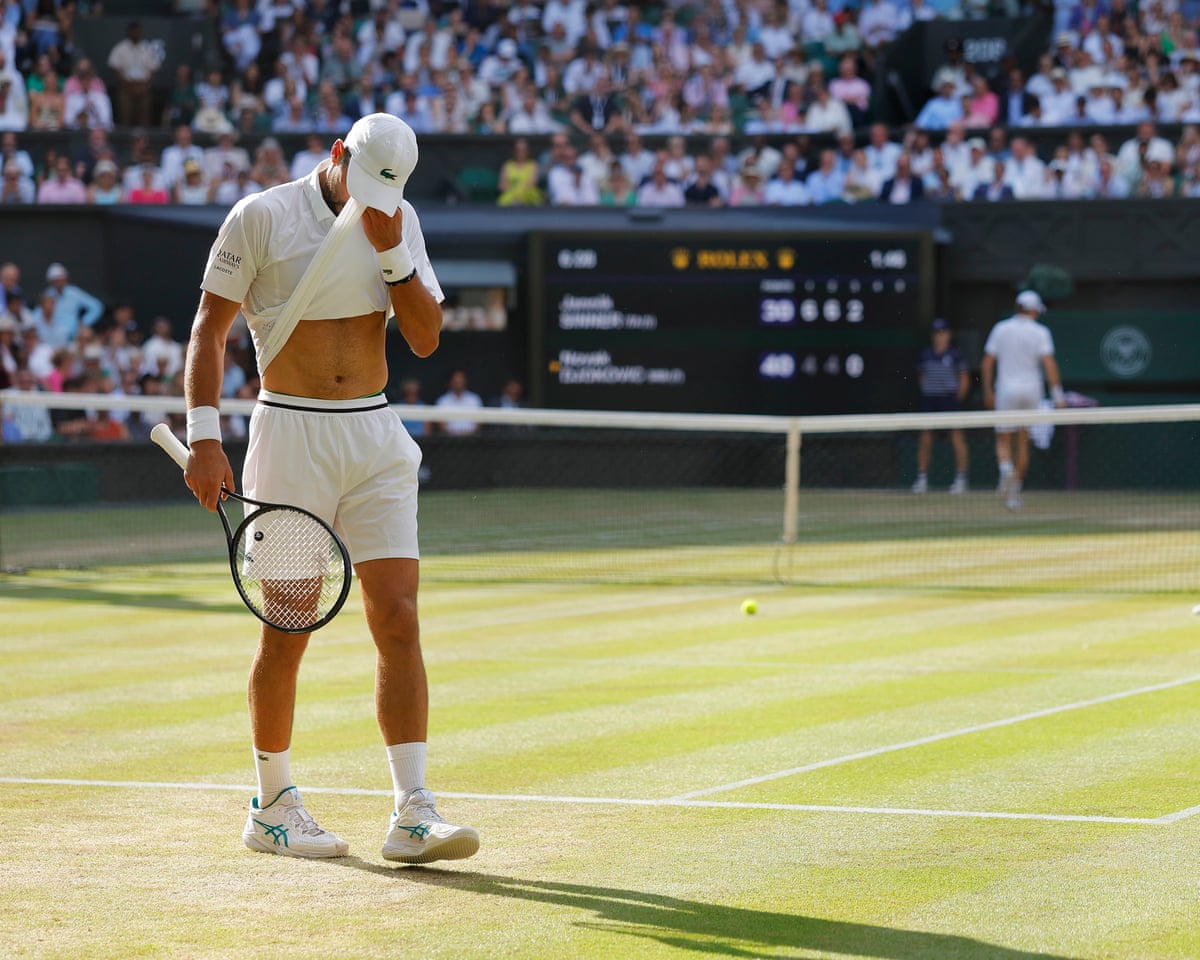
For nearly two hours, Novak Djokovic, aged 39 years and 51 days, displayed the signs of a seasoned competitor facing the physical demands of high-level tennis. Yet, moments of brilliance emerged—a sharp forehand, a subtle drop shot—that reignited hope among the crowd. The atmosphere on Centre Court grew electric with chants of “Nole! Nole!” and applause, as spectators sensed the possibility of a remarkable comeback.
Despite trailing by two sets and being outplayed by Jannik Sinner, the world No 1 secured his first break point, fueling anticipation for an extraordinary turnaround at Wimbledon.
Sinner’s Dominance and Tactical Excellence
On the opposite side, Sinner maintained composure, wiping sweat from his face as Djokovic showed signs of strain. Following a powerful 125mph ace down the T, Djokovic looked skyward and smiled, remarking,
“Ten years ago maybe.”Sinner responded with a 132mph ace wide to hold serve, later offering words of encouragement to Djokovic after securing a 6-4, 6-4, 6-4 victory to advance to his second final.
Pat Cash, Wimbledon’s 1987 champion, recently noted that the grass courts are the slowest he has witnessed. However, Sinner’s performance contradicted this, winning 45 of 51 first-serve points—an 88% success rate—and delivering 16 aces in a commanding display.
Djokovic’s Admiration for Sinner’s Serve
Djokovic expressed respect for Sinner’s serving prowess, stating,
“You cannot attack his first serve. You can try to read it, chip it, block it, get it back in play. It’s a very unpredictable serve, great variety, great balance, great pop.
He’s using his height extremely well. Also second serve very deep in the box. A lot of rotation. He can go for speed. He doesn’t make many double faults. He’s just super solid. He backs it up with the first aggressive shot.
If you play a shorter return, you’re, again, on your back foot. It’s really, really tough to play him.”

Conditions and Match Dynamics
The match conditions included a temperature of 30°C (86°F) at 4:20 pm, cooler than earlier in the week, with cloud cover and a breeze benefiting Sinner. Djokovic’s groundstrokes were tested, but Sinner excelled, hitting 40 winners against 15 unforced errors.
Reflecting on the match, Djokovic said,
“It was a good old blowout. I was just half a step late in any shot. It’s as simple as that. I was not sharp enough, not reactive enough, not balanced enough to play him. He was just at cruising speed and I couldn’t catch him.
I’m not upset with myself. I don’t think I’ve done too much wrong. I was just a level or two worse than he is. He was playing so solid from all ends.”
Final Moments and Sinner’s Near-Perfect Performance
Djokovic mounted a final effort by forcing Sinner to serve out the match, but Sinner’s near-flawless execution prevailed. The only notable shortcoming for Sinner was converting only three of 13 break points.
Outlook for the Final and Djokovic’s Future
Sinner’s serve and ground game suggest a challenging final against Alexander Zverev. Djokovic’s post-match press conference revealed his belief in his capacity to win future Grand Slams, citing his ability to compete against any opponent, as demonstrated in his record-setting 5-hour 15-minute quarter-final.
He also noted leaving the tournament without injury or feeling beaten, a positive sign for his ongoing career. Djokovic remains hopeful about pursuing a 25th Grand Slam, considering uncertainties such as Carlos Alcaraz’s wrist injury and potential tournament conditions favoring his play style.
Having spent nearly 17 hours on court during this Wimbledon compared to Sinner’s 13.5 hours, Djokovic acknowledged the physical toll but remains confident. He suggested that had Sinner faced adverse conditions, such as heat stroke, his chances against Zverev might have improved, underscoring his enduring competitive spirit.


