

Pre-Season Testing Begins in Bahrain
The final day of pre-season testing in Bahrain is scheduled to start at 07:00 GMT on Friday.
Domenicali Responds to Drivers' Criticism
Formula 1 chief Stefano Domenicali has urged calm in response to criticism from drivers regarding the sport's new regulations, while acknowledging that changes could be implemented if necessary.
Four active F1 world champions—Lewis Hamilton, Max Verstappen, Fernando Alonso, and Lando Norris—have all expressed varying degrees of dissatisfaction with the driving experience of the new cars.
Speaking at a news conference on Thursday, Domenicali stated:
"We need to avoid overreaction because it's just the beginning of a new journey, so that's why I say we need to stay calm.
And if there is something that is useful and can be implemented straight away, I've seen a very open approach by [governing body] the FIA and also the teams sharing their defined data of course with the others.
It's a new concept where it has to be, of course, improved if needed."
Mixed Reactions to New Cars and Rules
The 2024 season features the most significant rule changes in F1 history, affecting cars, engines, and tyres, alongside the introduction of carbon-neutral sustainable fuels.
Drivers have particularly criticized the new engines, which require constant energy management to optimize performance.
Verstappen likened the sport to "Formula E on steroids," Alonso remarked that "the chef could drive the car" at certain fast corners due to energy harvesting demands, and Hamilton described the new regulations as "ridiculously complex."
Norris, who initially defended the cars as "fun," later admitted that his comments were made to gauge reactions and acknowledged that the new cars are "certainly not the purest form of racing."
Engine Rules and Manufacturer Interest
Domenicali, who serves as president and CEO of F1's commercial rights holder, explained that the new engine regulations were designed to attract new manufacturers. This goal has been met with Audi and Cadillac joining the sport and Honda reversing its decision to leave.
"The evolution of that is natural and will become normal,"
said Domenicali. "I am pretty confident this will evolve in a situation that, at the end of the year, no-one will remember what we are talking about today.
We don't have to forget that, with all respect to all these technicalities we are taking about, it is something in the inner business of F1. [For] our 900 million fans, it is not in their business.
What has to be protected is having great racing, great overtaking opportunities, great challenge to the drivers to show they are best. If these points are not taken, we need to intervene and restart immediately."
On-Track Impressions and Testing Experience
Domenicali reported that he had been on track during the Bahrain pre-season testing on Thursday to observe the cars firsthand.

"The cars are really beautiful, the sound is very nice and if you go around the track here it seems that there is the car like it was last year and that's very important for the one that are very specific technical details to understand,"
he said.
Energy Management Challenges for Drivers
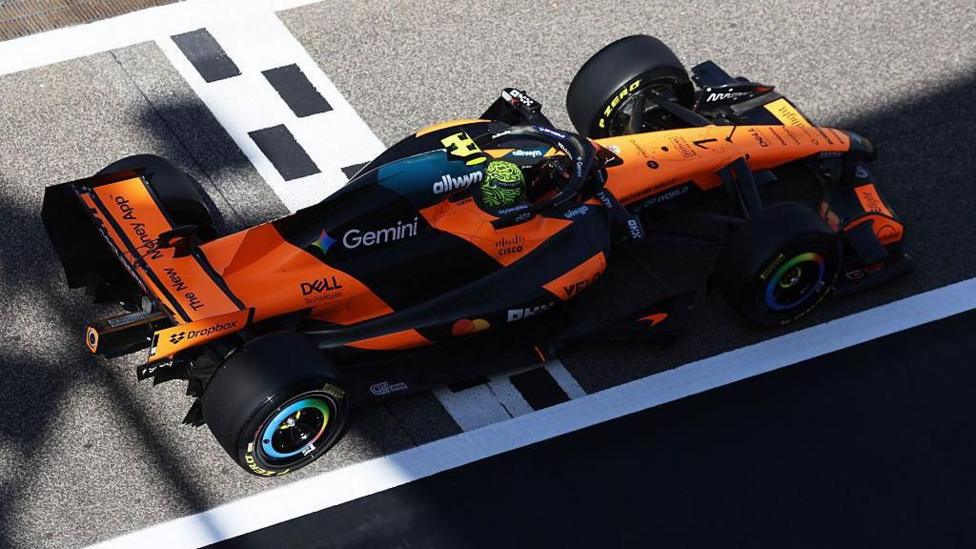
World champion Lando Norris commented on the challenges posed by the 2026 regulations, emphasizing the focus on battery management.
He stated that much of the driving is "focused on just trying to get the battery to work properly."
F1 Commission to Review Data and Potential Adjustments
At a meeting of the F1 Commission rules-making body on Wednesday, officials agreed to assess data from the final test to determine if short-term action is required.
The new engine rules have increased the electrical power output threefold but have kept battery size largely unchanged and removed one energy recovery device.
This has resulted in cars experiencing energy shortages, compelling teams to develop new strategies to harvest sufficient electrical energy for optimal performance. The energy recovery regulations are notably complex.
Consequently, drivers have had to adopt behaviors described as "counter-intuitive" to maximize lap times, such as not accelerating fully out of the final corner before qualifying laps, lifting and coasting during qualifying, and avoiding full power acceleration at the end of laps to conserve energy for other track sections.
Positive Feedback on Handling and Driver Skill
Despite the criticisms, drivers generally have responded positively to the handling characteristics of the new cars. Several top drivers informed that they are still driving at the limit of grip and that driver skill remains crucial.
Domenicali on Energy Management and Driver Discussions
Domenicali reassured stakeholders regarding energy management issues:
"Don't be worried about the energy management. We're going to solve that. If we need to solve it, by the way."
During his time in Bahrain, he has engaged in multiple discussions with individual drivers, including Max Verstappen.
"Max wants and does care about Formula 1 more than anyone else. He has a way of putting the point that he wants to say in a certain way.
Max will be part of the future of Formula 1 and of course it's very important that we listen to him and all the top drivers that are very important in this sport."
Exploring New Sporting Elements on Fridays
Domenicali revealed that F1 is considering introducing new sporting elements on Fridays, expanding on the sprint-race weekend format, which includes two qualifying sessions and a shorter race on Saturday in addition to the Sunday grand prix.
He has previously indicated that the number of sprint events could increase beyond the current six.
"Feedback from the fans, from the people attending the track, the promoter, [is] that people want to see action, real action during the three days.
People want to see already on Friday something that is sporting - qualifying, points, whatever it is.
So, it is true that there is the trend to go in the direction of, even if it is not a sprint every weekend."


