

Ousmane Dembélé, Khvicha Kvaratskhelia, Désiré Doué and Bradley Barcola Embrace Luis Enrique’s Philosophy
Ousmane Dembélé smiles when he remarks that if he fails to press, Luis Enrique will bench him. The Ballon d’Or winner does not undertake his defensive responsibilities reluctantly. Alongside his teammates, he appears to enjoy a facet of the game once considered unnatural for attackers. Traditionally, forwards attacked and defenders defended, simple roles in a straightforward game. However, the demands of modern football have evolved.
The forward trio of Kylian Mbappé, Lionel Messi, and Neymar was an enticing prospect but failed to secure a Champions League title, and their performances lacked joy. Their approach of all attack and no defense rendered PSG less engaging to watch. Their shortcomings taught a crucial lesson: football had changed, and victories could no longer rely solely on attacking prowess.
In his final season at PSG, Luis Enrique sought to instill this lesson in Mbappé. A documentary on Enrique’s first year at the club shows a scene where Mbappé is reprimanded and made to watch his defensive lapses during the Champions League quarter-final against Barcelona. Enrique’s message was clear:
“I read that you like Michael Jordan,” he said. “Michael Jordan grabbed his teammates by the balls and defended like a son of a bitch. You think you have to score goals for us. Of course, you’re a phenomenon, a world-class player, no doubt, but that doesn’t matter to me that much. Being a leader is, when you can’t help us with goals, you help us defensively. If you set the example by going to press, you know what we have? A fucking team.”
Mbappé later admitted he was “half-thinking about Madrid at that point” and acknowledged he “didn’t make the most of Luis Enrique.” The France captain never fully embraced the collective defensive philosophy, fearing it would limit his attacking freedom granted by previous managers.
In contrast, the current PSG forwards – Dembélé, Khvicha Kvaratskhelia, Désiré Doué, and Bradley Barcola – fully commit to this approach. Among Europe’s top five leagues, no player presses more per 90 minutes than Doué, with Kvaratskhelia also ranking in the top five. The iconic image of their pressing on Yann Sommer’s goal-kick in last season’s Champions League final symbolizes PSG’s defensive intensity. Non-compliance results in benching, and having four world-class options for three forward positions ensures the threat is genuine.
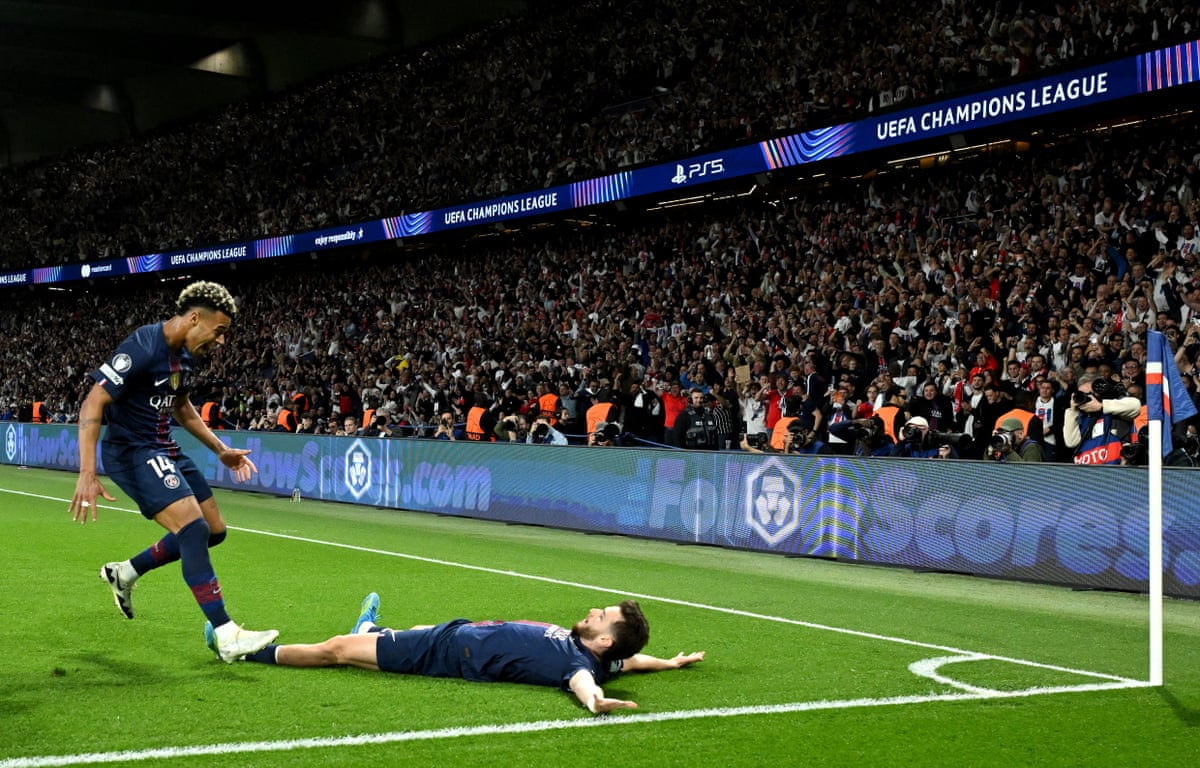
Moreover, the players themselves, especially Dembélé, uphold these standards. He stated in February:
“Above all, we have to play for Paris Saint-Germain to win matches because, if we play alone on the pitch, that won’t work. Last year, we put the club above everything else, before thinking about ourselves. We need to rediscover that. We have to play for the club first and foremost before thinking about ourselves.”
Recent Champions League performances suggest his message has resonated with the squad.
PSG currently rank second in ball recoveries in this season’s Champions League, behind Atlético Madrid. Last season, they led this metric by a significant margin. Their defensive commitment does not compromise their flair, entertainment, or efficiency, as demonstrated emphatically in their recent victory over Bayern Munich.
Kvaratskhelia exemplifies this balance. The Georgian forward has scored 10 goals and provided five assists in the Champions League this season, setting a PSG record for a single campaign. He is also only the fourth player to score or assist in six consecutive knockout games, a feat Dembélé achieved last season.
While PSG are not unique in employing an aggressive high-press, recent discussions have focused on factors enabling their superior execution compared to other clubs, particularly those north of the English Channel. The quality of Ligue 1, its reduction to 18 teams in 2023, the elimination of the Coupe de la Ligue in 2020, and PSG’s financial dominance domestically contribute to their ability to maintain this level of performance during the Champions League season. Bayern Munich’s similar Bundesliga situation explains their adoption of a comparable approach.
Regardless, PSG’s dynamic, fluid, high-pressing style has yielded success and is being emulated by many elite European teams. This represents a notable shift for French football, traditionally influenced by diverse external styles. While alternative tactics exist, as seen in the other Champions League semi-final, PSG’s approach signals the current direction of the sport.
Talking Points
PSG’s enthusiasm for defending contrasts sharply with Marseille’s struggles under Habib Beye. Since Roberto De Zerbi’s departure in February, Marseille’s decline has been dramatic. De Zerbi had stated last season that if he were the problem, he would leave. Recent weeks have underscored that he was not the issue. A visible lethargy now pervades the team, compounded by reported internal tensions and a sense that Beye’s tenure is nearing its end. Beye inherited a team in fourth place, but they have slipped to seventh following a 3-0 defeat to Nantes on Saturday. Securing Champions League qualification, vital financially, appears increasingly unlikely. Nantes, having won only five league games all season, have completed a double over Marseille and may have sealed Beye’s fate, though he is expected to remain until season’s end.
Paul Pogba made his first start since May 2023 as Monaco narrowly defeated Metz on Saturday. While his technical skills remain evident, his performance lacked dynamism, unsurprising given the time since his last start. Manager Sébastien Pocognoli cited this as a mitigating factor. Monaco’s momentum improved after Pogba’s substitution, culminating in a comeback victory in extra time thanks to Ansu Fati’s 10th Ligue 1 goal this season. Metz’s defeat confirms their relegation for the eighth time in 13 top-flight seasons. Although the club often bounces back, it may do so without manager Benoît Tavenot, who holds an unwanted record of 25 games without a win this season, spanning his time at Bastia in Ligue 2 and his 14 matches leading Metz.


