

Listen to A Small Town in Europe on
"That's the best night of my life. Sometimes I still go to YouTube to watch it, not just for my goal but for the atmosphere. It was a magical night."
It has been two decades since Middlesbrough's remarkable journey to the UEFA Cup final.
After 128 years, Boro qualified for their first major European competition by winning the League Cup in 2004, the club's inaugural silverware, which propelled them to a new level.
In 2005, Middlesbrough reached the last 16 of the UEFA Cup and secured a top-seven finish in the Premier League, followed by an extraordinary run through the knockout stages to face Sevilla in the final held in Eindhoven in May 2006.
Steve McClaren, featured in a seven-episode series from BBC Radio Tees reflecting on the club's most successful era, stated:
"Winning a trophy was special, great for the fans and for Steve Gibson, but getting into Europe... I knew it was different.
European nights are unbelievable. I wanted to bring that to the Riverside, and I loved going away, the Boro supporters, just proud of the fact we're a small town in Europe and we're in it.
Football is an adventure. How far can you go and what experiences can you give the players, fans, the owners, and yourself and the staff? Let's enjoy the adventure..."
The adventure proved to be extraordinary.
Middlesbrough: A Small Town in Europe
Massimo Maccarone etched his name into Boro's history during their 2006 UEFA Cup campaign.
'We'll play European football in two years'
Midfielder George Boateng, who joined from Aston Villa in 2002, was a key figure in McClaren's squad. Initially, the former Netherlands international was hesitant about joining Middlesbrough and preferred a move to London. However, after a conversation with Jaap Stam, who had worked with McClaren at Manchester United, Boateng agreed to meet the Boro manager.
"It was the best couple of hours I spent, looking back at my career," Boateng recalled.
"Steve said if you sign for us, I promise you that we'll get other players that come because of you and in the next two years we will be playing European football.
He said it in such a convincing manner and tone that I wanted to be a part of this. It was a step back but I wanted to build and invest and play in Europe."
Boateng's Dutch teammate Jimmy-Floyd Hasselbaink, who left Chelsea to join Boro ahead of their European debut in 2004, remarked:
"I wanted to stay in the Premier League. Middlesbrough was on the right path. It was a really exciting time."
"I am proud to have scored Boro's first goal in European competition at home to Banik Ostrava. That will never go out of the books. The UEFA Cup games on Teesside were very special.
It was a good learning curve, the first season. It was a special year. The year after we were much more confident and more equipped mentally and physically, we played some magnificent games."
Mark Viduka, who scored two goals in the 3-0 victory over the Czech side, brought considerable European experience from his time with Dinamo Zagreb, Celtic, and Leeds. He told BBC Radio Tees:
"I knew they were looking to do well in Europe, they had the resources and the will to invest in a good team.
The first year I had some problems with injuries and I was not as consistent as I wanted to be but I was rapt at the end that we got a new chance at Europe.
I really enjoyed the team, a good bunch of blokes, some older players, foreign players, our relationship with the youngsters.
Some of the youngsters really stepped up, Stewart Downing had one of the best left feet I've ever seen."
'We didn't want to be a one-season wonder'
The architect behind these signings, Steve McClaren, reflected on his five years at Teesside, praising Steve Gibson's vision:
"The goal was to win a trophy, we'd done that, I just felt the next season I needed more firepower and a bigger squad," McClaren said.
"We wanted to go further into cups, do well in the league and not just make it a one-season wonder."
McClaren identified the 2-0 group stage win over Lazio in their first European campaign as a pivotal moment, adding:

"That was it, that's what being in Europe is all about, it's different to beating the Arsenals or Man Uniteds at the Riverside."
With a wealth of attacking options, McClaren had loaned out striker Massimo Maccarone in 2004-05 after the Italian struggled to make an impact following his transfer from Empoli two years prior. McClaren intended to loan him out again in 2005, with Hasselbaink, Viduka, and Yakubu ahead in the pecking order, but Maccarone was determined to stay.
"I said I want to stay, I want to try to find my space. I worked hard every day, you have to show the coach and everybody you can play," Maccarone said.
Despite limited appearances—six starts and 16 as a substitute across the Premier League, FA Cup, and League Cup, scoring twice—Maccarone made a significant impact in the UEFA Cup quarter-final second leg against Basel. Coming on 23 minutes from time with the Swiss side leading 3-2 on aggregate, he contributed to a dramatic turnaround.
Hasselbaink scored 11 minutes from time, and Maccarone netted the winner in the final seconds, prompting wild celebrations and the iconic moment of him removing his Boro shirt.
"This game changed the opinion of McClaren for me going forwards. You have to be lucky sometimes," Maccarone reflected.
"This was an important goal, inside me was six or seven months of not playing a lot, it was emotion.
It's not easy training every day then going to the stands or the bench on a Saturday."
Middlesbrough also found themselves 3-0 down on aggregate in the semi-final against Steaua Bucharest before Maccarone replaced Gareth Southgate inside half an hour and initiated the comeback with a precise angled strike.
"I believed it could still be done," Maccarone said.
"The atmosphere was unbelievable, and because of the Basel game we knew it was possible."
Viduka and Chris Riggott equalized the tie, and with a minute remaining, Stewart Downing's cross was powerfully headed home by Maccarone, securing the victory.
"It's something you can't describe. It's hard to understand. I just put my head like Superman. You have to believe.
I haven't never felt anything like that moment since. Against Basel some people left the stadium with 20 minutes to go. Against Steaua nobody left. Everybody believed we could do it, and we did."
Maccarone recalled celebrating with champagne after the game and being told by Hasselbaink that he would be adored forever.
"That's the best night of my life," Maccarone said. "I'll never forget it. Sometimes I still go to YouTube to watch it. Not just for my goal but the atmosphere. It was a magical night.
When I went back to the Riverside last year it was fantastic - the people treated me like a hero. That was very emotional to me."
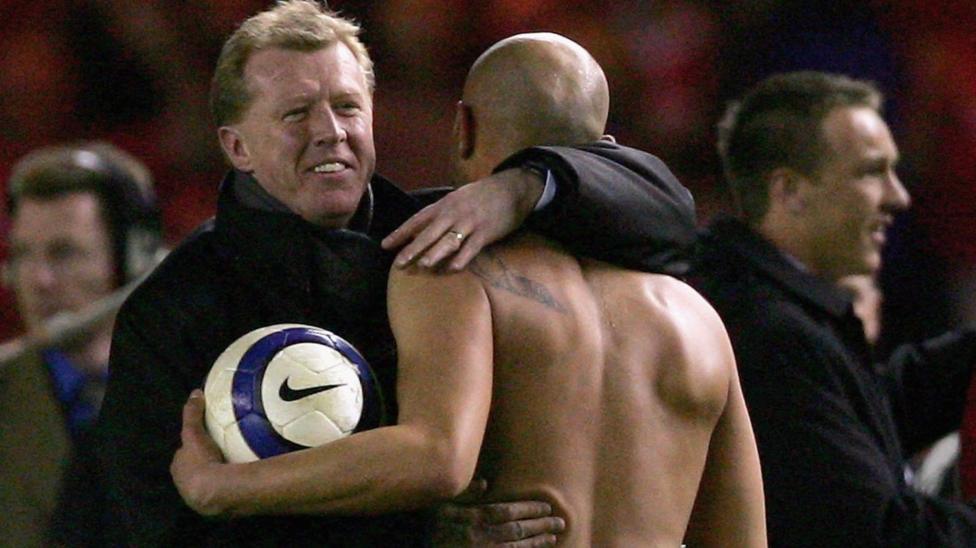
Their run ended as Sevilla proved too strong in the final in Eindhoven. Despite the disappointment, Maccarone reflected:
"It's football. We played a good team. In the moment you are very disappointed but now you look back, it's a good memory, history for the club."
Latest Middlesbrough news, analysis and fan views
Listen to Middlesbrough content on .
'The greatest adventure in Boro's history'
Mark Drury, BBC Tees Boro commentator, summarized the era:
"Over the course of two action-packed seasons Middlesbrough changed beyond all recognition.
They staged some of the most remarkable comebacks the game has ever seen and flew higher than at any time in their history before crashing back to earth after falling at the final hurdle.
It was the greatest adventure in Boro's history and is still the touchstone for a whole generation of the club's fans and players."
The series A Small Town In Europe, debuting on 15 June on , draws on memories from Steve McClaren, key players such as Mark Viduka, Jimmy Floyd Hasselbaink, Stewart Downing, young talents like James Morrison, Andrew Taylor, Tony McMahon, staff members, journalists, and fans who experienced the highs and lows of the UEFA Cup run. It also includes a fan of Boro's first foreign opponents Banik Ostrava, who was so captivated by the club that he relocated to Teesside.


