The last camp before the big one
Steve Clarke and his Scotland squad convene for the first time since their match against Denmark, with the primary focus now on preparing for the World Cup, which is just over two months away as the team prepares to travel to the United States.
This week’s camp marks the final assembly before the squad meets again in June, making it a crucial period for Clarke and his coaching staff to finalize preparations.
BBC Scotland examines three critical questions facing Clarke as he readies the team for a friendly double-header against Japan and Ivory Coast.
How Scotland reached the World Cup - told by those who made it happen
'Silly' not to offer Clarke new deal - Dalglish
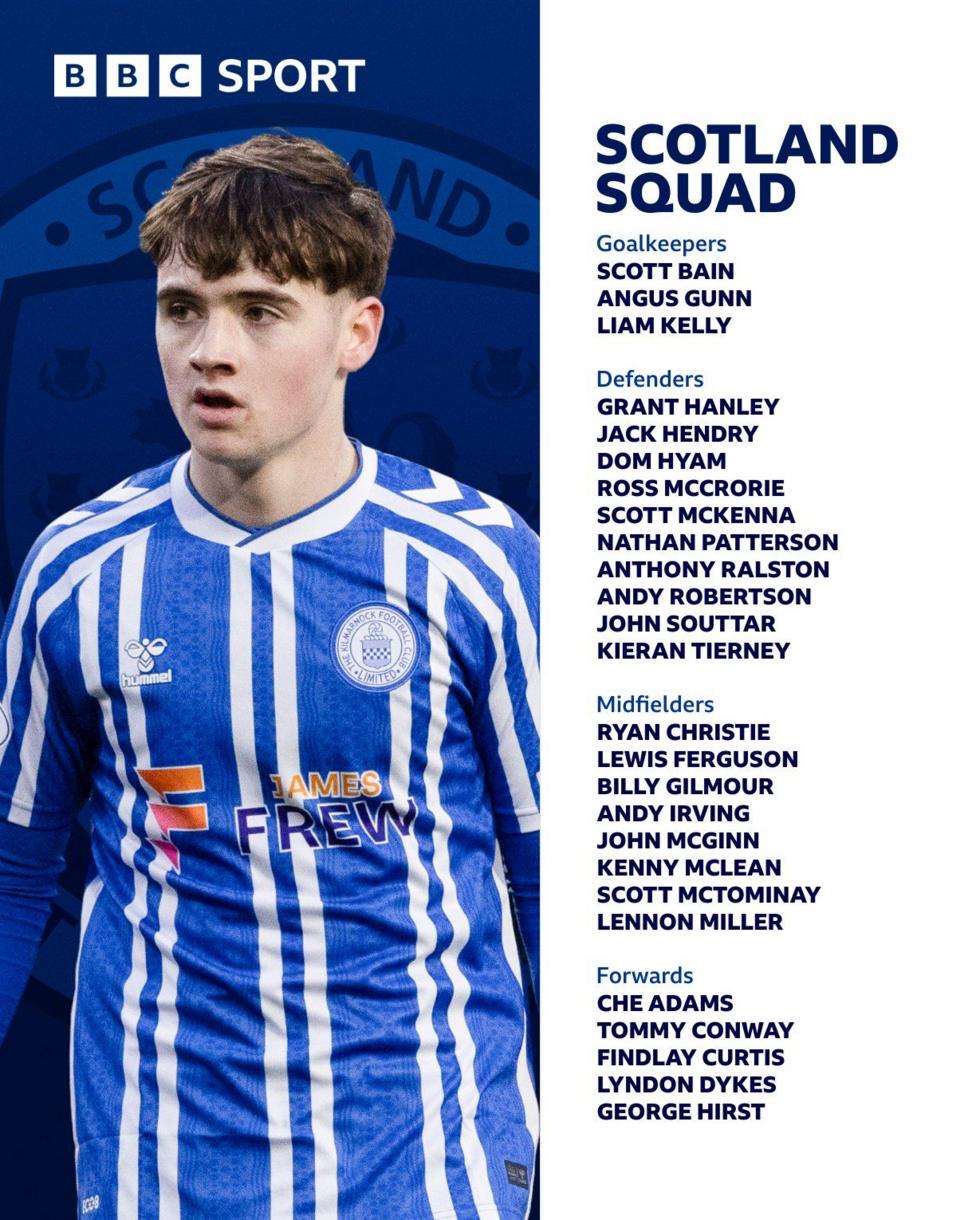
Teenager Curtis given maiden Scotland call-up
Is 'direct' Curtis for now or future?
While some anticipated Clarke to select players from Hearts and Motherwell for his latest squad, he surprised many by choosing teenage winger Findlay Curtis from his former club Kilmarnock.
Scotland’s lack of depth on the wings is evident, with Bournemouth’s Ben Gannon-Doak still recovering full fitness, yet Curtis’s inclusion raised eyebrows.
During Scotland’s remarkable 4-2 victory over Denmark in November, Curtis was not part of the Scotland Under-21s setup and was watching as a fan.
His rapid ascent to contention for a World Cup spot within months is notable. The 19-year-old has impressed under former Scotland winger Neil McCann as Kilmarnock fights to maintain its Scottish Premiership status.
On loan from Rangers, where McCann coached him last season, Curtis scored in Kilmarnock’s crucial win over bottom-placed Livingston on Saturday, further showcasing his talent.
Now, Curtis has a significant chance to demonstrate he is an immediate option for Clarke, not merely a prospect for the future. The question remains whether he will seize this opportunity.
Sportscene analysis: 'Curtis has grasped first-team opportunity at Kilmarnock'
Scotland assistant coach Steven Naismith praised Curtis’s determination to seek playing time on loan rather than remain a squad player at Rangers.
"This desire, this instinctive nature to get chances," Naismith said on scene while analyzing Curtis’s recent goal. "He's got a bit of pace, he's direct, he commits defenders - these are all things that have caught the eye."
Former Celtic and Hibernian midfielder Scott Allan added on the BBC’s Scottish Football Podcast:
"When we don't have Gannon-Doak, we don't have someone who can really travel with the ball. Curtis does have that. Yes, he's still developing and doesn't always have that final ball, but that can be worked on. We aren't blessed with a lot of pace, especially in the attacking areas. You have to have pace in those areas, especially when at times we'll be forced back and when we're then trying to get up the pitch. Players with pace can be the difference."
How can Scotland raise performance level?
It may seem unfair to question the performance level of a Scotland team that topped their qualifying group with four wins, one draw, and one defeat, securing a return to the World Cup after nearly 30 years.

However, much of the campaign was marked by underwhelming performances. Clarke and his players acknowledged this after certain matches.
The team faced boos from their own supporters on several occasions. Had it not been for a surprising draw between Denmark and Belarus that set up the decisive victory over Denmark in November, the atmosphere would be very different.
The 2024 Nations League campaign told a different story, with a shift to a 4-3-2-1 formation improving performances against stronger opponents, though results were lacking.
A relegation play-off loss to Greece initiated a concerning run of subpar displays, but results improved during World Cup qualifying despite ongoing concerns about performance quality.
Clarke’s Scotland have never been a team focused on controlling and dominating matches, and that is not the expectation. However, fans desire a more liberated approach from the head coach.
The team’s best moments have come when embracing chaos, as seen in November, but recently this boldness has often occurred only when chasing games after cautious or flawed starts.
Finding a balance and demonstrating it in the upcoming friendlies against challenging opponents will help restore confidence among the Tartan Army that their team can make an impact in the US.
How does Clarke address goalkeeping situation?
Scotland’s goalkeeping dilemma remains unresolved.
The likely solution is Angus Gunn, who has 20 caps and experience playing under Clarke at a major tournament.
Gunn is expected to be the starter again this summer if Hearts’ veteran goalkeeper Craig Gordon, aged 43, does not recover from injury in time.
However, Gunn has only played 45 minutes for Nottingham Forest this season and has not started since Scotland’s 2-1 win over Belarus in October.
The right-back position faces similar issues, with Brentford’s Aaron Hickey injured, and Everton’s Nathan Patterson and Celtic’s Anthony Ralston both lacking regular playing time.
Even after returning from injury, 30-year-old Gunn has sometimes been omitted from Forest’s squad, including for the recent win at Tottenham.
Other options in Clarke’s setup include Rangers’ Liam Kelly, who has made three appearances this season, and Falkirk’s first-choice goalkeeper Scott Bain.
Despite limited club action, Gunn performed well for Scotland in the first four World Cup qualifiers, keeping clean sheets against Denmark and Belarus.
The question remains how five more months without regular football will affect his form. The upcoming friendlies should provide clarity.