

President Trump on Balogun red-card suspension
Gianni Infantino has served as Fifa president for 10 years and is due for re-election next year. His tenure has been marked by increasing controversy, from the introduction of the Fifa Peace Prize to the significant rise in World Cup ticket prices and the expansion of the Club World Cup.
However, the unprecedented decision to overturn Folarin Balogun's red-card suspension for the United States' World Cup last-16 match against Belgium may represent a critical moment. Balogun, a standout player for the US with three goals in the tournament they co-hosted, was sent off but still allowed to play against Belgium despite World Cup rules prohibiting appeals against red cards.
More than 24 hours after the initial decision, Fifa issued an 871-word statement that provided little clarity on the rationale behind the reversal. Yet, US President Donald Trump claimed responsibility for prompting the review.
"I'm the one that got them to do it," Trump said when asked if he had contacted Infantino. He added that he merely requested a review and did not instruct Infantino to suspend Balogun's ban.
This intervention has raised significant concerns within the football community. In the US, the prevailing narrative emphasizes fairness, arguing that Balogun should not miss another game and that his red card against Bosnia-Herzegovina, which caused him to miss the remainder of that match, was sufficient punishment. Trump echoed these views.
Infantino dismissed allegations of political interference, asserting the disciplinary committee's independence. Nonetheless, perception remains critical. The decision favored the co-host nation, led by Trump, who has publicly aligned himself with Infantino and refers to him as a friend. The suspension of Balogun's ban resembled a presidential pardon.
"This is our sport, not theirs," said former Liverpool manager Jurgen Klopp. "If Donald Trump and Gianni Infantino really sorted this out between themselves, it is madness; it calls everything into question."
The question arises whether this controversy could jeopardize Infantino's position.
Fifa forbids political interference in football
Gianni Infantino has held the Fifa presidency since 2016. Fifa's statutes explicitly prohibit political interference in football. Governments' involvement in national football associations frequently results in suspensions, as seen with Pakistan, which has been suspended three times in eight years.
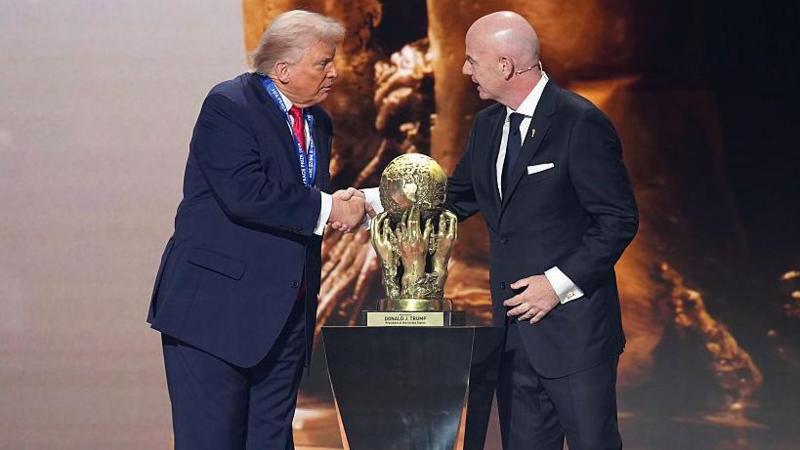
However, the relationship between Infantino and Trump appears to challenge these rules. During the World Cup draw, Trump received the inaugural Fifa Peace Prize, symbolizing two years of Infantino cultivating a close relationship with the US president.
"You can always count, Mr President, on my support, on the support of the entire football community to help you make peace and make the world prosper all over the world," Infantino told Trump when presenting the award.
Human rights organization FairSquare filed a complaint with Fifa's ethics committee in December, alleging Infantino violated political neutrality by creating the prize. After no response, 50 Members of the European Parliament sent a letter last month demanding action. As with many Fifa matters, no reply has been forthcoming.
Despite Trump not attending any World Cup matches, he publicly took credit for influencing Balogun's suspension reversal, exemplifying football's failure to manage its own affairs.
This was reminiscent of the situation with Somali referee Omar Artan, who was denied US entry by immigration officials, leading to accusations that Infantino lost control of his World Cup. When questioned by the media last month for the first time in over three years, Infantino responded dismissively:
"Just, you know, chill, relax," Infantino said regarding Artan's situation.
Controversy has consistently loomed during Infantino's presidency, often without transparency or clear explanations. For example, on a recent Friday, Fifa spent five hours in uncertainty after initially changing the kick-off time for England's last-16 match against Mexico, then reversing the decision without acknowledgment.
The Balogun case follows a similar pattern: decisions communicated without explanation, leaving football to accept them without question.
Controversy bubbling under the surface at World Cup
FairSquare contends that only 10 individuals were involved in creating the Fifa Peace Prize, and the Fifa Council did not approve the decision.
Numerous recent controversies have surrounded football. One example is the allocation of the 2030 and 2034 World Cup finals. The 2030 tournament will be hosted across Africa, Europe, and South America, guaranteeing that the 2034 event will be held in Asia or Oceania. This arrangement effectively ensured Saudi Arabia, a nation with human rights concerns similar to Qatar, would host in 2034.
Saudi Arabia and Fifa, under Infantino's leadership, have developed a close relationship. Norway's football federation abstained from the vote, criticizing the bidding process for undermining "Fifa's reforms for good governance" and challenging "trust in Fifa."

Additionally, the Club World Cup, a largely unpopular summer tournament created by Fifa to claim a share of club football's revenue, has drawn criticism. Sergio Marchi, president of the global players' union Fifpro, stated last year that it was established "without dialogue, sensitivity, and respect."
The Balogun case has also allowed unexpected voices to take a moral stance. Former Fifa president Sepp Blatter, who resigned amid a corruption scandal and was succeeded by Infantino in 2016, wrote on X:
"Football must never become a playground for political power."
Courting controversy and befriending Trump - Fifa's 'unlikely saviour'
The red card system has been thrown into disarray by the intertwined decisions involving Trump, Fifa, and Balogun. Trump confirmed he requested Fifa to review Balogun's ban, highlighting the unusual political involvement in football disciplinary matters.
Could Uefa go to war with Infantino?
On Tuesday, Uefa publicly opposed the Balogun decision, stating that Fifa had "crossed a red line" and describing the reversal as an "unprecedented, incomprehensible and unjustifiable decision."
This is not the first confrontation between Uefa and Fifa. In May 2025, Uefa president Aleksander Ceferin led European delegates in walking out during a Fifa Congress break after Infantino arrived two hours and 17 minutes late following a diplomatic trip to the Middle East with Trump.
Uefa has also sought to score political points during the World Cup. Shortly after Somali referee Omar Artan returned home last month, Uefa announced his invitation to officiate the Uefa Super Cup between Paris St-Germain and Aston Villa on 12 August.
Throughout the year, Uefa has highlighted the affordability of Euro 2028 tickets compared to the World Cup and has rejected introducing hydration breaks or red cards for players who cover their mouths.
Infantino, who previously worked for Uefa and presented Champions League draws, is no longer fully embraced by the organization. Although he spoke at the Uefa Congress in February, tensions remain evident.
Given these factors, Infantino's position might appear vulnerable. However, he remains popular with many federations worldwide, largely due to Fifa's development initiatives.
Infantino's Fifa Forward programme has funded football projects globally and expanded World Cup participation. Sixteen additional nations now qualify, mostly from confederations with less depth; Europe received only three extra spots.
This World Cup has revealed that, beneath the elite level, Asia and Concacaf require significant development to be competitive. Nonetheless, Infantino has offered hope to nations previously excluded from the World Cup, such as Cape Verde, Curacao, Jordan, and Uzbekistan.
Despite criticism of the 48-team format, it enabled Cape Verde to realize their dream and will help less traditional football nations grow stronger, benefiting global football.
Revenue from tournaments like the World Cup, including high ticket prices, finances these projects. Fifa anticipates generating $9 billion (£7.9 billion) this year.
While Uefa opposes many of Fifa and Infantino's policies, European football is financially self-sufficient. The remainder of the football world relies on Infantino and Fifa's revenue.
Fifa comprises 211 member countries, each with a vote in presidential elections, requiring 106 votes to win. In April, Conmebol (South America) pledged support for Infantino's re-election. Three weeks later, the Confederation of African Football (Caf) unanimously backed him, followed by the Asian Football Confederation's 47 nations.
Infantino already commands 111 votes, making him unbeatable. Even if Uefa could field a candidate, the race is effectively decided. Infantino was re-elected unopposed in 2019 and 2023, and it would require extraordinary circumstances for anyone to challenge him in 2027.
- How to watch the World Cup on the BBC and ITV
- Everything you need to know about the World Cup


