

Messi's Emotional Journey in the World Cup
After Argentina overcame a 2-0 deficit to reach the World Cup quarter-finals, Lionel Messi was overcome with tears. These were not just tears of celebration but of profound relief. Earlier in the tournament, he had also cried upon learning of a health complication involving his father following the opening match.
This time, his tears stemmed from relief—not merely from escaping defeat against Egypt but from not letting his teammates down after missing a penalty that momentarily threatened Argentina's continuation in the tournament.
Messi's emotions are complex and intertwined: relief, pressure, family, the support of the crowd, and teammates who deeply care for him and desire to see him triumph once more. This World Cup could be his last, though that remains uncertain.
Amid this emotional whirlwind, there is immense happiness for a player who has finally found an ideal environment—a football team tailored to his strengths, embodying the spirit of unity: all for one and one for all.
Argentina's manager, Lionel Scaloni, encapsulated this sentiment before the Switzerland quarter-final:
"The best moments of all, by far, are celebrations of the group. I coach for this, not because I like a 4-3-3," he said. "I like drinking mate [a South American tea] with my friends and players, sharing a barbecue, playing truco [a card game], as we have always done."
This could have been Messi speaking. He is extending his career to savor these moments. Under Scaloni, he has reconnected with his roots—the young man from Rosario, deeply Argentine, surrounded by mates and mate, rediscovering the joy of competing alongside like-minded teammates.
Make no mistake: this Argentina squad is built around Messi, designed to give the 39-year-old the best chance to win a second consecutive World Cup.
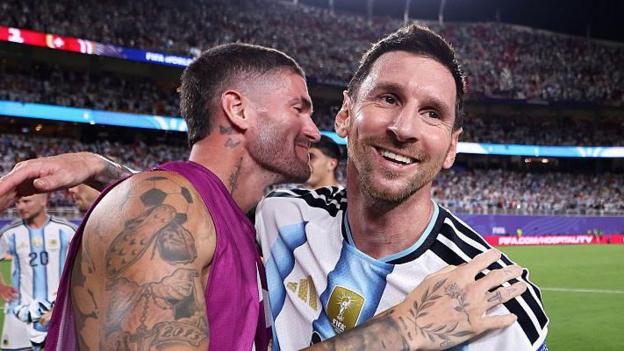
De Paul Friendship and a 'Gang Protecting Its Leader'
Rodrigo de Paul has become, within this Argentina squad, akin to what Jose Manuel Pinto was at Barcelona or Luis Suarez later became: the teammate with whom Messi instantly feels at home.
Their friendship developed during international duty. Prior to that, De Paul's only connection to Messi was having asked for a photo after a Valencia–Barcelona match, which he proudly shared on social media.
One afternoon, De Paul noticed Messi leaving training alone, appearing subdued. Concerned, he waited about 40 minutes before knocking on Messi's door with an invitation:
"Fancy a mate and a game of truco?"
This marked the beginning of a friendship with its own strict etiquette. Every morning, they share mate together in De Paul's room. The order of arrival is fixed: Messi first, followed by other squad members. If they rise too early, they wait for the designated time to gather; no one breaks the routine.
De Paul sometimes calls Messi 'El Pequeno' (the little one), despite Messi being the oldest in the room. He teases him, treating him like an ordinary person rather than an icon, which is often what Messi prefers: to be Leo, not Messi. De Paul knows when to give him space as well.
On the pitch, Messi leads with De Paul beside him, the rest of the squad fanning out behind them almost like a street gang protecting its leader.
For many in this group, Messi was never merely a teammate; he was the childhood idol seen on television, the inspiration for picking up a football in the first place.
The entire squad wears the Adidas Adistar Messi boots. For Messi's birthday in June, the players donned T-shirts printed with a photo of themselves alongside him from various moments in his national team career.

Double Training Sessions and Obsession with Nutrition
Scaloni has created an environment optimized for Messi's success—patient, collective football. In turn, the Inter Miami forward has committed to rigorous double training sessions with De Paul and meticulous attention to nutrition.
A nutritionist close to Messi's camp reports that his top speed is now approximately 5% higher than during the Qatar World Cup. Messi walks for 47% of a match and has covered only 631 metres at maximum speed throughout the tournament.
He is also the top goalscorer of the World Cup. Historically, only two players have achieved 10 or more direct goal involvements across two different World Cups: Messi, with 10 in 2022 and 10 again now, and Kylian Mbappé, with 10 and then 11.
The team's recent titles underscore this approach's success. Argentina has won its past three semi-finals and secured four trophies during this cycle: two Copa Americas, a World Cup, and a Finalissima.
Asked about Scaloni as a teammate, Messi's response is affectionate. He recalls Scaloni as a character, more serious now but once always teasing and close to the younger players:
"I still tease him, he used to kick lumps out of me in training at the 2006 World Cup. It's not true, he tells me. But I remember," said Messi.
When appointed in 2018, Scaloni inherited a squad of exhausted stars forming Argentina's inner circle, under constant scrutiny and unable to perform at their peak.
He accepted the role on an interim basis when no one else wanted it, began leaving out big names, and called up players previously underrated.
He restored harmony off the pitch and logic on it: prioritize Messi. Messi does not seek solutions in congested play; he creates them, leveraging his extraordinary ability to read the game and identify opponents' weaknesses.
Scaloni allows Messi to make decisions on the field. For example, Messi moved to the right-hand side of the attack against Egypt and shifted centrally after 38 minutes versus Switzerland. The team adapts accordingly.
"No, we did not tell him to do it," Scaloni said. "But the team needs to respond to his decision." This means De Paul exploits the space Messi vacates.
Argentina's World Cup Anthem Dedicated to Messi
In Argentina, football is the most important of the least important things.
Underlying it all is the thread connecting Diego Maradona and Messi. For generations, Argentines have believed their country was destined for greatness, rich in talent but repeatedly hindered by instability.
When a figure like Maradona, and later Messi, reaches football's pinnacle, it transcends personal achievement. It becomes proof that Argentina remains among the world's elite. This may explain the near-religious adoration they receive.
After every victory, led by De Paul, the squad sings "La Cuarta Estrella"—the anthem of this World Cup, dedicated to Messi and settling an old score for Maradona:
"We won the third one with Lionel, we want to be champions again, and 32 years on, La Scaloneta will avenge the cup stolen from the number 10 [a reference to 1990]. I want to see the fourth star shine on the shirt. Argentine from cradle to grave, for the Falklands, for Diego, for Leo's last outing. Argentina, I want to see you become champions again."
Never before has a player already regarded as a legend been celebrated with a song by his own teammates while still playing alongside them. With Messi, new ground is constantly being broken.
Leandro Paredes expressed this sentiment perfectly. When they saw Messi in tears, they embraced him—not only to comfort but to remind him they were there and would give their all to ensure his last game never arrives.
:
- Listen to the latest Football Daily podcast
- Premier League rules World Cup defences - but not attacks
- 'We should all be excited' - Messi set for first England meeting


