

Carlo Ancelotti on Ambition and Leading Brazil
In an exclusive interview, Brazil’s head coach Carlo Ancelotti discusses his role leading what he calls "the most important national team," his approach to maximizing Vinícius Júnior’s potential, and insights gained from his time at Real Madrid.
When asked if he is an ambitious man, the 66-year-old Italian smiles and replies,
“Me? I’m not ambitious. Why? Why are you asking that?”Despite his remarkable career, including five Champions League titles and league championships across England, France, Germany, Italy, and Spain, Ancelotti’s appointment as Brazil’s coach last May came with a clear goal: winning the World Cup.
“I’m not obsessed with winning,”he explains.
“What I have is a passion for enjoying the moments that football has given me. I’m not obsessed with winning the World Cup, but I have the pleasure and passion to enjoy the moment I’m living in, leading the most important national team in the world.”
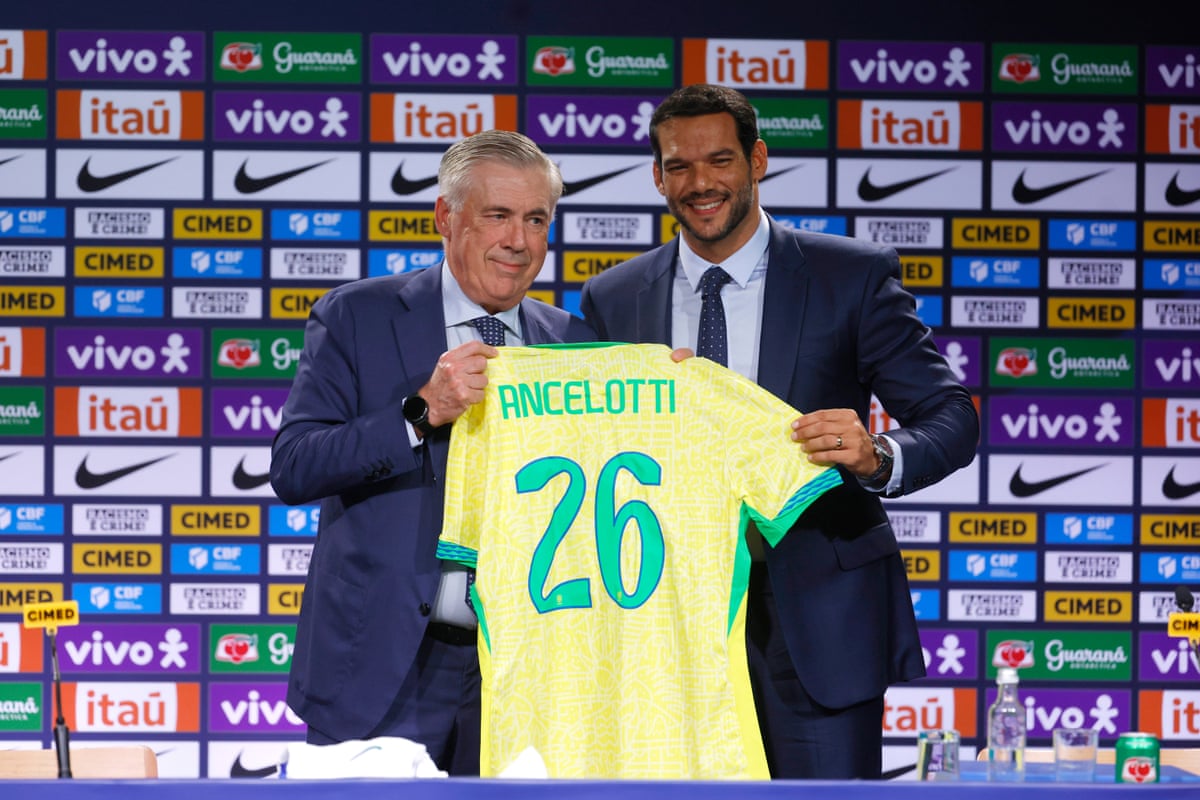
Having participated in the World Cup as a player, this is Ancelotti’s first time managing a team at the tournament. His mission is to restore Brazil’s dominance and end a 24-year World Cup drought, matching the longest such period since 1970–1994. Despite the challenge, his passion for football remains undiminished after 47 years at the highest level—16 as a player and 31 as a coach.
“I couldn’t live without football,”he says.
“If I’m no longer on the pitch, I’ll be there as a fan watching the match. For me, watching a match on the TV isn’t work. It’s a pleasure. I really love cinema. For me, football is like the pleasure of watching a film. It’s the same feeling. The day I stop working in football, I’ll still watch in the same way, without any problem.”
Coaching Philosophy and Player Relationships
Many players, including Kaká, Toni Kroos, Gareth Bale, and Vinícius Júnior, regard Ancelotti as the best coach they have worked with. When asked what sets him apart, he responds with a laugh,
“I really don’t know. Maybe it’s my attitude, the way I behave towards the players, the respect I show them as people. I place great value on building those personal relationships.”
He acknowledges the complexity of a manager’s role, which involves managing relationships with players, clubs, media, and fans.
“A manager’s job is very difficult because you have to manage so many things. There’s the relationship with the players, with the club, with the press, with the fans. There are so many aspects of this job that you have to manage. The most challenging of those is the relationship with people – and it’s also the most important.”
Despite his success, Ancelotti is sometimes labeled a “man-management coach,” implying his achievements stem mainly from interpersonal skills rather than tactical acumen. He dismisses this notion, stating,
“I don’t win titles just because of my relationship with the players. The [good] relationships I have with players help because it allows you to get the most out of the player. Sometimes even more than the maximum. But that is just one part of the game. It doesn’t matter to me whether people say I am or I am not a good tactician. All I can say is that I know all aspects of the game very well.”
Adapting to Modern Football and Brazil’s Culture
Ancelotti will extend his contract with Brazil through the 2030 World Cup, when he will be 70 years old. He notes the evolution of football, emphasizing a shift toward more analytical, intense, and physical play, with a greater focus on attacking tactics compared to defensive strategies prevalent a decade ago.
Having worked with over 40 Brazilian players during his career, Ancelotti believes he understands the nation’s football culture well, which contributed to his appointment.
“I really like the Brazilian spirit,”he says.
“Brazilians have a special love for the yellow jersey. This special love for the national team is very much a Brazilian trait. In other countries, the national team isn’t as important as it is in Brazil.
“Brazil has preserved its own culture. It’s a country that knows how to value the importance of family and religion. These are things that Europe has lost. In sport, Europeans don’t have the same love for the national team shirt. I really admire the joy of the Brazilian people, the energy the country has and the beauty of Rio de Janeiro. This is very clear, especially at carnival. I really like Brazil.”
Faith and Personal Values
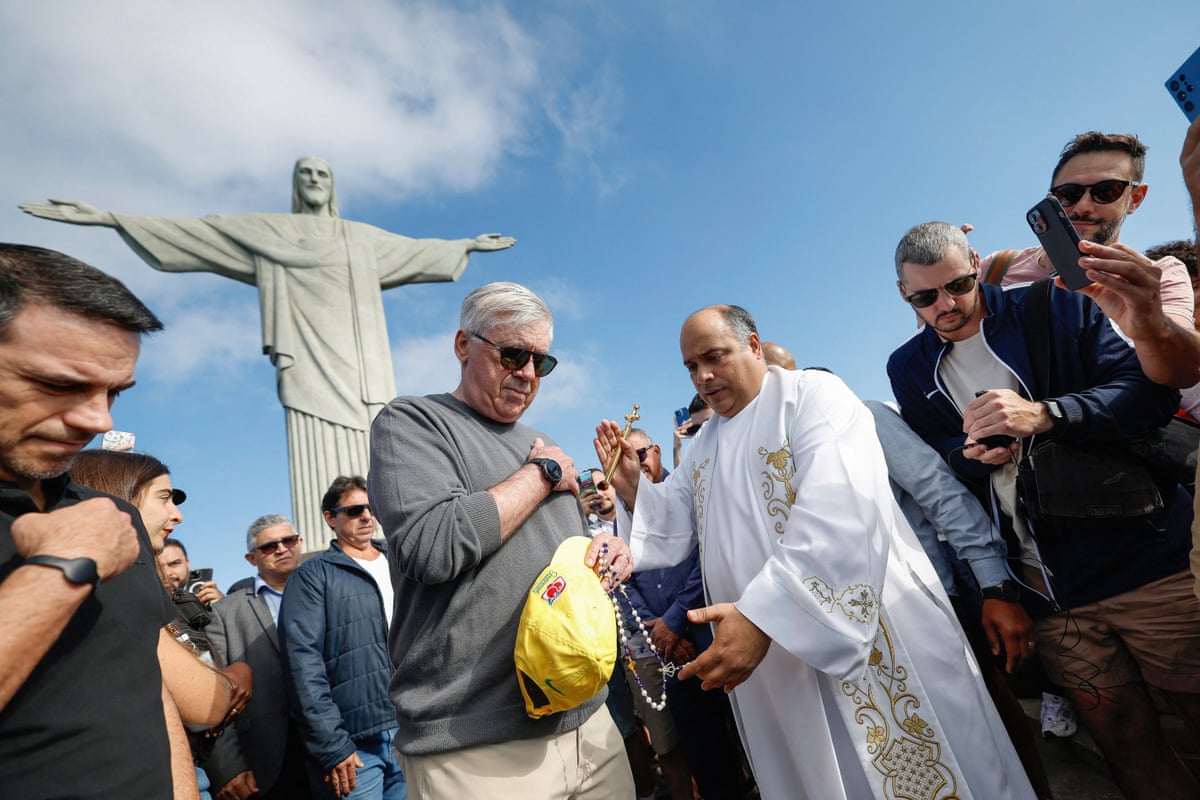
Ancelotti highlights the significance of religion in Brazil, noting the country’s Catholic majority, similar to Italy. He credits his faith with teaching him important life lessons.
“Religion has taught me good things like how to conduct myself in life, how to respect others,”he says.
“I am Catholic and religion has been very important to me and has taught me to be a good person in the world.”
When asked if he prays for an end to Brazil’s injury woes, Ancelotti responds with a laugh before becoming serious:
“Ha, yes. It is a concern. We’ve already had three major injuries. I hope we don’t have any more problems before the World Cup.”
Injury Challenges and Team Selection
Brazil, currently ranked sixth globally, has already lost Éder Militão and Rodrygo to injury, with Estêvão’s participation in doubt. These setbacks complicate Ancelotti’s task. In his 10 games in charge, Brazil has recorded five wins, two draws, and three losses.
Among his priorities is replicating his success at Real Madrid in 2024 by helping Vinícius Júnior reach his full potential. The 25-year-old has yet to shine as brightly for Brazil, scoring eight goals in 47 international appearances. Ancelotti seeks to alleviate the pressure on Vinícius to enable him to play with joy and energy.
“Look, the responsibility he carries for Brazil is huge, especially recently,”Ancelotti explains.
“This responsibility can be a burden for him. Our job in the national team is to take some of that weight off his shoulders so he can play with joy, energy and all the qualities he possesses.
“I see Vinícius as I saw him at Real Madrid: a spectacular player and a spectacular person who can win a match on his own. He’ll be very important for Brazil at the World Cup. But being the No 1? The star player? We don’t need a No 1. We can’t focus everything on just one player. We must think as a team. That’s the only way to win the World Cup.”
Neymar’s World Cup Future
Ancelotti faces a different scenario compared to recent Brazil coaches who relied heavily on Neymar. The 34-year-old forward, with 79 international goals, has struggled with fitness and has not played for Brazil since October 2023. Public opinion is divided; a Datafolha survey found 53% of Brazilians want Neymar included in the World Cup squad, 34% oppose, and 13% are undecided.
With the squad announcement imminent on 18 May, Ancelotti is clear about Neymar’s inclusion:
“Neymar’s call-up depends only on him,”he asserts.
“It depends on what the player shows on the pitch. That’s a very clear criteria and that is not only for Neymar. With most players you need to assess talent and physical condition. With Neymar we only need to assess his physical condition because his talent is beyond question. It depends on him, not on me.”
Veteran Players and Leadership
Another experienced player under consideration is Thiago Silva, the former Chelsea and PSG centre-back, who at 41 has had a strong season with Porto and aims to participate in his fifth World Cup.
“Thiago Silva is on the radar, yes,”Ancelotti confirms.
“He’s been playing very well, he won the Portuguese league and is in a great physical condition.
“Leaders are important. Fortunately, this squad has highly respected leaders. Leaders who don’t say much but set a good example, such as Alisson, Casemiro, Marquinhos and Raphinha. In that sense, the squad is in good hands.”
World Cup Experience and Reflections
This will be Ancelotti’s fourth World Cup involvement. He played for Italy in 1986 and 1990 and was assistant coach to Arrigo Sacchi during the 1994 tournament in North America, where Italy lost the final to Brazil on penalties. Returning to the US after 32 years evokes both happiness and nostalgia.
“In 1994 the matches were at midday in New York with temperatures of 43C (109F). Now the kick-off times are better. The weather won’t be a problem as it was in 1994.”
Comparing Club and National Team Management
Upon his appointment, many Brazilian headlines noted Ancelotti’s move from the world’s biggest club to the most important national team. He acknowledges similarities but also significant differences.
“They’re different ways of working for a manager,”he says.
“But the most important thing I learned at Real Madrid, and which I use in Brazil, is high standards. When you are demanding you have a better chance of winning. Real Madrid is the most successful club in the world because the club is demanding of everyone who works there. If you are demanding, you get the best out of everyone.”
Personal Life and Perspective
Ancelotti, a dog lover, finds comfort in his pets amid the pressures of football.
“I have three dogs who are in Canada,”he shares.
“A dog isn’t a person, but it’s more loyal than a person. A dog doesn’t care if you win or lose. They don’t blame you. When you get home, whether you’ve won or lost, the dog doesn’t care. The important thing is that you’re home with them.”
Outlook for Brazil at the World Cup
Brazil’s group includes Morocco, Haiti, and Scotland. When asked what it will take for Brazil to become world champions, Ancelotti emphasizes talent and motivation.
“Talent,”he states.
“I have a very talented squad. Also, the motivation that this country has to win again after 24 years is enormous. I’m convinced we’re going to have a great World Cup.”


