
Leadership Under Scrutiny Ahead of New Zealand Series
The upcoming series against New Zealand will serve as a critical test to determine whether the leadership team’s previously unsuccessful approach has truly evolved.
Culture and Character: Foundations for England’s Reset
There is a quote from Legacy, James Kerr’s book about the All Blacks, that resonates strongly:
“Our values decide our character, our character decides our value.”
As England’s Test side embarks on a significant reset following the Ashes, this sentiment is particularly relevant.
Culture is an ongoing process and will always require attention. The positive outcome from England’s challenging winter in Australia—where their culture was found lacking both on and off the field—is the opportunity and willingness to reset it.
McCullum and Key Tasked with Leading the Rebuild
Brendon McCullum, who initially established the team’s culture after his appointment, is now charged with transforming it. The New Zealander, serving as England’s head coach across all formats, and Rob Key, the England and Wales Cricket Board’s managing director of men’s cricket, have been given the responsibility to lead this rebuilding phase.
I cannot recall any team in any sport whose leaders have been so steadfast in their philosophy over several years, have seen that philosophy and its results brutally exposed at the pivotal moment they had been preparing for, undergone a comprehensive review of all factors contributing to that failure, and yet retained their positions.
For better or worse, McCullum and Key remain at the helm, and England must hope they succeed.
Reconfiguring Relationships Beyond the Squad
When discussing cultural change, it is not limited to the squad alone—the relationship with the county game also required adjustment. Some of Key and McCullum’s earlier remarks about English domestic cricket were perceived as crass and condescending. It is encouraging, therefore, to observe a tangible shift in their attitude, exemplified by the creation of a head coaches’ group that will meet regularly with England’s leadership.
While Key and McCullum have not been held accountable for their roles in England’s Ashes failure, a few players have faced consequences after a period marked by excessive loyalty.
McCullum’s Position and Evolution After the Ashes
Where does McCullum stand now, after England’s style of play, culture, planning, preparation, strategy, and player technique and fitness were tested and found wanting against an Australian side not at full strength? One must assume he is evolving. If he and Key have reflected thoroughly, they will have gained significant insights. McCullum developed a particular approach throughout his playing and coaching career; the question now is whether he can adapt and improve it.
At times, I find it difficult to see the best in McCullum. In 2006, during my level four coaching course—the ECB’s highest qualification for professional coaches—we were taught that even before speaking, much is communicated through dress, conduct, punctuality, and the example set.
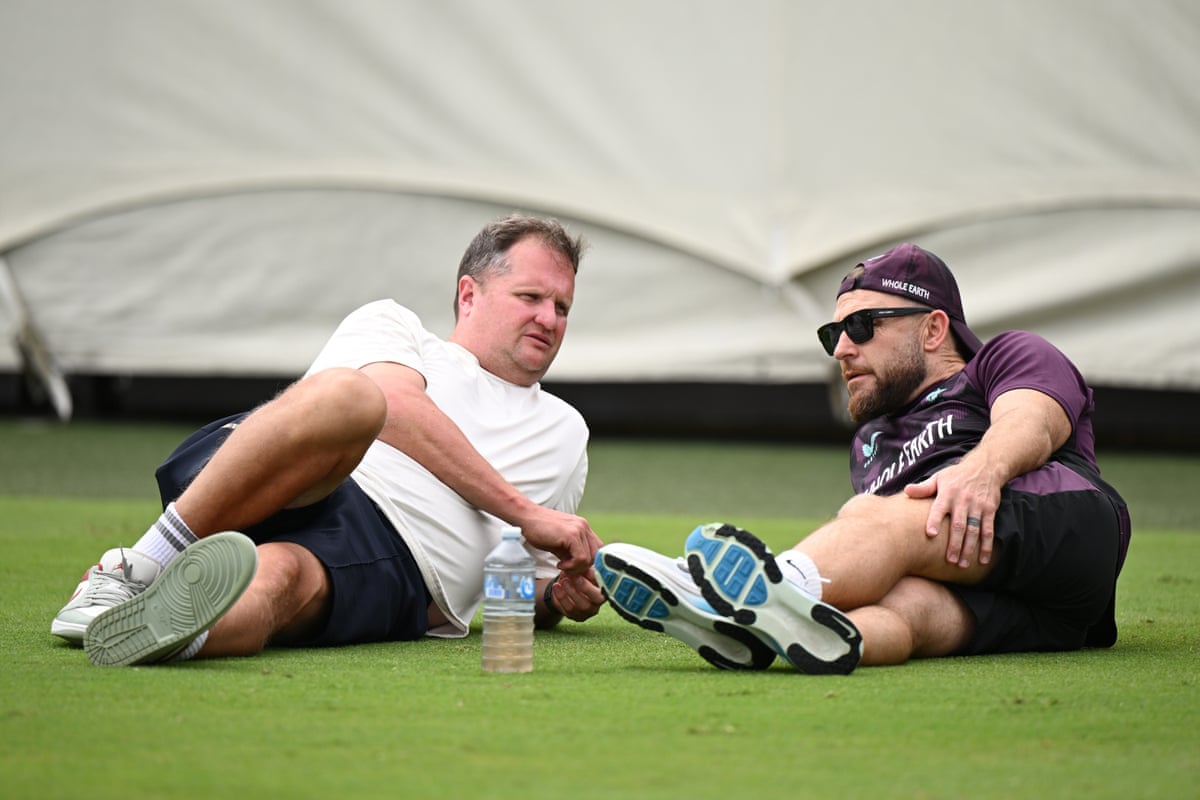
Though this was 20 years ago and times have changed, I am reminded of that lesson whenever I see McCullum with his feet up, wearing flip-flops, sunglasses, a baseball cap worn backward, and visible tattoos. When he spoke during the Ashes about England being
“within a bee’s dick of getting a win,”
it made me cringe. This does not imply he is a poor coach, but I often have to manage the unconscious bias this image triggers in me.
McCullum is clearly a people person—unpretentious, empathetic, and an effective communicator who understands the pressures of representing one’s country. He possesses significant strengths, but many coaches strive to surround themselves with individuals who complement their weaknesses. I am uncertain whether he has fostered such an environment within England’s setup.
Technical Coaching and Player Foundations
McCullum acknowledges he is not a highly technical coach. Has he ensured the presence of experienced coaches specializing in technical aspects to support players’ foundational skills? One might assume players selected for England have solid technical bases, but this is not always the case. For example, two players recently dropped—Zak Crawley and Ollie Pope—exhibited technical flaws: Crawley’s tendency to play across straight balls and Pope’s head falling over to the off side, leading to recurring dismissals.
We want players to succeed because of their technique, not despite it. England has made new coaching appointments since the winter, but it remains to be seen if the right personnel have been brought in to create a comprehensive support environment.
Shifting Messaging and Tactical Approach
McCullum’s messaging will also need to evolve. For four years, he has advocated "running towards the danger," but now the focus must shift to winning key moments and playing intelligent cricket while maintaining an attacking style. It will be interesting to observe how this transition unfolds, but England’s squad comprises intelligent players capable of adaptation.
Upcoming Challenges and Expectations
England’s coaching staff will be evaluated primarily on major series, currently against India and Australia. McCullum has led the team through four such series without a win, which explains why he is fortunate to retain his position. However, the pressure remains intense with New Zealand and Pakistan visiting this summer. Expectations will be high; I anticipate a comprehensive victory over Pakistan, but the New Zealand series will be a significant test.
This is no longer a young, developing side. It is composed of experienced players at prime ages, expected to be nearing their peak. If McCullum can bring them along as he implements changes, England should be well-positioned to win both series and move forward positively, leaving last winter’s difficulties behind as they prepare for greater challenges ahead.


