

End of Bazball: A Brief, Bright Experiment
Farewell to Bazball, a term defined by the Collins English Dictionary in 2023 as “a style of Test cricket in which the batting side attempts to gain the initiative by playing in a highly aggressive manner.” Over time, the approach became less aggressive, the attempts to seize the initiative less apparent, and the results less convincing. Brendon McCullum, whose philosophies and nickname inspired Bazball, was often irritated by the term, describing it as “silly” when he addressed it. Yet, Bazball without its defining characteristics became puzzling.
Ben Stokes’ Bold Claim and Early Success
In 2023, Ben Stokes was widely mocked during a drawn home Ashes series when he said in a private dressing room speech, later released by the England and Wales Cricket Board (ECB):
“What we have managed to do is we’ve managed to become a sports team that will live forever in the memory of people who were lucky enough to witness us play cricket. What we have done is something a lot bigger than any Ashes trophy … be[ing] the team that everybody will always remember.”
At the time, England were 2-1 down with one match to play, making the statement seem hyperbolic, though somewhat belated. Those who witnessed the team in the summer of 2022, the first after McCullum and Stokes’s appointments as coach and Test captain respectively, saw a team chasing down targets of 277, 299, and 296 to beat New Zealand 3-0, comfortably reaching 378 against India, and recovering from 1-0 down to beat South Africa 2-1. Jonny Bairstow’s 11 innings average of 75.66 at nearly a run a ball contributed to a summer filled with memorable performances. England then toured Pakistan, facing extraordinarily challenging conditions, and appeared to operate without limits, uncertain if any existed for them.
2023 Ashes and the Shift in Focus
The 2023 Ashes, despite England’s achievements and a third victory denied only by rain in Manchester, were disappointing enough that the focus shifted overwhelmingly to reclaiming the urn in Australia. McCullum described the return series as “the biggest of all our lives,” and the 2-2 draw marked a clear end to an era. The question remained: the end of what?
The defeat felt like more than a sporting loss; it was a comprehensive critique of England’s team, player selections, management, and tactical ambitions. The ECB promptly launched a review, which reportedly went as badly as feared.
The review concluded that despite popular calls for personnel changes, the ECB would not pursue them immediately. Richard Gould, ECB chief executive, stated:
“Moving people on can sometimes be the easy thing to do. That’s not the route we’re going to take. It may not be the popular route, it may not be the easiest route, but I think it’s the right route.”
However, three Tests later, McCullum was dismissed, making Gould’s words and the process leading to them appear questionable.
Gould acknowledged the rapid changes in sport, saying on Sunday:

“Positions, particularly in sport, change very quickly.”
McCullum’s Commitment and the New Approach
At the start of the summer, McCullum, newly freed to focus on the future, welcomed “some clarity around those things” and recommitted to his role. He expressed eagerness to “finish the job we started” and promised a streamlined, modified, and more nuanced approach to Test cricket:
“I’m confident we’ll be a more refined version of the team that we have been. I still want us to play brave and positive cricket. I’d like us to be slightly smarter on occasions. There’s lots to be really proud of over the last four years and there’s lots where you can look back and say we missed opportunities, and if we had nailed those moments then the conversations would be slightly different.”
The first Test against New Zealand at Lord’s, played under slate-grey skies on a challenging wicket, seemed an encouraging start to this regeneration. Emilio Gay was introduced as opener and scored a crucial half-century, while Ollie Robinson made a significant impact after his recall. However, Stokes was already feeling unease within the dressing room and uncertainty about his future. Following a confrontation involving Stokes and Gus Atkinson, any positivity from the performance dissipated.
Leadership Changes and Future Prospects
Following the incident, New Zealand captain Tom Latham refused to back Stokes’s captaincy but praised McCullum’s coaching, stating:
“[McCullum has] been outstanding in the way that he’s led this side as a coach and that this is one of the more successful England Test teams, and it’s not even anywhere near the end of it.”
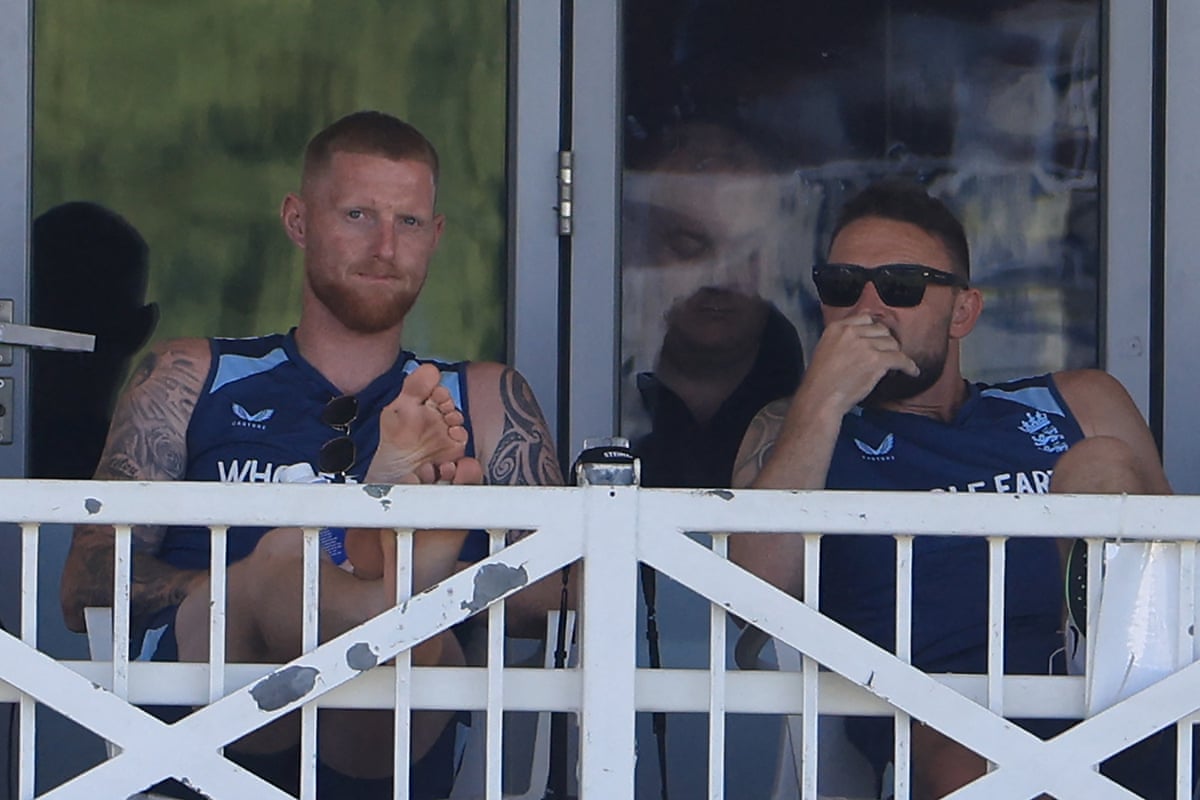
Yet, just over a month later, McCullum’s tenure ended. Of the three leaders in the men’s Test setup at the start of the summer, only New Zealand’s captain remains. On Sunday, Latham was promised long-term job security by Gould. With Stokes and McCullum departing, many believe the restructuring is far from complete.
McCullum’s Career Decisions and Future Focus
McCullum famously declined the white-ball coaching role in 2022, though he accepted it three years later, explaining:
“I wasn’t really interested in a cushy kind of gig. If you’re prepared to change your life for something it’s got to be something a bit grunty, a bit meaty, and the challenge of trying to bring a team which is rock bottom at the moment, and try to build something long-term that is sustainable and successful, that is more where the challenge lay.”
The irony is that after being judged to have failed in building sustainable long-term success with the Test side, McCullum is left with the white-ball job.
On Saturday, McCullum stated that England had “scaled the summit of what we wanted to achieve” by reaching No 1 status in T20s, but his focus should now shift to the 50-over format. A World Cup is scheduled for autumn 2027 in South Africa, Zimbabwe, and Namibia, and recent ODI performances have been unconvincing:
“It’s fair to say we’re further in front in T20, but there’s still a lot of optimism about where we can take the one-day side.”
The question remains whether the recent upheavals will cause McCullum to question his relationship with the ECB and whether he can trust his footing amid the organization’s shifting dynamics.


