

Cardiff Huskies have come a long way from a handful of players 30 years ago
For one of the UK's original Para ice hockey teams, May 2026 marks 30 years since Cardiff Huskies played their first competitive game.
Similar to many Para sports organisations, the Huskies represent more than just a club.
A slow beginning
Sledge hockey, now known as Para ice hockey, gained prominence at the 1994 Winter Paralympics when it was introduced as a sport.
Before the Lillehammer Paralympics, the sport—originally invented in the early 1960s for patients at the Stockholm Rehabilitation Centre in Sweden—was relatively unknown.
The speed and physicality of the sport attracted significant attention during the two weeks of competition in March 1994. However, after the games concluded in Norway, the sport largely faded from public awareness.
By 1995, the UK had no properly established clubs or leagues for Para ice hockey.
Change began when a few Cardiff Devils fans expressed disappointment over their team's performance in spring 1995.
"As these things do, it started all over a beer in a bar," said former Great Britain player Andy McNulty.
"I was a season-ticket holder at the Cardiff Devils, and we were struggling a bit. We had just watched a particularly poor game.
"And I said to my mates, Ken Ridell and Jammo (David James), 'I could do better than that!'
"Out of the blue Ken - who was an ice hockey referee as well - said, 'I might be able to sort something for you about that'.
"Apparently, he had been asked a few weeks before to referee a (sledge hockey) game for the GB team."
A few weeks later, equipment arrived courtesy of the wheelchair sports charity WheelPower.
"They sent these plastic seats attached to a very basic frame with some hockey blades underneath and some shortened ice hockey sticks that we used to get ourselves around," McNulty explained.
"No helmets, no body armour, so it was very basic.
"Then the owner of the Cardiff Devils at the time, David Temme, said: 'If you can get it off the ground, I won't charge you to use the rink for six weeks and see how you get on'."
Initial participation was slow, but McNulty promoted the sport among friends, and after six weeks the team had gained about six new players.
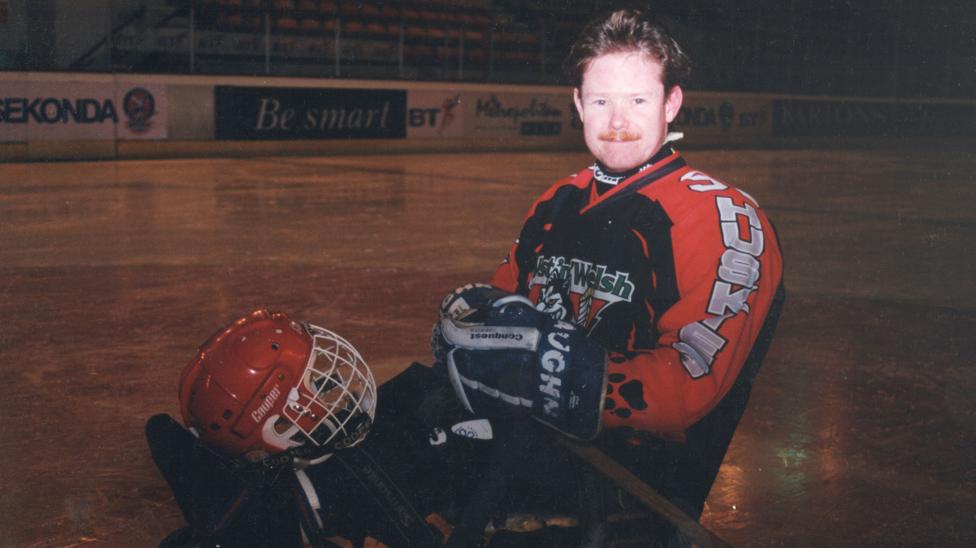
Andy McNulty admits Cardiff Huskies started life "over a beer in a bar"
'A minority sport within a minority'
Among the early participants was Joanna Coates-McGrath (née Coates), who tragically passed away after a brief illness in February 2026.
"The first time I went, I didn't go in sports kit because I was determined I wasn't going to play. So, for the first week I just watched," Coates-McGrath said before her passing.
"I did start taking part from the next week, but what always intrigued me was that I just wanted to organise it.
"I was just asking those questions, 'who runs this, how are you set up and how are you going to keep it going?'
"We were the first club. There was GB, but there were no clubs.
"I looked into setting up the club properly with a constitution, getting committees together, grants that we could apply for, getting sponsorship and it just went from there."
Coates-McGrath, who was Cardiff Met Sport's disability and inclusive sport coordinator, reflected:
"It was a minority sport within a minority. People hadn't heard of it; they didn't know what sledge hockey was.
"The toughest bit was building the player base when you didn't have the links - the internet, social media or organisations - that we have now.
"It was all word-of-mouth stuff, stopping people in the street, doing demonstration games during the breaks of a Cardiff Devils game to people who might know someone who wants to come and play."
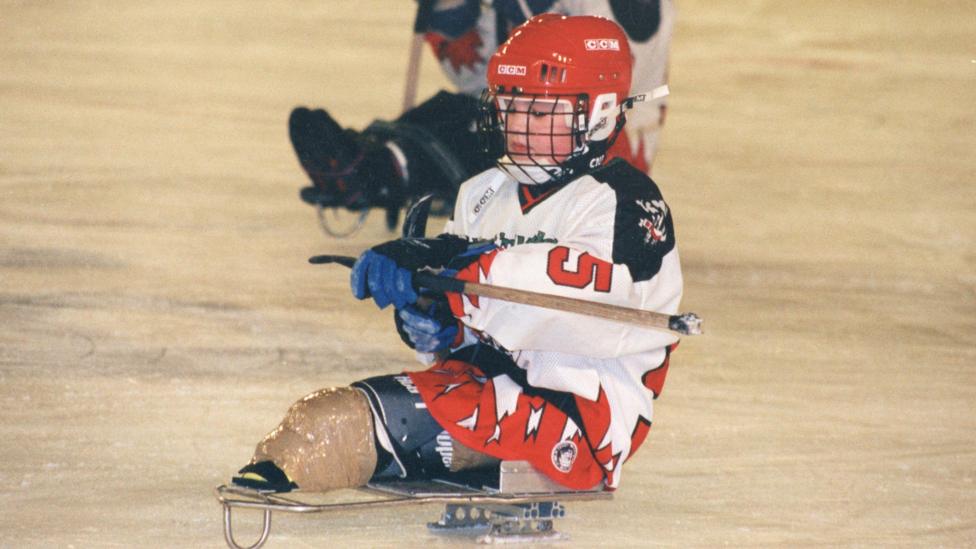
Nathan Stephens began his Para career at Cardiff Huskies and would represent Great Britain at both winter and summer Games
Lift-off with 'Welsh' derby
After many practice sessions, in May 1996 the Huskies arranged a match that was effectively a Welsh derby.
"Our first proper game calling ourselves the Cardiff Huskies was away against Deeside Dynamos.
"We all drove up in convoy to north Wales, there was no funding for things like a club minibus back then.
"The ice wasn't great, the rink hadn't bothered to run the Zamboni ice machine over it.
"The Deeside players were largely a bunch of GB players mostly based in the Manchester area and used the Deeside rink for their sessions.
"We got beat 6-1 but we weren't disappointed, it was good fun, we really enjoyed it."
With limited opposition in the UK, the Huskies soon sought competition abroad.
"The first time we went to Germany we played this game in Hannover against what we thought was just a local team," McNulty said.
"There were hundreds of people in the rink because they'd just been watching the able-bodied game.
"They were trying to build the German hockey side up, they were in their infancy and had sponsorship from Mercedes, so there was a guy there in his suit with the Mercedes logo on it, he didn't look very happy at the end of the game.
"Hannover were basically the German national hockey team, and we beat them. It was one of the first games that we'd ever won."
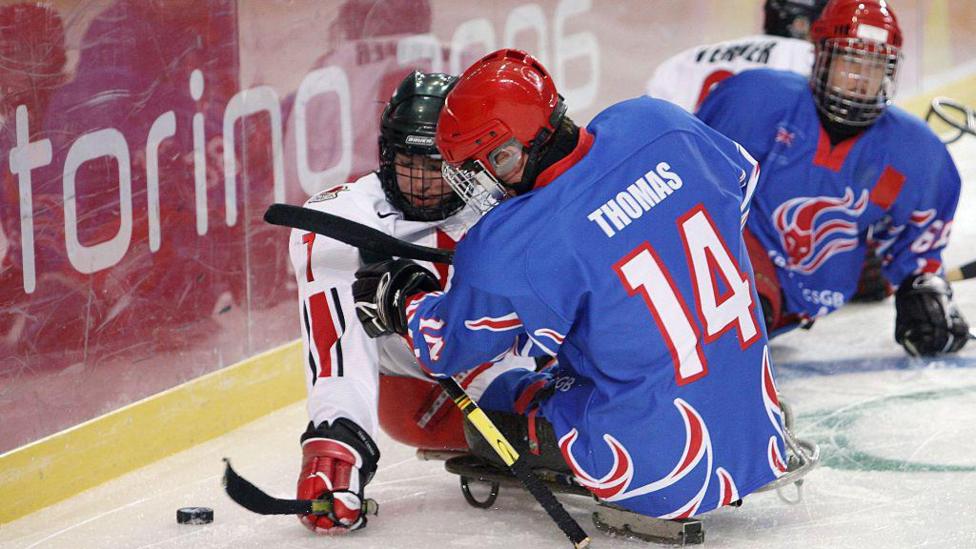
Cardiff Huskies players have gone on to represent Great Britain at international level
Confidence, fitness, mental health and big hits
As Para ice hockey developed in the UK during the 1990s, several Cardiff Huskies players were selected for the Great Britain squad.
Current Huskies coach Andy Brown stated:
"We've had quite a few talented male athletes with us who have played for GB such as Andy McNulty, Llyr Gwyndaf, Kim James, Matt Broadbent, Stephen Thomas and Nathan Stephens."
Nathan Stephens and Stephen Thomas both made their Paralympic debuts at the 2006 Turin Winter Paralympics and later competed as summer Paralympians as well.
Stephens represented Great Britain in track and field, competing in the men's F57 javelin at the 2008 and 2012 Paralympic Games.
He was a world leader in his event for a period, winning gold at the 2011 Paralympic World Championships and setting a world record later that year.
Thomas became a three-time world champion in Parasailing and represented Great Britain at three consecutive Paralympic Games.
The Huskies have been a mixed-gender team since their inception and have contributed several women to the Great Britain mixed team.
Five Huskies players—Shannon Couch, Leanne Emmerson, Jodie Hill, Helen McGivern, and Dani Czernuszka-Watts—were selected for the inaugural Women's World Championships held in August 2025.
Over the past 30 years, Cardiff Huskies have had a profound impact on many individuals' lives.
Head coach Andy Brown reflected on his own journey:
"I started as a player and with my disability (muscular dystrophy) I was very weak and was barely able to skate, but by being resilient and coming every week I grew and grew, and then I was able to have enough strength to play in a game.
"Some people who are newly disabled, we can be amongst the first people that they meet with something similar, for them it's, 'Oh, there are some people like me'."
Current Huskies forward Josh Davies shared his story:
"I had my 20th birthday in hospital. On 7th February 2011 I was felling a tree on our family trout farm, and the tree fell on me and broke my back, so no feeling from the waist down. It was hard to get over, but you've got to keep going.
"My dad is Canadian, so I've always been passionate about hockey. He coached his own street hockey team, and I played for them from the age of eight, so I've always followed the Cardiff Devils and the Toronto Maple Leafs.
"It was a good 10 years before I started feeling like I wanted to get out and play sport, it took me a long time to gain the confidence.
"I found Cardiff Huskies one day on Facebook and jumped at the chance to give it a go, and after the first session I fell in love with it straightaway.
"It was hard to begin with using muscles I didn't know I had. It took a while to get my balance, but I'm getting somewhere now.
"Once you've got the right set-up on your sled you're away, it just clicks.
"It's as brutal as stand-up hockey, fast paced, a lot of strategy in it. You've got to keep your head up all the time because there are big hits coming in from anywhere. I love the big hits, I thrive off them.
"It gave me loads of confidence, my fitness and mental health improved, and I met a load of good friends.
"I've played in one World Championships; I'm hoping one day to reach the Paralympics."
Brown added:
"It's about growing people, when they come sometimes, they can be insecure, but they just develop in confidence and strength. It's just brilliant.
"I'm so proud of the team, just good people, amazing people."


