

Supreme Court Clears Path for Trump Administration to Restrict Asylum Seekers at US-Mexico Border
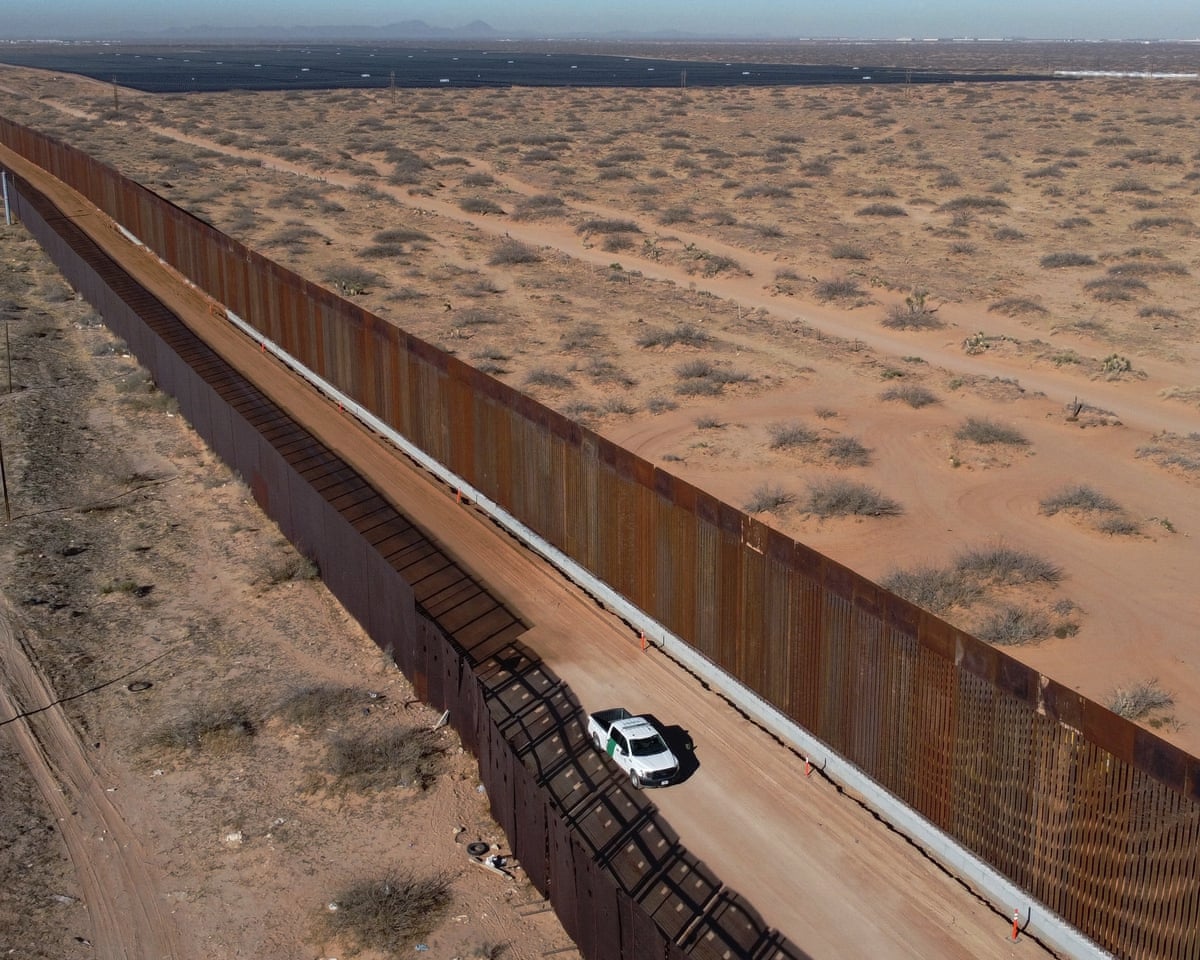
The Supreme Court has enabled the Trump administration to potentially reinstate an immigration policy that restricts the number of asylum seekers allowed to apply daily at the US-Mexico border.
The justices overturned a lower court injunction that had blocked the practice known as "metering," which was implemented during the Obama administration and expanded under Trump’s first term. Metering limited the number of migrants who could apply for asylum each day.
Advocates criticized the policy for creating a humanitarian crisis, as thousands of migrants were forced to wait in unsafe makeshift shelters. The Trump administration defended the policy as necessary to manage the surge of asylum seekers at the border.
Currently, metering is not active, although other restrictions on asylum seekers remain in place.
The administration argues that metering is a vital tool historically used by presidents from both parties and should remain available. Federal attorneys contend that migrants turned away can return later, despite previously long lines when the policy was enforced.
Under federal law, migrants arriving in the US must be allowed to apply for asylum and be screened for fear of persecution in their home countries.
The Justice Department argued that individuals stopped before entering the US have not technically "arrived," so immigration agents are not obligated to process their asylum claims.
Conversely, attorneys for asylum seekers maintain that the law requires screening of anyone arriving at a port of entry, and that blocking arrivals undermines national principles.
Metering originated during the Obama administration in response to large groups of Haitians arriving at the San Diego crossing from Tijuana, Mexico. It was later expanded to all border crossings from Mexico during Trump’s first term.
The policy ended in 2020 amid the coronavirus pandemic, and President Joe Biden formally rescinded it in 2021.
In 2021, a federal judge in California ruled that metering violated asylum seekers’ rights and federal law mandating screening. A divided appeals court panel upheld this ruling, but nearly half the judges on the full San Francisco-based court voted to rehear the case, signaling potential Supreme Court interest.
Supreme Court Rules in Favor of Former Monsanto in Pesticide Liability Case
The Supreme Court ruled in favor of the former Monsanto company in a significant case limiting how individuals can sue pesticide manufacturers for alleged illnesses.
The 7-2 decision, authored by Justice Brett Kavanaugh with a dissent by Justice Ketanji Brown Jackson joined by Justice Neil Gorsuch, addressed whether federal law granting the Environmental Protection Agency (EPA) regulatory authority over pesticides preempts state claims alleging failure to warn users of certain risks when the EPA has not mandated such warnings.
The Court held that the EPA’s control over pesticide labeling ensures nationwide uniformity. Since the EPA evaluated Monsanto’s Roundup and decided a cancer warning was unnecessary, state-level lawsuits demanding such warnings conflict with federal law.
The case focused on glyphosate, the active ingredient in Roundup and other herbicides formerly produced by Monsanto, now owned by Germany’s Bayer. Glyphosate has been linked to cancer in multiple studies and was classified as a probable human carcinogen by the World Health Organization’s International Agency for Research on Cancer in 2015.
Bayer has faced over 100,000 lawsuits alleging that exposure to glyphosate caused non-Hodgkin lymphoma. The company has paid billions in settlements and jury awards but maintains its products do not cause cancer. Bayer argues that under the Federal Insecticide, Fungicide, and Rodenticide Act (FIFRA), the EPA is the sole authority to determine labeling requirements, and since the EPA has not required a cancer warning, Bayer cannot be held liable for failure to warn.
The ruling means thousands of failure-to-warn claims pending against Monsanto and pesticide maker Syngenta, whose paraquat weed killer is alleged to cause Parkinson’s disease, cannot proceed. Syngenta disputes the evidence linking paraquat to Parkinson’s.
The vote was 6-3, with conservative justices Alito, Roberts, Thomas, Gorsuch, Kavanaugh, and Barrett concurring, and liberal justices Kagan, Jackson, and Sotomayor dissenting. Justice Sotomayor authored a detailed 35-page dissent, nearly twice the length of the majority opinion.
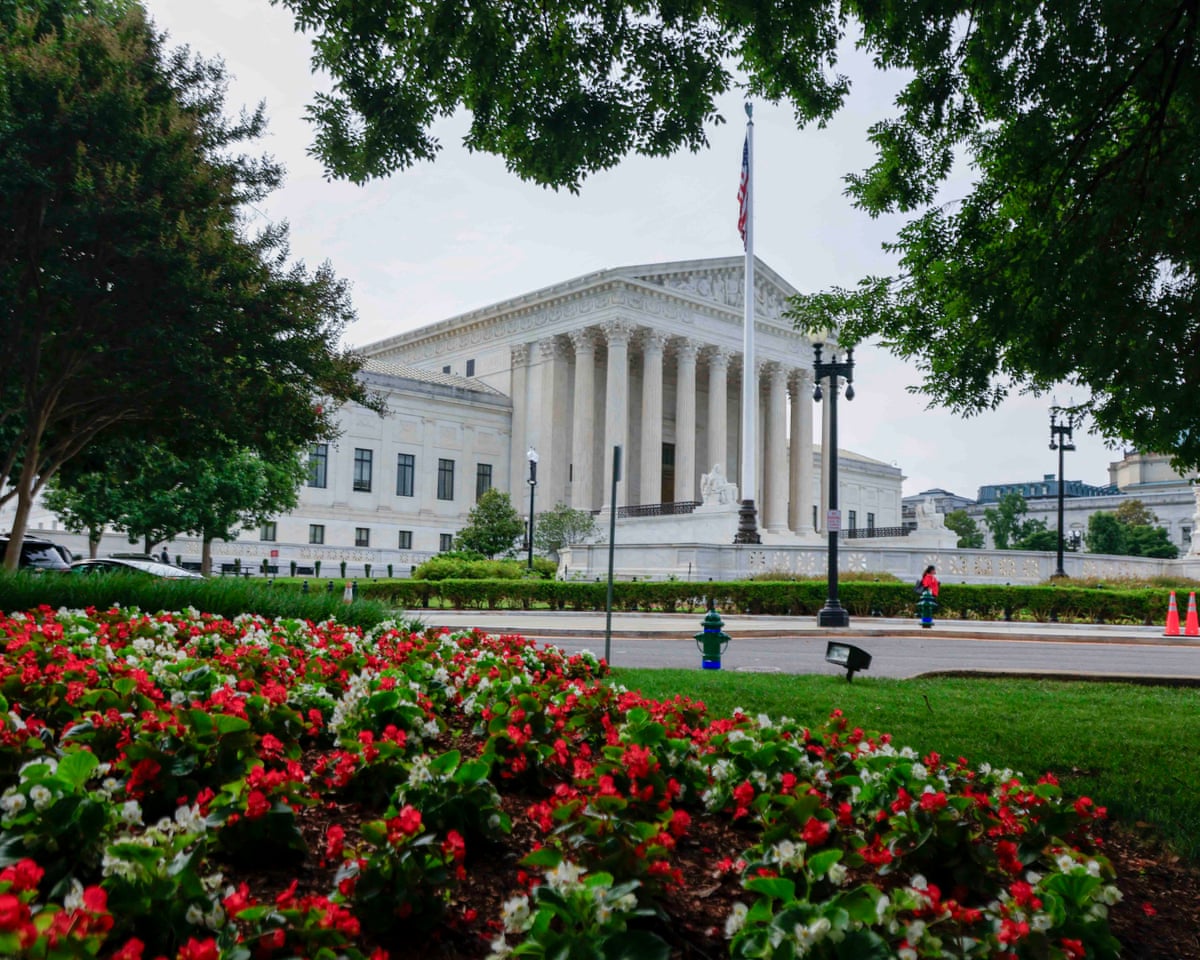
Supreme Court Defines "Arrival" in US Asylum Law, Impacting Migrant Rights
US immigration law entitles migrants arriving in the US to seek asylum. The Supreme Court case centered on the interpretation of "arrive in" the US. During oral arguments in March, Chief Justice Roberts and Justice Barrett appeared to agree with the Trump administration’s position that "arriving" means physically setting foot on US soil. Therefore, migrants turned back before crossing are not entitled to asylum.
While much of the discussion focused on the definition of "arrive," liberal justices expressed concern about the broader implications of denying asylum seekers entry.
Justice Sotomayor compared turning away asylum seekers to the tragic case of the MS St. Louis, a ship carrying Jewish refugees turned away from the US before World War II, many of whom later perished after being returned to Europe.
"In ordinary speech, no one would say that a person ‘arrives in’ a place ... before the person enters that place." — Justice Alito
Justice Sotomayor strongly dissented, warning that the ruling allows the government to circumvent laws protecting asylum seekers by blocking entry at the border, even when asylum officers are available to process claims and the individuals face persecution or death if returned.
"They may do so even if the asylum seeker is at the threshold of a port of entry designated to receive all noncitizens who seek entrance into the country. Even if the port of entry has ample capacity to inspect that person, including an available asylum officer trained to process asylum applications. Even if the asylum seeker is certain to be persecuted, or killed, if she is turned away. The Court’s illogical interpretation is driven almost entirely by a fixation on a single word: ‘in.’ Words, however, must be read in context and with attention to how they fit into the statute as a whole. The majority ignores the statutory context and history, not to mention the longstanding position of the Executive Branch, all of which show that any noncitizen arriving at our doorstep and seeking admission must be inspected and allowed to apply for asylum, regardless of whether her foot has crossed the threshold. Because the Court today blesses the Executive Branch’s decision to slam the door shut on all who are fleeing persecution, despite the detailed inspection and asylum system that Congress enacted and commands, I respectfully dissent." — Justice Sotomayor
Supreme Court Permits Trump Administration to End Legal Protections for Haitians and Syrians
In a significant ruling, the Supreme Court allowed the Trump administration to terminate legal protections for migrants fleeing violence and natural disasters in Haiti and Syria, exposing hundreds of thousands to potential deportation.
The decision overturned lower court orders and authorized the Department of Homeland Security (DHS) to swiftly end Temporary Protected Status (TPS), a program shielding approximately 1.3 million people from 17 countries.
The Trump administration argued that courts should not second-guess immigration officials’ decisions regarding TPS, which was designed as a temporary measure.
Immigration attorneys contend that the countries remain unsafe for return and that the administration ended protections hastily and with racial animus. During his 2024 presidential campaign, Trump amplified anti-immigrant rhetoric.
The Justice Department appealed to the Supreme Court after judges delayed the termination of TPS for about 350,000 Haitians and 6,000 Syrians. The Supreme Court previously sided with the administration in ending TPS for Venezuelans.
Federal authorities deny racial animus influenced the decisions, citing a prior Supreme Court ruling from Trump’s first term that rejected bias claims based on his social media posts and upheld a travel ban on several Muslim-majority countries.
Since Trump’s return to the White House in January 2025, DHS has ended protections for people from 13 countries, including some that had been in place for over a decade.
Immigration attorneys emphasize that countries like Haiti and Syria remain dangerous. Court documents reveal that four Haitian women deported in February were found beheaded and dumped in a river months later.
In April, the House passed bipartisan legislation to extend protections for Haitians, but the bill has stalled in the Senate.
The US first granted TPS to Haitians in 2010 following a devastating earthquake and extended it multiple times amid ongoing gang violence displacing over a million people. Syrians were granted TPS starting in 2012 during a civil war lasting over a decade before the fall of President Bashar Assad’s government in late 2024.
TPS, created by Congress in 1990, prevents deportations to countries experiencing natural disasters, civil unrest, or instability. It allows beneficiaries to remain in the US with work permits in 18-month increments but does not provide a path to citizenship.

Supreme Court Strikes Down Hawaii’s Gun Restrictions in Major Second Amendment Ruling
The Supreme Court invalidated a Hawaii law requiring individuals to obtain permission to carry guns into stores and hotels, reinforcing Second Amendment rights.
The 6-3 ruling permits carrying firearms onto privately owned properties such as shopping malls and gas stations unless owners explicitly ban guns.
This decision follows last week’s ruling that marijuana users cannot be denied gun ownership rights.
The Trump administration supported the challenge, arguing the law violated constitutional rights. Hawaii maintained that the 2023 law ensured private owners could decide firearm policies on their properties.
The law was enacted amid a surge in legal gun carry permits following a Supreme Court decision expanding concealed carry rights for law-abiding Americans.
Similar laws exist in about four other states, although presumptive restrictions on guns in publicly accessible private property have been blocked elsewhere.
Hawaii continues to restrict guns in parks, beaches, and alcohol-serving restaurants, but these provisions were not before the Supreme Court and are being contested in lower courts.
The lawsuit was filed by a gun rights group and three Maui residents. A lower court initially blocked the law, but an appeals court allowed enforcement. The Trump administration backed the Supreme Court appeal.
Federal Judge Blocks Trump’s Executive Order on Mail-In Voting
A federal judge in Boston blocked implementation of Donald Trump’s executive order directing the administration to compile a national voter file and restrict mail-in ballot use ahead of the November midterm elections.
US District Judge Indira Talwani ruled in favor of several Democratic-led states that argued the order unlawfully interfered with state administration of federal elections.
Trump has long advocated for tighter mail-in voting rules, falsely claiming widespread voter fraud cost him the 2020 election. Multiple studies and investigations have found no evidence of widespread fraud, including via mail-in ballots. Trump himself acknowledged this shortly before signing the order.
The US Constitution assigns states the role of administering federal elections. Trump’s order directed the Department of Homeland Security to compile and transmit to states a list of confirmed US citizens eligible to vote, derived from federal databases.
The order also required the US Postal Service to deliver ballots only to voters on state-approved mail-in ballot lists. USPS proposed new rules to implement this directive, requiring states to provide names and barcodes linked to mail-in ballots.
The order further instructed the Department of Justice to prioritize investigating and prosecuting election officials who issue ballots to individuals deemed ineligible.
Voting rights groups, along with 23 states and the District of Columbia, sued the administration, arguing the order is unconstitutional and exceeds presidential authority over election administration.
The states contended that enforcing the order would force rushed election system changes before November, risking chaos and disenfranchisement.
Judge Talwani’s ruling followed a related case in Washington DC, where Trump-appointed Judge Carl Nichols declined to issue a preliminary injunction, finding the challenge premature as the order had not yet been implemented. The plaintiffs are appealing.
Supreme Court to Release Opinions Amid High-Stakes Cases Pending
The Supreme Court is expected to release additional opinions soon as the term nears its end, with major cases pending including former President Trump’s efforts to end birthright citizenship, terminate Temporary Protected Status for Haitians and Syrians, and his firing of Federal Reserve governor Lisa Cook.
We will provide updates on all key rulings.
Meanwhile, a restrictive voting bill passed the House but stalled in the Senate, where Democrats oppose it, leaving it short of votes to overcome a filibuster.
House Speaker Mike Johnson proposed advancing a grant program linked to the bill through a GOP reconciliation package to bypass the filibuster. He told Trump this might be the only way forward.
However, GOP hardliners oppose this plan, arguing it would only create incentives rather than enact the full Save America Act, which aims to tighten election integrity.
"The save America act cannot be placed in reconciliation and I’m not drinking the Kool-Aid. Neither should you." — Representative Anna Paulina Luna
"States who want to do it would take the incentive. States who don’t wouldn’t necessarily. Maybe it’s pressure. I’m not saying I’m opposed to putting something like that on if there is a moving vehicle that’s otherwise moving in order to get some elements of the election integrity done, but let’s not kid ourselves that it would be full Save. It wouldn’t be." — Representative Chip Roy
Roy added that every effort should be made to attach the Save America Act to moving legislation, such as the housing bill.
Trump was asked if he would accept a compromise including provisions of the Save Act in a reconciliation bill. He responded:
"Not really, no, the Save Act should be … there’s no compromise, it’s voter ID, it’s proof of citizenship, and it’s also the mail-in ballots." — Donald Trump
House Speaker Mike Johnson is scheduled to meet with Trump at 2pm ET to seek a resolution after a rebellion from GOP hardliners stalled the House floor.
"It is 10pm and Thune just got unanimous consent (meaning not one senator objected) for the Senate to adjourn 19 days (July 13th) meaning the Senate is going home after tonight’s votes. I will not be voting to re-open the floor until the Senate gets back to Washington. The Senate is literally running and not ONE senator objected to going on vacation before 4th of July. [Senate majority leader] John Thune is running and hiding because he doesn’t want to get voter ID across the finish line." — Representative Anna Paulina Luna
If Trump cannot help Johnson break the impasse, the House is expected to recess for the week, according to sources.
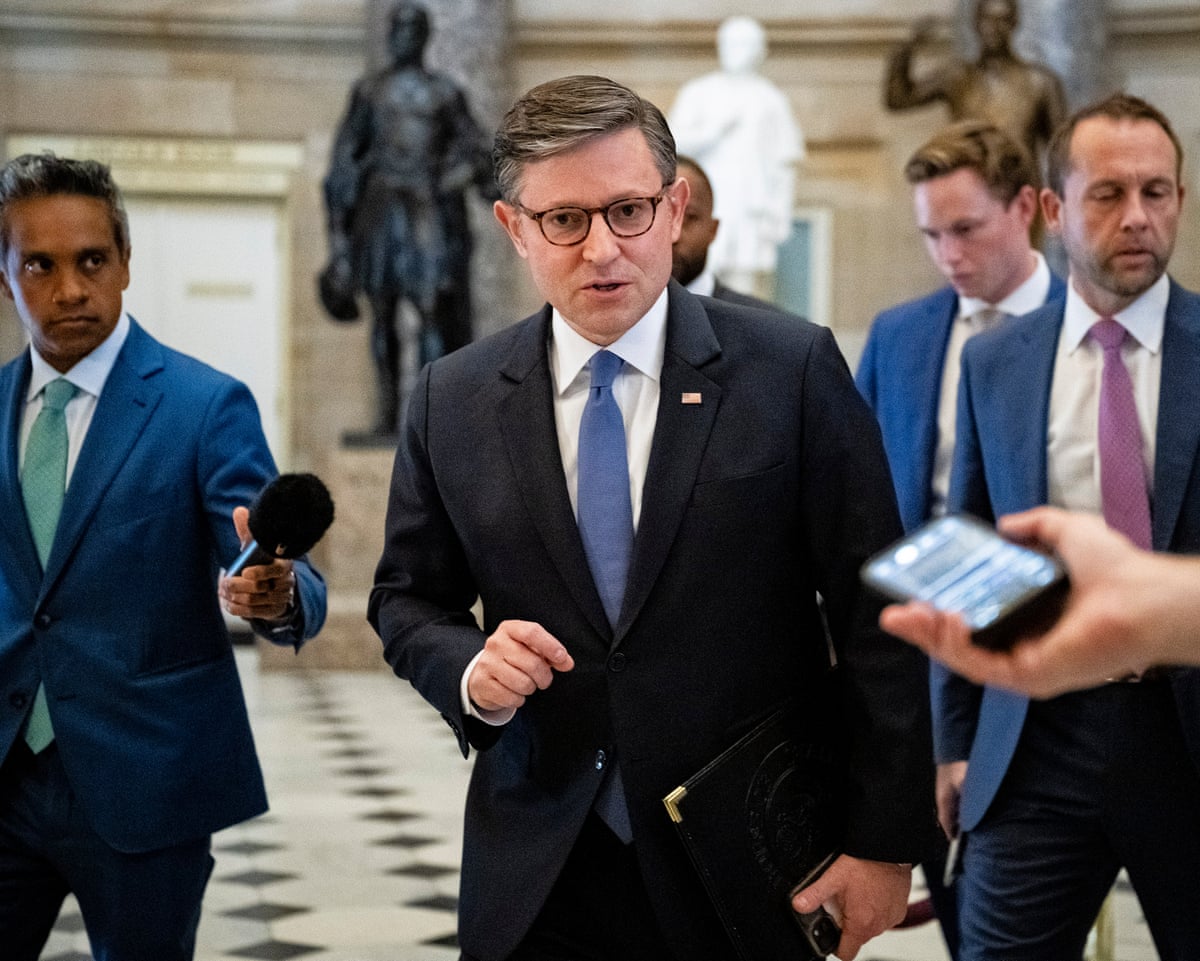
Trump to Meet House Speaker Amid Capitol Hill Showdown
Welcome to the live blog covering a dramatic day in Washington DC as former President Donald Trump meets with House Speaker Mike Johnson to attempt to break a legislative deadlock amid escalating tensions on Capitol Hill.
The House abruptly recessed for two weeks following a contentious lunch attended by Trump, which devolved into a shouting match over the US-Israel conflict with Iran and loyalty tests. This occurred after Trump unexpectedly canceled the signing of a bipartisan housing bill earlier that day. Trump’s demands that the Senate change rules to pass his controversial voter ID bill have deepened the divide between the White House and the Senate.
Johnson faces a difficult task persuading the House to advance Trump’s agenda.
Separately, Maryland Senator Chris Van Hollen endorsed progressive candidate Abdul El-Sayed in Michigan’s Senate primary, diverging from Senate Minority Leader Chuck Schumer, according to the Associated Press.
The Supreme Court is expected to issue opinions at 10am ET, with major cases on immigration and finance still pending.
On Capitol Hill, the focus remains on the 2pm meeting between Johnson and Trump, as they seek to quell a rebellion within the Republican caucus over the Save America Act, which aims to tighten voting regulations.
Louisiana Senator Bill Cassidy reportedly clashed with Trump at the Senate lunch after Trump criticized four senators, including Cassidy, for supporting a resolution to limit the Middle East war. Cassidy responded,
"You have not told the American people what’s going on" and "It was supposed to last four weeks. It’s lasted four months."


